Thermal Evaporation Systems
Configure a thermal evaporation system around your material, film stack, substrate and deposition requirements. SDACME provides resistive evaporation equipment for thin-film deposition, with evaporation sources, thickness monitoring, substrate handling, vacuum configuration and transfer options selected according to the project.
Material-Driven Configuration
Select the evaporation source and system configuration around the material and film stack.
Configurable Deposition Platform
Configure source quantity, thickness monitoring, substrate handling and transfer conditions for the deposition task.
From R&D to Project-Specific Systems
Support laboratory, research and project-specific thin-film deposition requirements without forcing every process into one fixed machine configuration.
Start with your material, substrate size, target film thickness and transfer requirement.
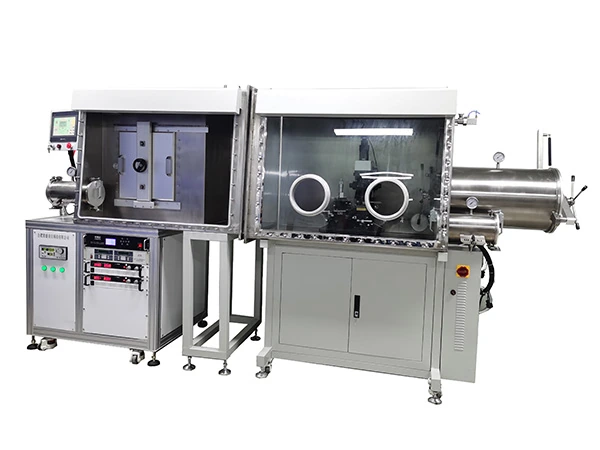
Choose a Thermal Evaporation System Around the Deposition Task
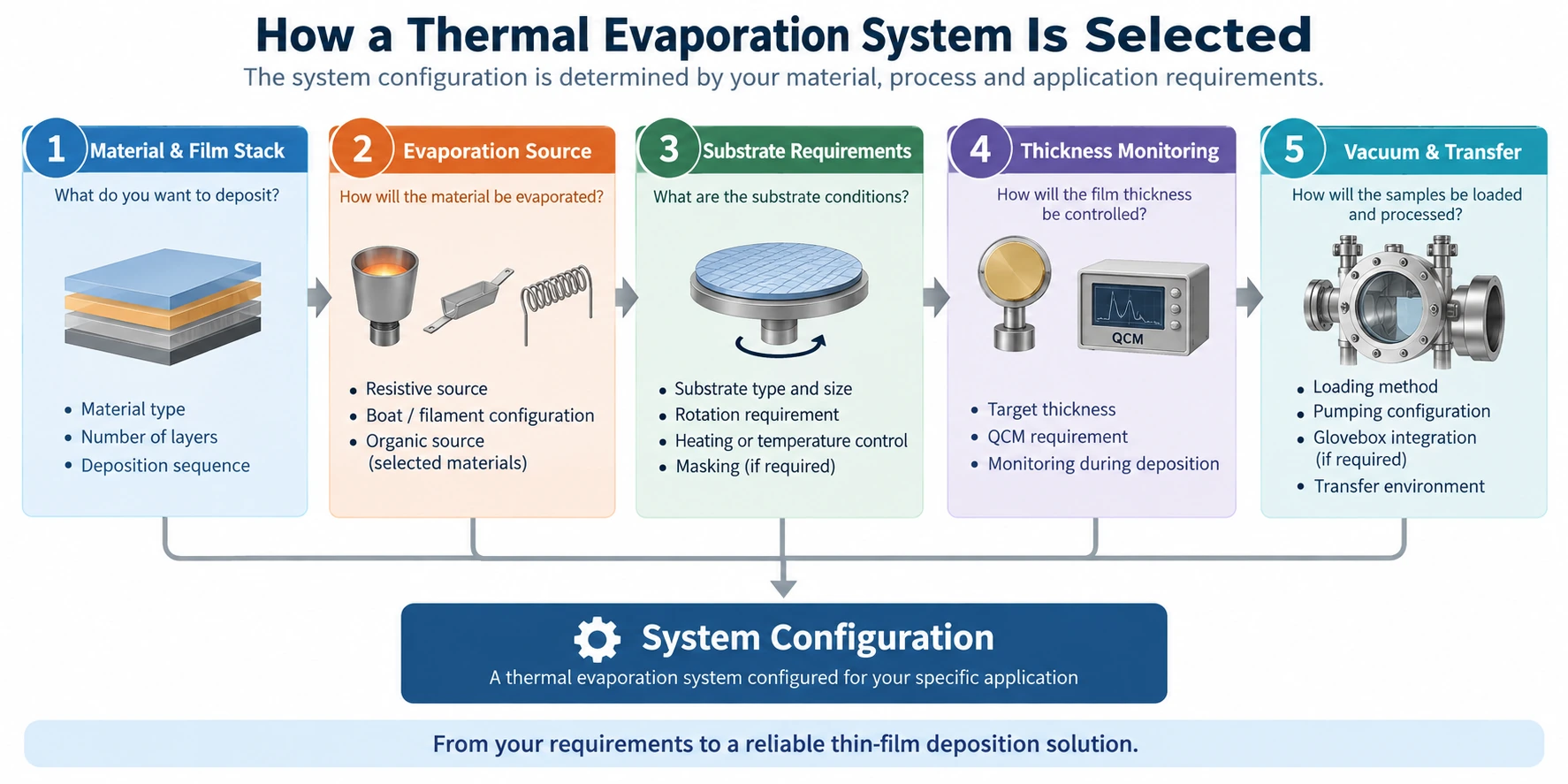
A thermal evaporation system should be selected from the deposition task outward, not from a fixed model number. Start with the material and film stack, then define the evaporation source, substrate requirements, thickness monitoring, vacuum configuration and transfer environment.
SDACME thermal evaporation configurations are built around resistive evaporation requirements. Depending on the project, documented configurations include multiple evaporation sources, quartz-crystal thickness monitoring, substrate rotation or lifting, selected substrate heating, glovebox integration and manual or touchscreen-based control.
Material & Film Stack
What materials will be deposited, and how many layers or materials are involved?
Evaporation Source
Match the source configuration to the material and deposition sequence.
基材
Define substrate size, handling, rotation, heating and masking requirements.
Thickness Monitoring
Define target thickness and the required level of monitoring or control.
Vacuum & Transfer
Define pumping, loading and any glovebox or controlled-transfer requirement.
Is sputter deposition a better fit for your process?
If your project specifies sputter deposition rather than thermal evaporation, review the sputtering equipment family before defining the system configuration.
Match the Evaporation Source to the Material
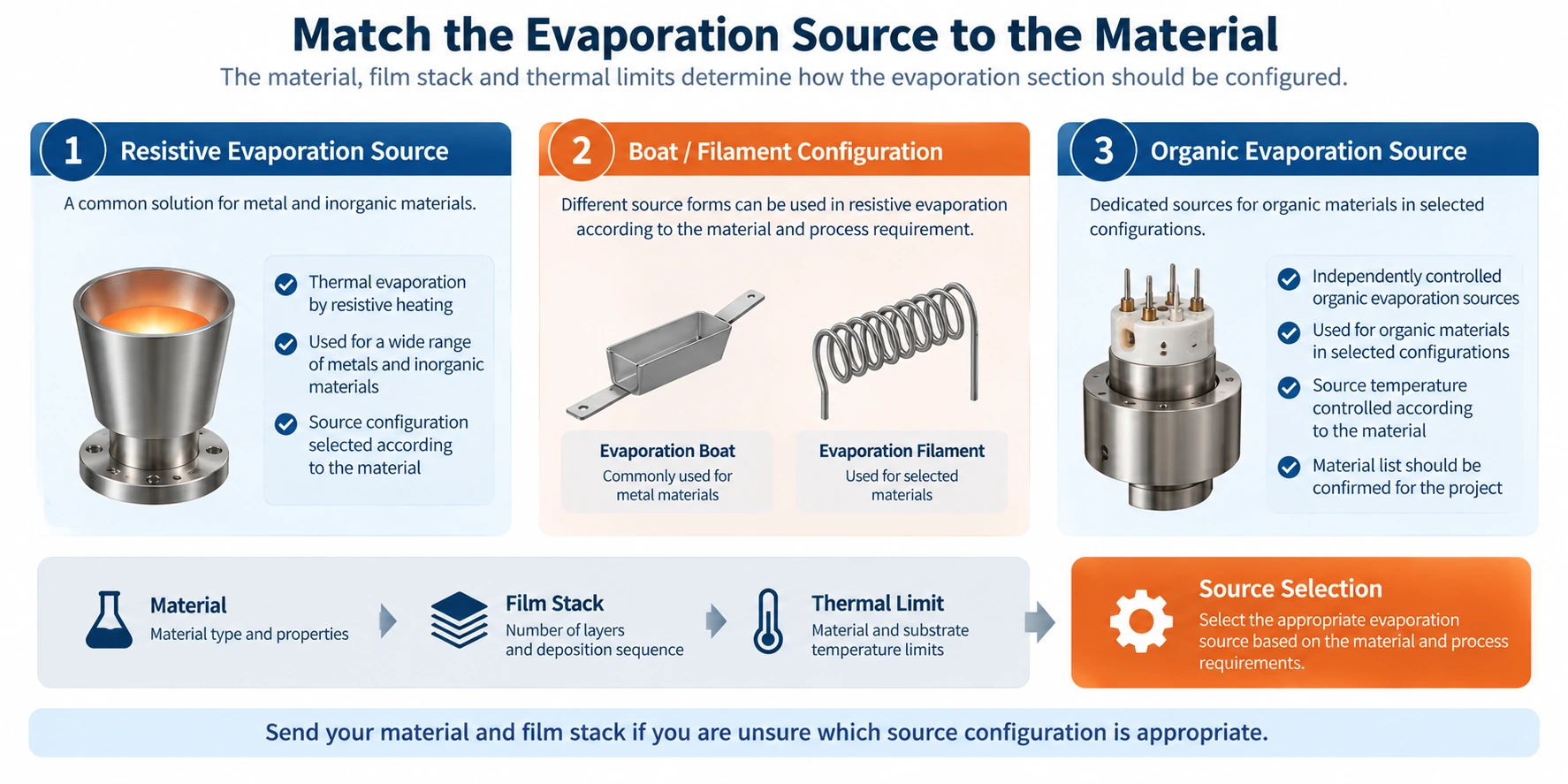
Evaporation-source selection starts with the material. The material, film stack, required deposition sequence and thermal limits determine how the evaporation section should be configured.
Documented SDACME configurations use resistive evaporation electrodes for thermal evaporation. In the existing glovebox-integrated configuration, water-cooled evaporation electrodes can accept evaporation boats or spiral evaporation filaments. The same system also uses independently powered, temperature-controlled organic evaporation sources.
Resistive Evaporation Source
The source configuration is selected around the material, deposition sequence and required thermal conditions rather than around one fixed machine specification.
Evaporation Boats & Filaments
The documented glovebox-integrated resistive configuration can use evaporation boats or spiral evaporation filaments with water-cooled evaporation electrodes.
Organic Evaporation Sources
Selected configurations use independently powered, temperature-controlled organic evaporation sources for suitable organic deposition requirements.
Documented Metal Examples
Material examples recorded in the existing glovebox-integrated evaporation configuration include:
Documented Organic Examples
Organic material examples recorded in the same documented configuration include:
Material not listed above?
The examples above are documented materials, not a universal compatibility list. For other metals, organics or sensitive materials, provide the material name, film stack, substrate and process conditions for configuration review before the evaporation source is fixed.
Configure the System Around the Process
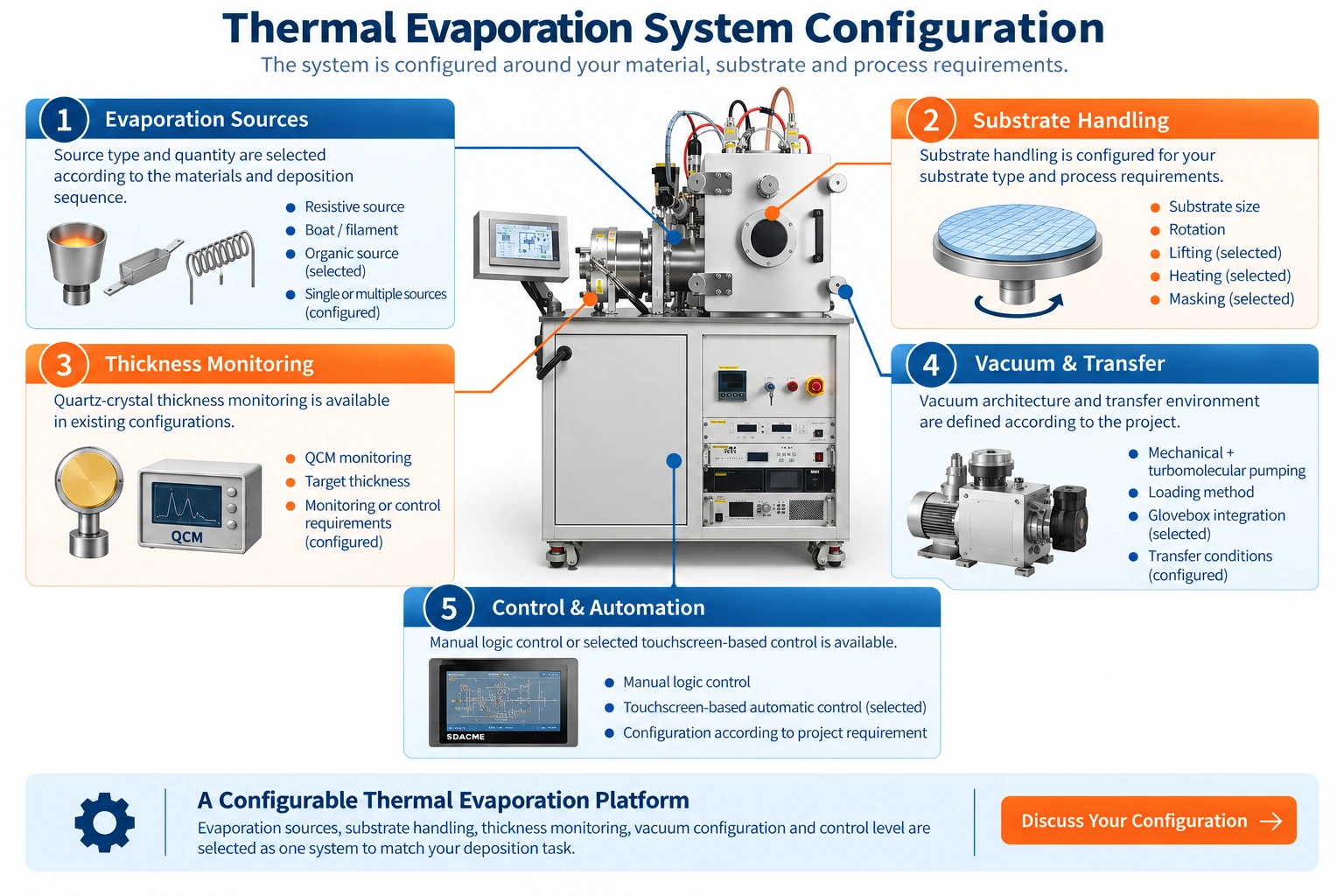
The evaporation source is only one part of a thermal evaporation system. Substrate handling, thickness monitoring, vacuum architecture, transfer conditions and control level should be defined together around the deposition task.
Existing SDACME documentation shows different combinations of evaporation sources, quartz-crystal thickness monitoring, substrate motion, selected substrate heating, glovebox integration and manual or touchscreen-based control. The final combination is defined at project level rather than treated as one fixed family specification.
Evaporation Source Configuration
Selected systems can use multiple evaporation sources. Source type and quantity are defined according to the materials, film stack and deposition sequence rather than as one fixed standard.
Thickness Monitoring
Quartz-crystal thickness monitoring is documented in existing thermal evaporation configurations. Monitoring and control requirements should be defined from the target film thickness and process needs.
基材处理
Documented configurations include substrate rotation and lifting, with selected configurations also supporting substrate heating and masking according to the deposition requirement.
Vacuum & Transfer
Existing configurations use mechanical and turbomolecular pumping. Glovebox integration is documented in the DM400 configuration; other loading or transfer requirements should be defined during project evaluation.
Control & Automation
Documented systems use manual logic control or selected touchscreen-based automatic control. The required operating and automation level is defined according to the project instead of being assumed as a family-wide standard.
Have a Special Configuration Requirement?
If your process requires a special substrate fixture, controlled transfer, simultaneous multi-material deposition, additional temperature management or another non-standard arrangement, include it in the project requirements for engineering review. These requirements are evaluated at project level rather than presented as standard features of every thermal evaporation system.
Configuration should follow the deposition task — not the option list.
Source quantity, substrate handling, monitoring, vacuum configuration and control level influence one another. Defining them together helps avoid selecting individual options that do not match the complete deposition process.
How to Select a Thermal Evaporation System
Start with the deposition requirement rather than with a pump model, source count or control option. Seven project inputs usually provide a practical starting point for defining the thermal evaporation system.
These inputs allow the evaporation-source arrangement, substrate handling, monitoring, vacuum configuration and control level to be evaluated as one system instead of as isolated equipment options.
材料
List every material that needs to be evaporated. Material selection comes before source selection because different materials can require different evaporation-source arrangements.
电影堆
Define the number of materials, layer sequence and whether the materials are deposited sequentially or require another deposition arrangement.
基材
Provide the substrate type and dimensions together with any requirements for rotation, lifting, heating, masking or other substrate handling.
Film Thickness
Define the target film thickness and whether thickness monitoring or additional process control is required for the deposition task.
Temperature Limit
Provide the maximum substrate temperature or other temperature-sensitive process conditions that may affect source, substrate or system configuration.
Transfer Environment
State whether standard loading, glovebox integration or another controlled-transfer requirement is needed for the material and process.
Operating Requirement
Define whether the equipment is intended for research, R&D, pilot work or a higher-throughput project, together with the expected substrate quantity or batch requirement.
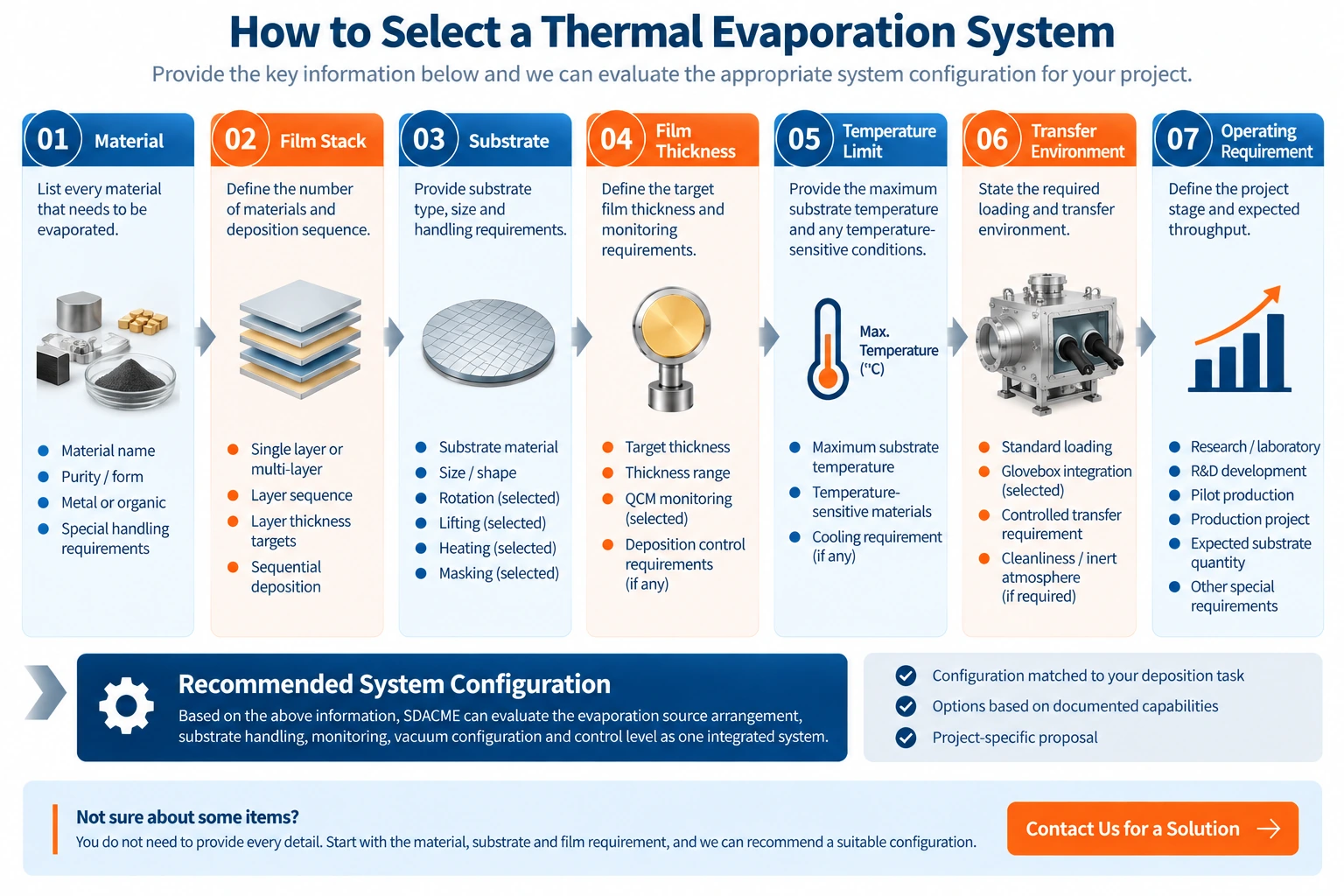
From Process Inputs to a Recommended System Configuration
Material, film stack, substrate, film thickness, temperature, transfer environment and operating requirement are reviewed together. From these inputs, the source arrangement, substrate handling, monitoring, vacuum configuration and control level can be defined for the project.
You do not need to define every equipment option before contacting us.
If you do not yet know the pump model, evaporation-source quantity, controller or automation level, leave those items open. Start with the material, film stack, substrate and deposition requirement, and the equipment configuration can be evaluated from there.
Thermal Evaporation Configuration Examples
Thermal evaporation systems do not need to follow one fixed machine configuration. Existing documentation shows different configurations for resistive evaporation and glovebox-integrated metal and organic deposition, with source arrangement, substrate handling and control selected around the process.
The examples below show how documented equipment can be configured for different deposition requirements. They are configuration references, not a fixed model ladder that every project must follow.
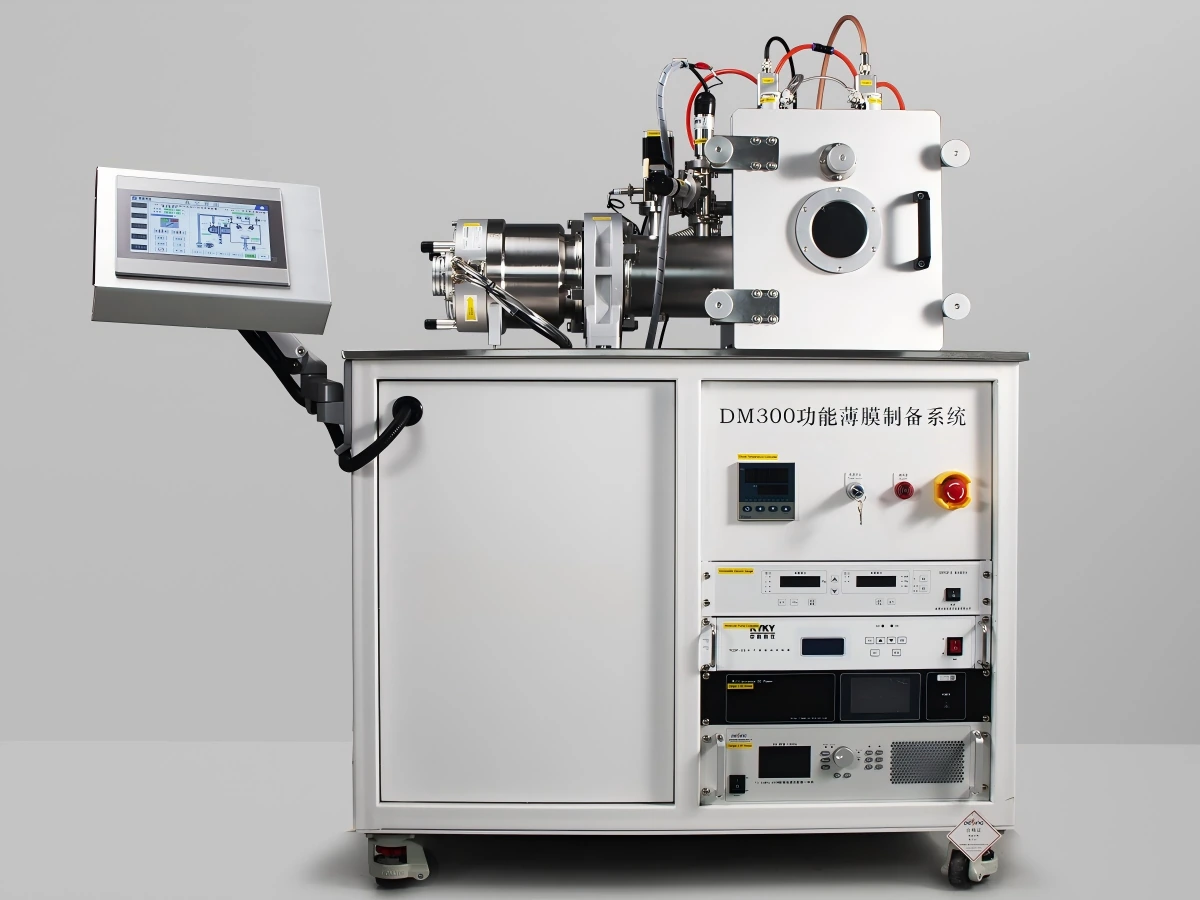
Resistive Evaporation Platform
Configurable Resistive Evaporation Platform
A documented resistive evaporation configuration includes multiple water-cooled evaporation-source options, quartz-crystal thickness monitoring and substrate motion, with selected heating and touchscreen-based automatic control available as configuration options.
- Multiple resistive evaporation-source options
- Quartz-crystal thickness monitoring
- Substrate rotation and lifting
- Selected substrate heating
- Manual or selected touchscreen-based control
Existing DM400 Configuration
Glovebox-Integrated Thermal Evaporation
The existing DM400 configuration integrates resistive metal evaporation with independently controlled organic evaporation sources and a glovebox interface. It also includes quartz-crystal thickness monitoring, substrate rotation and lifting, and a mask assembly.
- Resistive metal evaporation
- Independently controlled organic evaporation sources
- Multiple source positions
- Quartz-crystal thickness monitoring
- Glovebox-integrated transfer environment
What Changes From One Project to Another?
Material type and film sequence influence the evaporation-source arrangement.
Source type and quantity are defined around the deposition task, not around one standard model.
Rotation, lifting, heating and masking depend on substrate and film requirements.
Glovebox integration and control level are selected according to the project workflow.
These examples are configuration references — not a fixed product ladder.
Chamber size, source quantity, substrate handling, monitoring, vacuum configuration and automation can change with the project. The final equipment proposal should therefore be based on the deposition requirement rather than on selecting the nearest existing configuration by model name alone.
Engineering Confirmation Before Proposal
Before the final configuration and quotation are prepared, the process inputs that change the equipment design should be confirmed together. This keeps the proposal tied to the actual deposition task rather than to a generic equipment specification.
The goal is not to ask the customer to design the machine. It is to confirm the process, substrate, vacuum and control requirements that affect source arrangement, handling, monitoring and integration.
Material & Source Compatibility
Confirm the materials, film stack, deposition sequence and required source arrangement before source quantity or source type is fixed.
Substrate & Handling
Confirm substrate dimensions and any requirements for rotation, lifting, heating, masking or other project-specific handling.
Monitoring, Vacuum & Transfer
Confirm thickness-monitoring requirements, vacuum configuration and the required loading or transfer environment, including glovebox integration where applicable.
Control & Integration
Confirm the required operating mode, automation level and any project-specific interface requirements that affect the final system configuration.
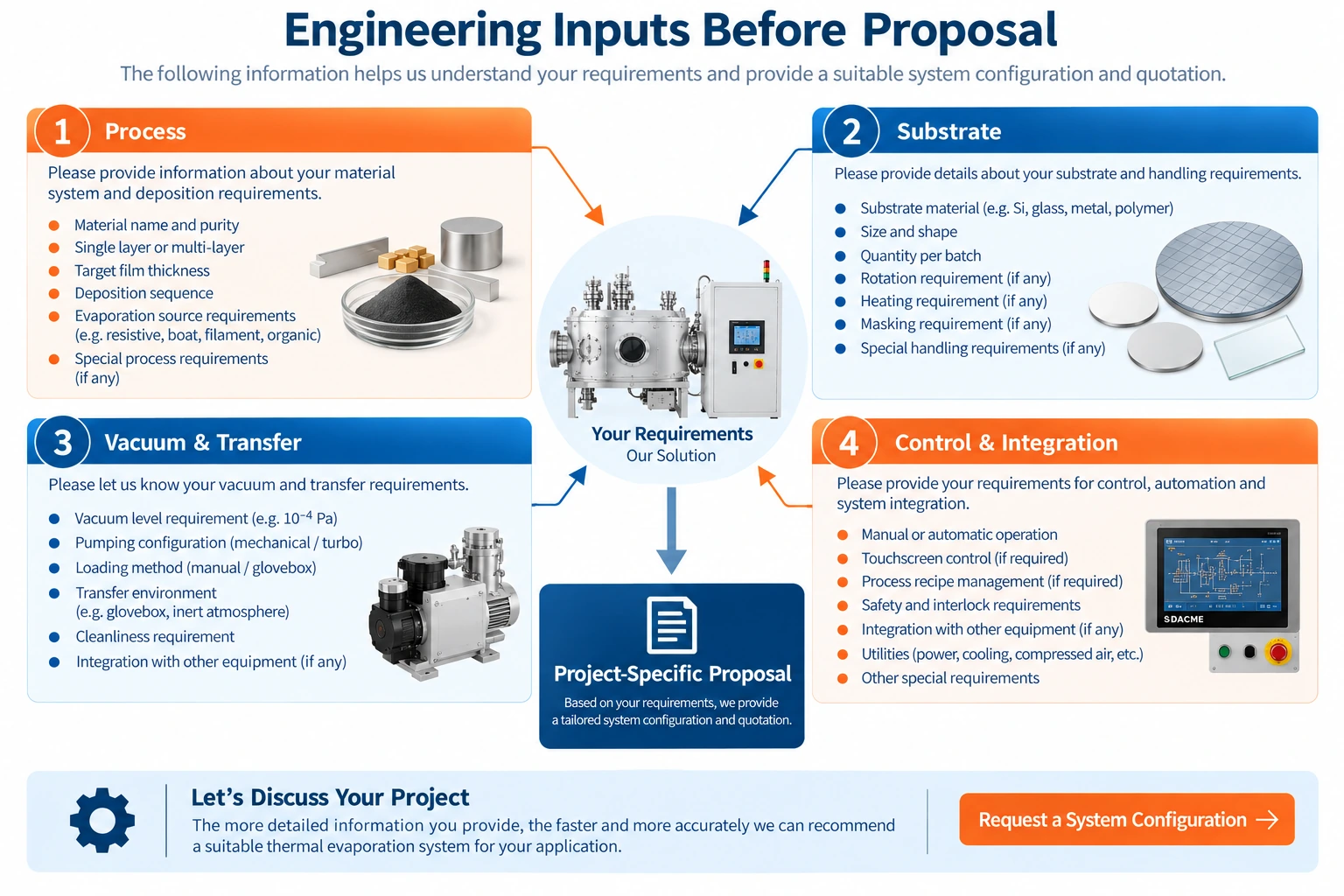
Project-specific values are confirmed in the proposal.
Specific source quantities, ratings, substrate-handling details, monitoring functions and automation features should be confirmed for the project rather than treated as family-wide defaults. This allows the equipment specification to remain aligned with the actual deposition requirement.
Need deposition-rate control rather than thickness monitoring alone?
Include the required control objective in the RFQ for engineering confirmation. Existing documentation supports quartz-crystal thickness monitoring, while the required level of deposition-rate control should be defined at project level.