6kW vs 10kW vs 15kW MPCVD: How to Choose the Right System
Choosing an MPCVD machine is not simply a matter of selecting the highest microwave power available.
A 6kW, 10kW or 15kW system may be the more appropriate starting point depending on the material you plan to grow, seed or substrate dimensions, intended loading, process-development stage, available utilities and future expansion plan.
SDACME’s current 2.45GHz MPCVD range covered by this guide includes the 6kW ACME-2060, 10kW ACME-MW1070 Upgraded and 15kW ACME-2150.
This MPCVD machine selection guide is designed to help you identify which platform should be evaluated first based on the engineering requirements of your project—not simply the largest power rating.
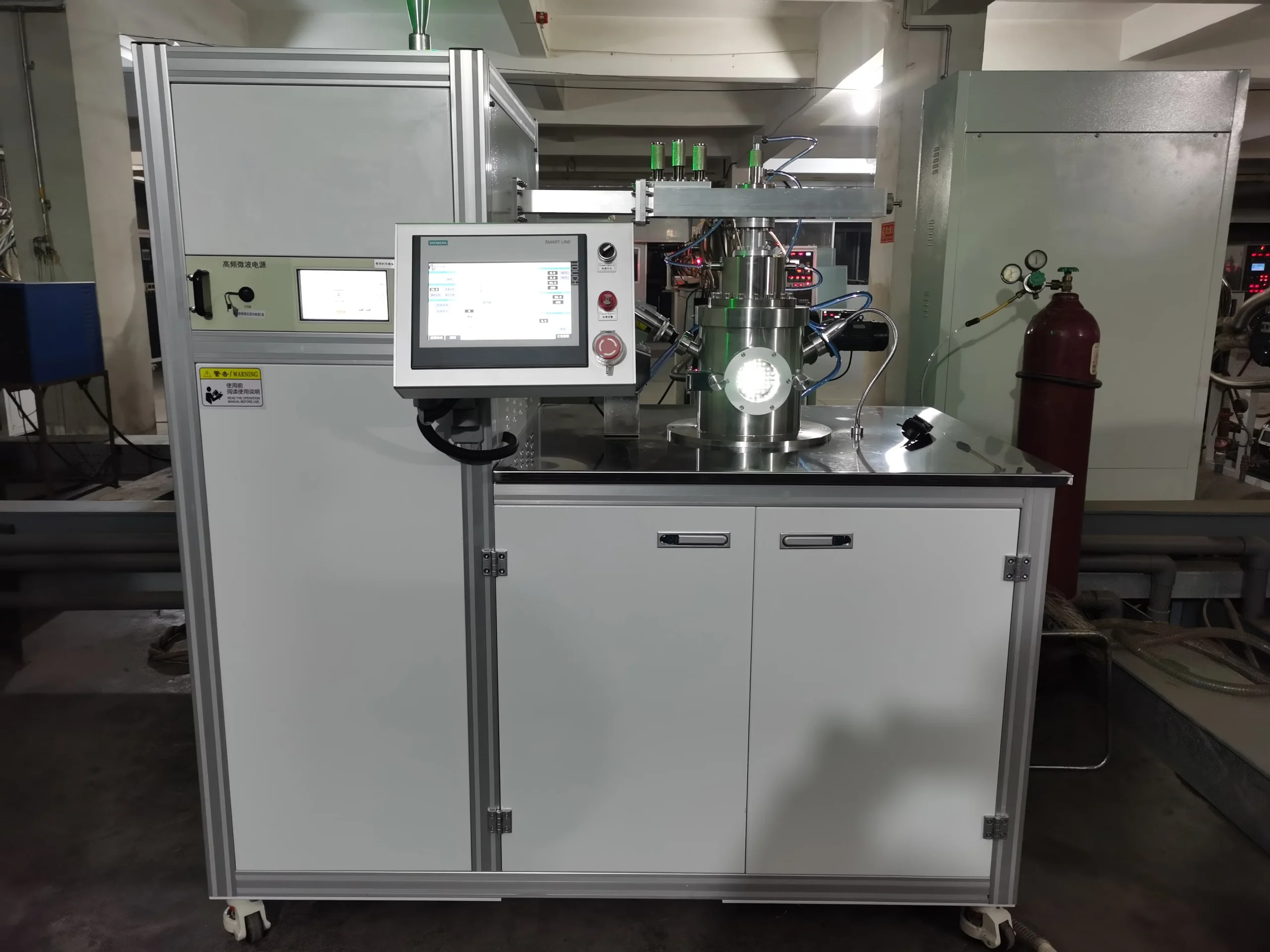
Research and process-development direction with smaller loading requirements.
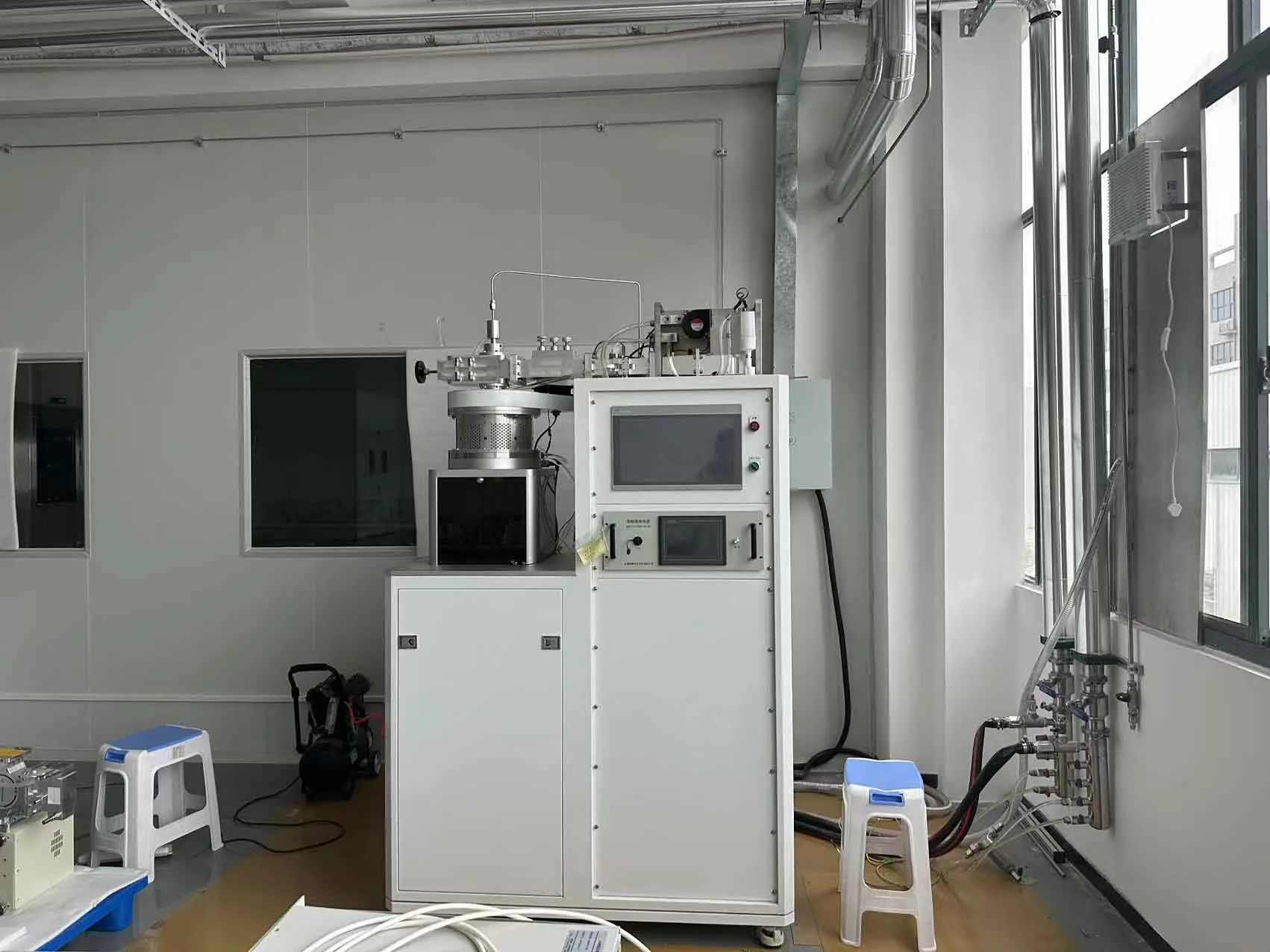
Balanced production-development direction for broader project requirements and expansion flexibility.
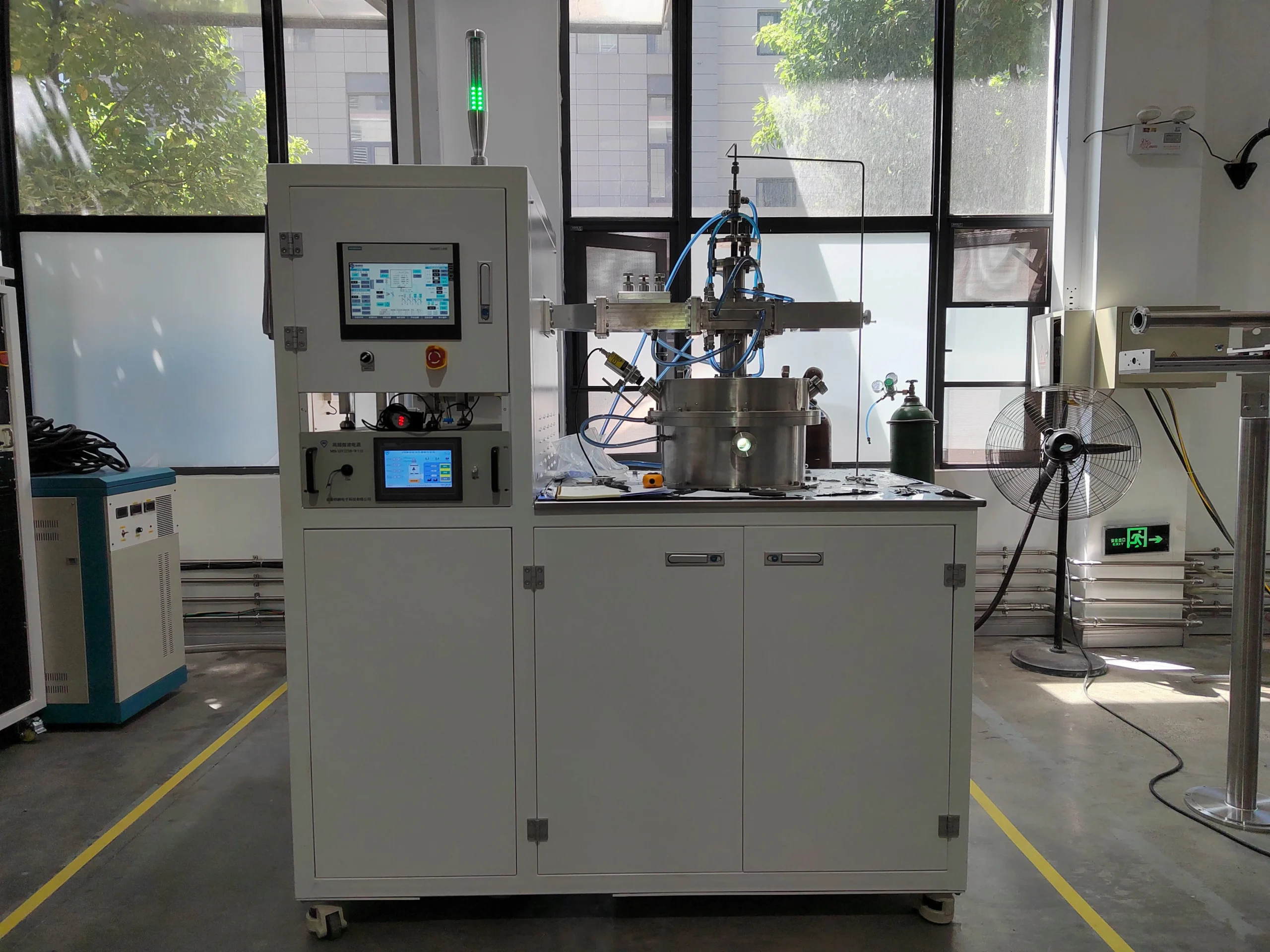
Higher-loading and future-scale direction for production-oriented and expansion projects.
6kW vs 10kW vs 15kW MPCVD at a Glance
The three systems should not be viewed as a simple “small, medium and large” product ladder.
Each platform serves a different combination of research stage, loading requirement, process-development objective and expansion plan.
| Selection Factor | 6kW MPCVD | 10kW MPCVD | 15kW MPCVD |
|---|---|---|---|
| Model | ACME-2060 | ACME-MW1070 Upgraded | ACME-2150 |
| Microwave Platform | 2.45GHz | 2.45GHz | 2.45GHz |
| Rated Microwave Power | 6kW | 10kW | 15kW |
| Typical Project Direction | Research and process development | Balanced production development | Higher-loading and expansion-oriented projects |
| Loading Direction | Smaller loading requirements | Broader, balanced loading requirements | Higher-loading requirements |
| Expansion Emphasis | Moderate | Important | High |
| Facility Planning | Required | Required | Particularly important as project scale increases |
| Typical Buyer Question | Do I need more than a research-oriented platform? | Is this enough for production development and future growth? | Do I need additional loading and expansion headroom? |
6kW · ACME-2060
10kW · ACME-MW1070 Upgraded
15kW · ACME-2150
How to Choose an MPCVD Machine
MPCVD power selection should start with the project requirement as a whole rather than the microwave rating alone.
A suitable MPCVD system should be selected from the complete project requirement. Before choosing between 6kW, 10kW and 15kW, review the following factors.
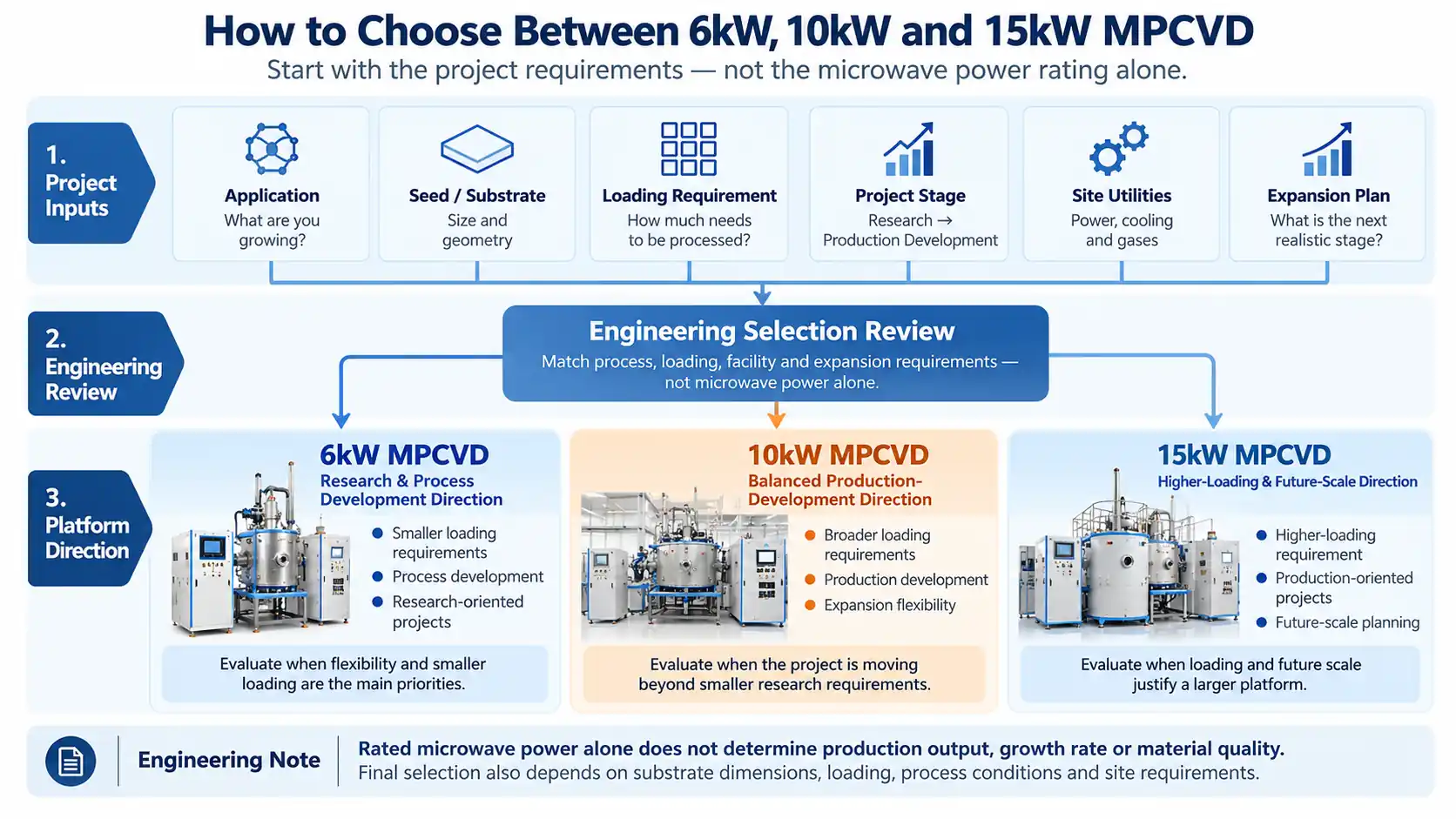
What Material or Application Are You Developing?
Different MPCVD projects can have different process priorities.
Typical projects may include:
- lab-grown diamond;
- single-crystal diamond;
- diamond films;
- industrial diamond materials;
- semiconductor-related diamond research;
- thermal-management materials;
- optical or other advanced diamond-material development.
The required substrate arrangement, process area, operating conditions and project workflow may differ between applications.
What Seed or Substrate Size Will You Use?
Seed and substrate dimensions directly affect how the process area is used.
A project using smaller diamond seeds is different from one requiring larger substrates or a wider usable deposition area.
The engineering review should consider:
- substrate dimensions;
- geometry;
- spacing;
- usable process area;
- thermal distribution;
- required uniformity.
What Loading Do You Actually Need?
A common mistake is to compare MPCVD machines only by how many seeds can physically be placed on the stage.
Physical placement is only one part of the problem.
Practical loading also depends on:
- seed dimensions;
- spacing;
- plasma distribution;
- thermal conditions;
- process recipe;
- required uniformity;
- cycle objective.
A theoretical maximum arrangement should not automatically be treated as a stable production configuration.
What Stage Is the Project In?
The same customer may need a different platform at different stages of development.
A project may be:
- laboratory research;
- process development;
- pilot development;
- production development;
- capacity expansion.
A research project may prioritize flexibility and process experimentation.
A production-development project may place more emphasis on loading, repeatability, operating workflow and expansion planning.
What Utilities Are Available at the Site?
The selected MPCVD platform must match the facility.
The engineering review may include:
- electrical supply;
- cooling-water capacity;
- process gases;
- compressed air;
- exhaust;
- installation space;
- environmental conditions;
- local operating and maintenance capability.
A higher-power system can increase the importance of site engineering even when the process goal itself remains similar.
What Is Your Expansion Plan?
A system that is sufficient today may become restrictive if the customer expects to increase loading, standardize more reactors or build a larger production line.
However, buying the largest platform only for “future-proofing” can also introduce unnecessary facility and project complexity.
What Changes When You Move from 6kW to 10kW?
The decision to move from 6kW to 10kW should normally be driven by a change in the project—not simply by a preference for more microwave power.
A Starting Direction for Research and Process Development
A 6kW system is a logical starting point for projects where the main priorities are:
- university or institutional research;
- process development;
- smaller loading requirements;
- additional research capacity;
- a relatively compact engineering scope.
This does not mean that 6kW is “laboratory only.”
The actual suitability still depends on the process, substrate and loading requirements.
When the Project Is Moving Beyond Smaller Research Requirements
The 10kW platform becomes more relevant when:
- the project is moving beyond basic research;
- loading requirements are increasing;
- production development is becoming important;
- the customer expects future expansion;
- a broader general-purpose engineering platform is preferred.
The current ACME-MW1070 Upgraded is positioned as SDACME’s mainstream 2.45GHz MPCVD platform for production-development projects.
Project Maturity
A 6kW platform is a logical starting direction for research laboratories, process-development work and projects with relatively smaller loading requirements.
As a project moves toward production development, the operating objective usually becomes broader. Repeatability, loading, operating workflow and future expansion may begin to matter more.
That change in project maturity is one reason to evaluate the 10kW platform.
Loading Requirement
A customer should consider 10kW more seriously when the intended loading has moved beyond the requirement that originally justified a smaller research-oriented system.
The question is not whether 10kW can hold “more pieces” in isolation. The question is whether the substrate dimensions, arrangement and process requirement now justify a broader platform.
Expansion Risk
The customer should also ask:
If we select 6kW today, how likely is it that the next development stage will require a larger platform?
If expansion is already visible in the project plan, the 10kW ACME-MW1070 Upgraded may deserve stronger consideration from the beginning.
When Does the Additional Headroom of 15kW Become Justified?
For many projects, the decision between 10kW and 15kW is not about whether the customer can afford a larger machine. It is about whether the project has reached the point where additional loading and future-scale headroom are technically justified.
When Loading Becomes a Primary Constraint
The 10kW ACME-MW1070 Upgraded is SDACME’s current mainstream 2.45GHz direction for many production-development evaluations.
A move toward 15kW becomes more relevant when loading itself is becoming one of the primary engineering constraints rather than a secondary consideration.
In this situation, the substrate arrangement, process requirement and intended operating scale should be reviewed against the higher-power platform.
When Future Scale Is Already Visible
A 15kW evaluation is also more relevant when the customer already knows that the project is intended to move toward a larger operating scale.
Examples include plans for additional reactors, higher loading requirements or a broader production-oriented facility.
The purpose is not to buy excess power. It is to avoid selecting a platform that is already too close to the expected next-stage requirement.
When the Facility Can Support the Direction
The equipment decision and facility decision should be made together.
Electrical capacity, cooling, gas infrastructure, layout and maintenance access may all become more important as project scale increases.
Research and Production Are Not Defined by Power Alone
It is tempting to divide MPCVD machines into: 6kW = research, 10kW = pilot, 15kW = production. That is too simple.
The actual role of a machine depends on more than rated microwave power.
Research-Oriented Priorities
A research-oriented project may prioritize:
- recipe development;
- process flexibility;
- experimental substrates;
- smaller loading;
- frequent changes in operating conditions.
Production-Development Priorities
A production-development project may place greater emphasis on:
- repeatability;
- loading;
- longer operating cycles;
- workflow standardization;
- utility reliability;
- maintenance planning;
- future capacity expansion.
Selection principle: Research versus production is a project definition—not simply a microwave-power label.
Why Seed Count Alone Is Not a Reliable MPCVD Selection Metric
A frequently asked question is:
How many diamond seeds can the MPCVD machine hold?
The useful answer requires more than a single number.
The number of seeds that can physically be arranged on a substrate stage is not the same as guaranteed production capacity.
Practical loading depends on:
- seed dimensions;
- spacing;
- usable plasma area;
- substrate-stage geometry;
- temperature distribution;
- plasma uniformity;
- process conditions;
- required material result.
For example, changing from smaller seeds to larger substrates may reduce the number of pieces that can be arranged even though the machine itself has not changed.
Likewise, placing more seeds inside the available area does not automatically mean that the process should be operated at that maximum arrangement.
Two projects using the same rated microwave power may still require different stage and loading arrangements if their substrate dimensions, spacing or process objectives differ.
Selection implication: when comparing 6kW, 10kW and 15kW systems, send the actual seed or substrate dimensions and expected loading.
That information is more useful than asking only for the maximum theoretical seed count.
Check the Facility Before Choosing a Higher-Power MPCVD System
An MPCVD machine is part of a larger operating environment.
The system must work with the facility’s electrical supply, cooling-water system, process-gas supply, exhaust, compressed air where required, installation space, environmental controls and maintenance resources.
As the system scale and intended loading increase, utility planning can become more important.
This is especially relevant when a customer expects to install additional reactors later.
Planning for One Machine
For a single research or development machine, the facility may be relatively straightforward.
Planning for Expansion
For multiple systems or future production expansion, the customer should also consider:
What If You Are Looking for 3kW or 20kW MPCVD?
3kW MPCVD
The current standard 2.45GHz range covered by this selection guide starts at 6kW.
If your specification calls for a 3kW MPCVD machine, first define:
- application;
- substrate size;
- loading;
- research objective;
- process requirement.
A 6kW platform may be a more suitable route depending on the actual project.
The requirement should be reviewed against the available platform rather than assuming that the requested microwave rating is the only acceptable solution.
Submit Your Requirement →20kW MPCVD
A 20kW system is not part of the standard 6kW / 10kW / 15kW 2.45GHz selection range presented on this page.
If your project specifies 20kW, the requirement should first be reviewed against:
- microwave frequency;
- substrate or process-area requirement;
- loading target;
- material application;
- facility conditions;
- production objective;
- overall system architecture.
The correct solution should be defined from the engineering requirement rather than from a power number alone.
Request Project Review →Send These Data for an MPCVD Model Recommendation
You do not need to prepare a complete technical specification before contacting SDACME.
The following information is enough for an initial MPCVD selection review.
Application
Tell us what you plan to grow or develop:
- lab-grown diamond;
- single-crystal diamond;
- diamond film;
- industrial diamond material;
- semiconductor-related diamond material;
- thermal-management material;
- other advanced diamond application.
Seed or Substrate
Please provide:
- material;
- dimensions;
- intended quantity;
- expected arrangement if already known.
Project Stage
Select the closest description:
- research;
- process development;
- pilot development;
- production development;
- capacity expansion.
Operating Objective
Tell us what matters most:
- process flexibility;
- loading;
- repeatability;
- expansion;
- material development;
- production workflow.
Site Utilities
If available, provide:
- local voltage;
- frequency;
- available electrical capacity;
- cooling-water conditions;
- available process gases;
- installation environment.
Project Scope
Please also tell us:
- required quantity;
- installation country;
- target delivery schedule;
- standalone machine or wider system scope;
- FAT requirements;
- installation or commissioning support;
- training requirements.
MPCVD Selection Questions
What Size MPCVD Machine Do I Need: 6kW, 10kW or 15kW?
Start with the material, seed or substrate size, intended loading, project stage, utilities and expansion plan. 6kW is generally more oriented toward research and smaller-loading process development. 10kW provides a balanced direction for many production-development projects. 15kW should be evaluated when higher loading and expansion headroom become more important. The final selection should be confirmed against the complete project requirement.
Is a Higher-Power MPCVD Always Better?
No. Higher rated microwave power does not automatically mean better material quality, faster growth or better project economics. The usable process area, substrate arrangement, chamber configuration, thermal conditions, process recipe and facility requirements must also match the project.
Which MPCVD Machine Is Best for Research?
A 6kW platform is a common starting direction for research and process-development projects with relatively smaller loading requirements. However, a research program requiring larger substrates, higher loading or future expansion may justify reviewing a 10kW platform. The correct choice depends on the actual experiment and development plan.
Which MPCVD Machine Is Suitable for Production?
There is no single power rating that automatically defines a production MPCVD system. 10kW is a mainstream direction for production-development projects, while 15kW may be evaluated where higher loading and expansion headroom are required. Production suitability also depends on loading, repeatability, operating workflow, utilities and process maturity.
When Should I Choose 10kW Instead of 6kW?
Consider 10kW when your project is moving beyond basic research and requires broader loading capability, production-development flexibility or stronger expansion potential. If the project remains focused on smaller-loading research and process development, 6kW may remain sufficient.
When Should I Choose 15kW Instead of 10kW?
Consider 15kW when higher loading, greater process-area headroom or future production expansion becomes an important engineering requirement. If those factors are not required, the more balanced 10kW platform may remain the more appropriate starting point for evaluation.
How Many Diamond Seeds Can an MPCVD Machine Hold?
There is no useful universal answer without knowing the seed dimensions, spacing, usable process area and process conditions. Physical seed count should not be treated as guaranteed production capacity. Provide the actual seed size and target loading so the stage arrangement can be reviewed properly.
Do I Need to Check Utilities Before Choosing MPCVD Power?
Yes. Electrical supply, cooling-water capacity, process gases, exhaust and installation conditions can affect whether a particular system configuration is practical at your site. Utility review becomes especially important when planning larger systems or future multi-machine expansion.
What If I Need a 3kW MPCVD Machine?
The standard 2.45GHz range covered by this guide begins at 6kW. If your specification requests 3kW, send the application, substrate and loading requirement first. The project can then be reviewed against the available platform.
What If My Specification Requests a 20kW MPCVD System?
20kW is not part of the standard 6kW / 10kW / 15kW range presented in this guide. The requirement should be reviewed together with microwave frequency, process-area requirement, loading, material application and facility conditions before the appropriate technical route is defined.
Not Sure Whether You Need 6kW, 10kW or 15kW?
Send us your material, substrate dimensions, intended loading, project stage and site conditions.
SDACME can review the requirement and help identify the MPCVD platform that should be evaluated first.