MPCVD Machines & Systems
SDACME supplies project-configured microwave plasma chemical vapor deposition systems for diamond growth and process-development projects, and can evaluate system configurations for selected advanced diamond-material applications.
Our current public 2.45GHz MPCVD range includes 6kW, 10kW and 15kW systems for different research, loading, production-development and capacity-expansion requirements.
A complete MPCVD project involves more than microwave power alone. Reactor design, substrate or seed arrangement, vacuum control, gas delivery, cooling, process monitoring, site utilities and the required supply scope all influence the final system configuration.
Use this page to compare available MPCVD systems, understand the main engineering modules and applications, review selection factors, and prepare the information required for a technical recommendation.
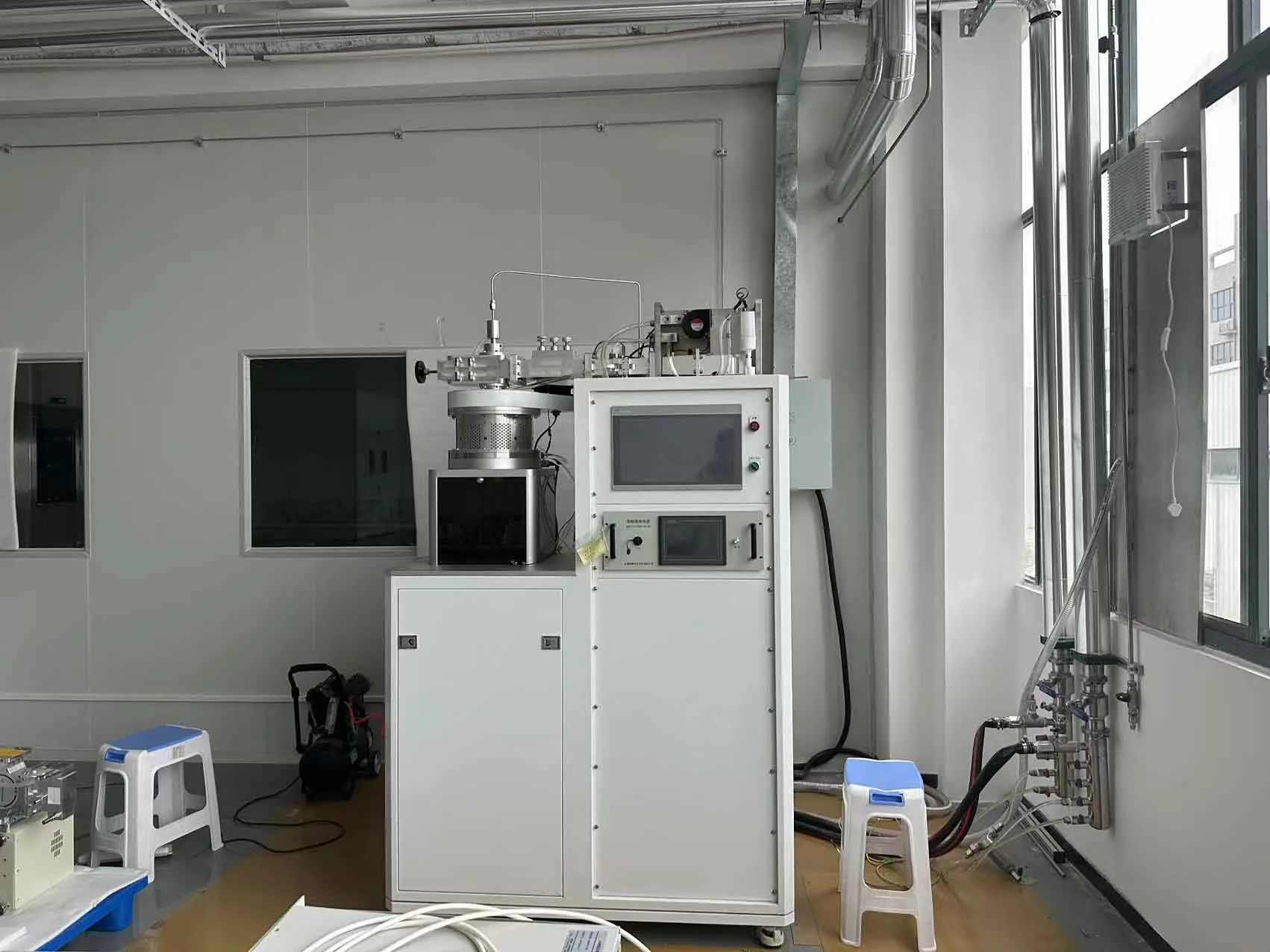
Configure an MPCVD System Around the Application, Not Only the Power Rating
SDACME supplies 2.45GHz MPCVD systems in 6kW, 10kW and 15kW configurations for diamond-growth and diamond-material projects.
The appropriate system depends on what you plan to grow or deposit, the substrate or seed size, expected loading, project stage, site utilities, operating experience and future capacity plan.
Our project scope can coordinate the principal MPCVD subsystems, including:
Microwave Generation & Transmission
Microwave generation, transmission and applicable operating-condition monitoring.
Reaction Chamber & Stage
Reaction chamber and substrate-stage configuration coordinated around the required process.
Vacuum & Pressure Control
Vacuum preparation and operating-pressure control according to the selected machine configuration.
Gas Delivery & MFC
Configured process-gas delivery and mass-flow-control channels.
Cooling
Cooling requirements coordinated around the chamber, microwave equipment and selected project scope.
Monitoring
Temperature and applicable machine operating-condition monitoring.
PLC / HMI Control
Centralized parameter setting, machine status, alarms and applicable operating functions.
Safety Monitoring & Interlocks
Configured monitoring and interlock functions according to machine and project requirements.
FAT, installation coordination, commissioning support, training and technical documentation can also be included according to the agreed project scope.
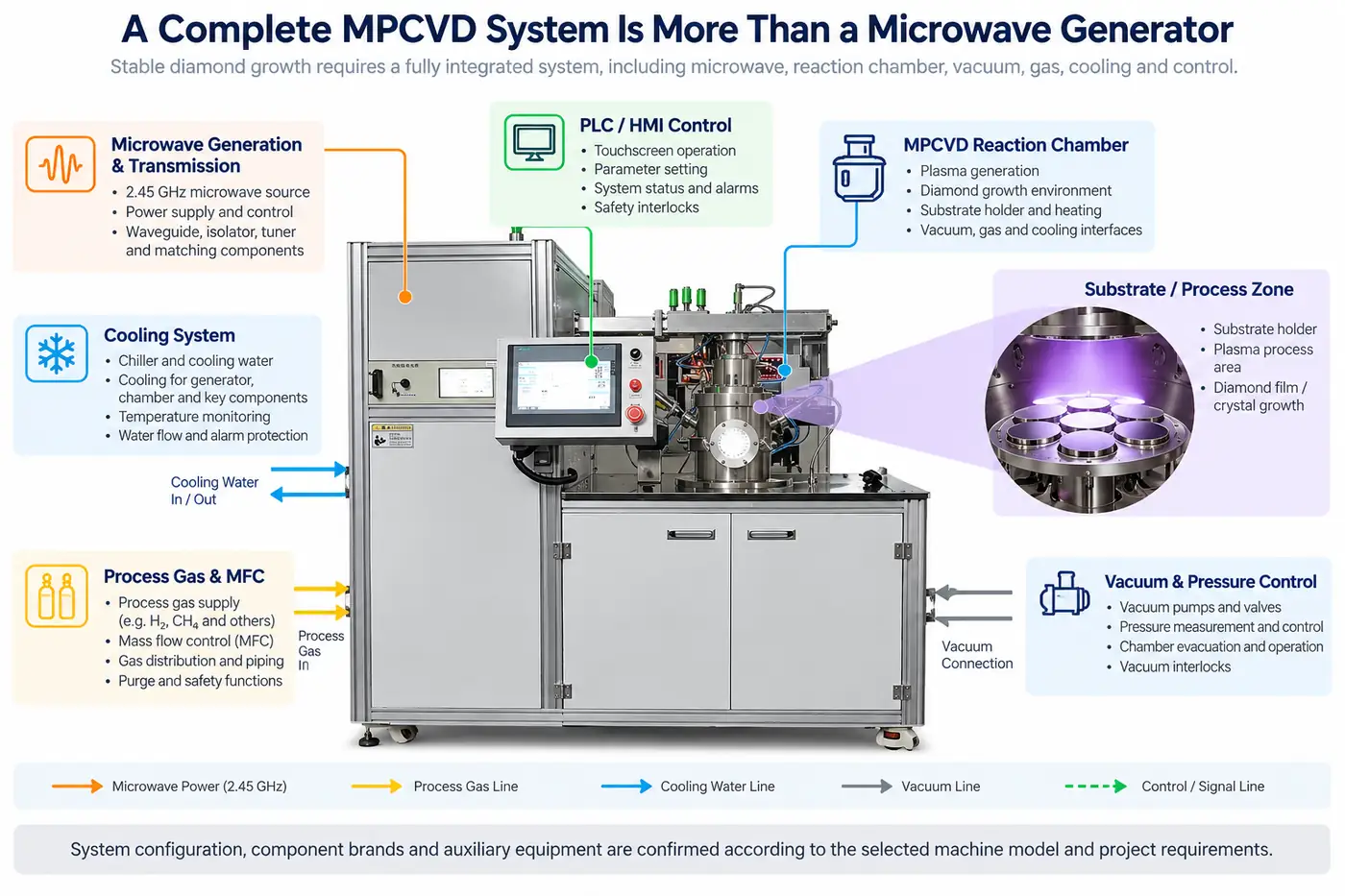
M02 · What Is an MPCVD Machine?A Complete Microwave Plasma CVD System Is More Than a Microwave Generator
An MPCVD machine uses microwave energy to generate and sustain plasma inside a controlled reaction environment for chemical vapor deposition.
A complete MPCVD system typically integrates the microwave source and transmission components with the reaction chamber, vacuum system, process-gas delivery, pressure control, substrate-temperature monitoring, cooling, PLC/HMI control and system-protection functions.
MPCVD systems are commonly evaluated for applications including:
Lab-Grown Diamond
Diamond-growth research, development and production-oriented projects.
Single-Crystal Diamond
Single-crystal growth and related material development.
Polycrystalline Diamond
Diamond-film growth over defined substrate areas.
Industrial Diamond Materials
Project-specific industrial diamond-material development.
Semiconductor-Related Diamond
Selected diamond-material projects related to semiconductor applications.
Thermal / Optical / Doped Diamond
Selected advanced diamond-material development programs.
The final system and process configuration should be reviewed against the required material result rather than selected from rated microwave power alone.
Compare 6kW, 10kW and 15kW MPCVD Systems
Three 2.45GHz platforms for different project requirements.
The 6kW, 10kW and 15kW systems belong to the current SDACME public MPCVD range, but they are not simply three versions of the same machine with different microwave ratings.
Chamber configuration, usable process area, substrate-stage arrangement, loading requirements, cooling demand and the intended research or production role should all be considered.
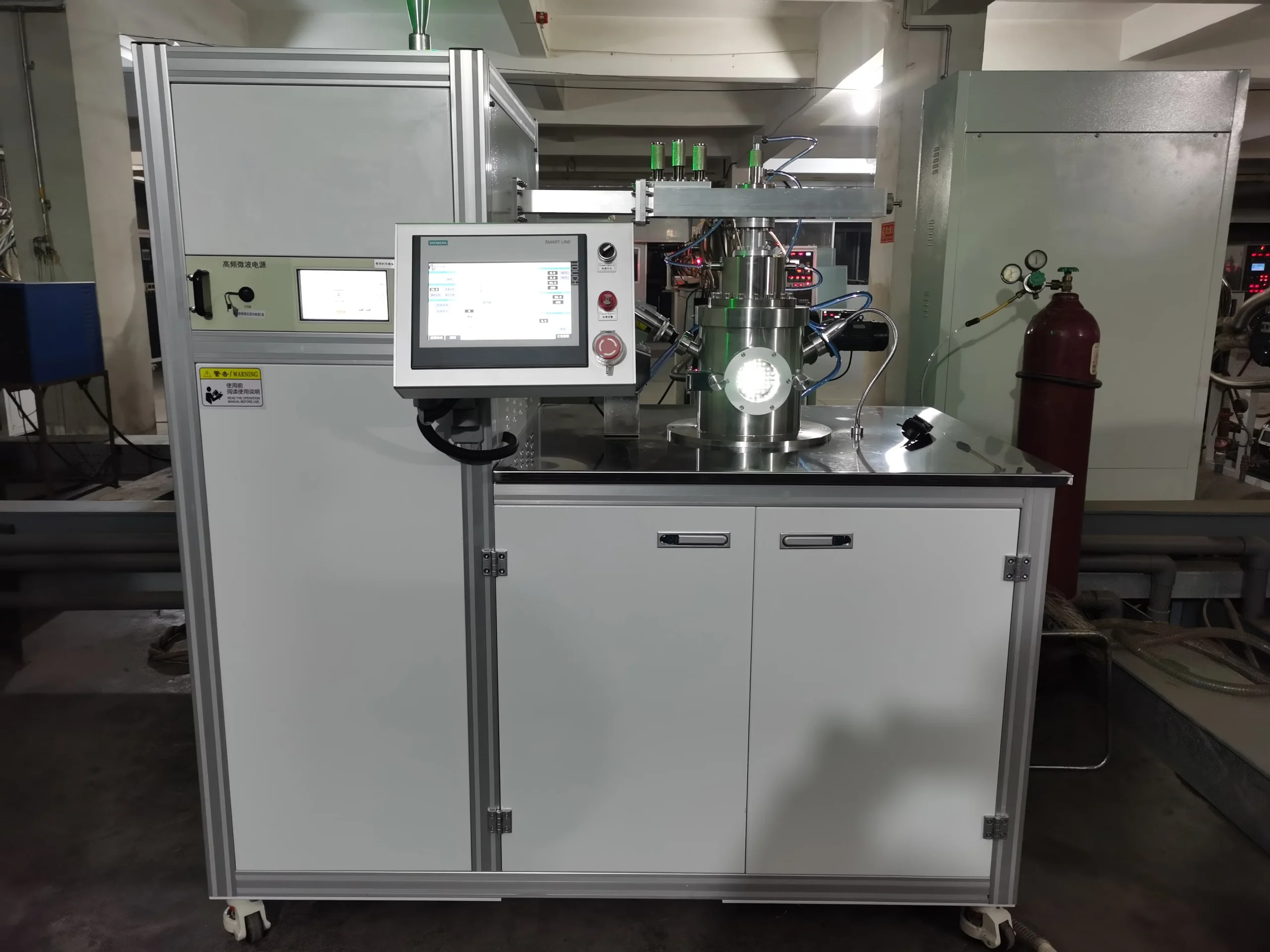
ACME-2060
Typical fit
- University and research laboratories
- Process development
- Smaller loading requirements
- Supporting or additional research capacity
- Projects where a more compact system is preferred
Key reference:
2.45GHz platform with a rated 6kW microwave configuration
for research and smaller-scale engineering requirements.
ACME-MW1070 Upgraded
Typical fit
- Production-development projects
- Growing teams moving beyond basic laboratory research
- Customers requiring increased loading capability
- New production projects requiring a balanced configuration
- Existing users planning capacity expansion
Key reference:
2.45GHz platform with rated 10kW microwave output
and current mainstream SDACME positioning.
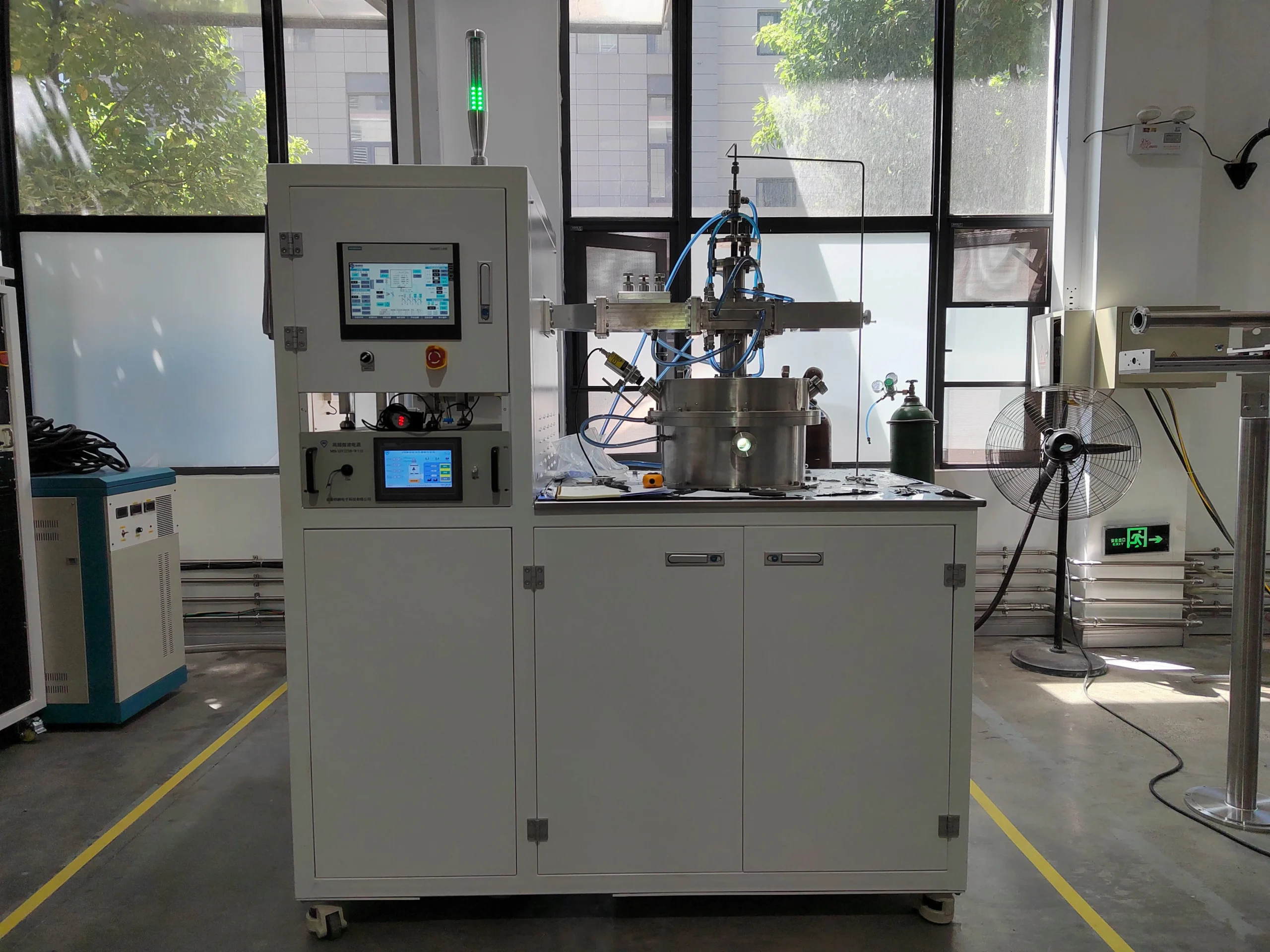
ACME-2150
Typical fit
- Higher loading requirements
- Production-oriented projects
- Capacity-expansion projects
- Applications requiring a larger usable stage arrangement
- Customers evaluating greater process and loading headroom
Key reference:
2.45GHz platform with a rated 15kW microwave configuration,
higher microwave power and greater loading headroom.
How to Choose an MPCVD System
Higher microwave power is not automatically better.
1. What are you trying to grow or deposit?
Requirements can differ between gem-diamond growth, single-crystal material development, diamond films and semiconductor-related diamond research.
2. What seed or substrate size will be used?
Seed dimensions, substrate geometry and required usable deposition area influence the stage and plasma configuration.
3. How many substrates are required in one run?
Loading should be evaluated together with spacing, thermal distribution and process conditions.
4. What is the project stage?
Research, pilot development, production development and expansion projects can prioritize different machine characteristics.
5. What utilities are available?
Electrical power, cooling, process gases, compressed air, exhaust and installation conditions should be reviewed before final configuration.
6. What is the future expansion plan?
If additional reactors may be installed later, facility layout, utility capacity and process standardization should be considered from the first installation.

Core Modules of an MPCVD System
The reactor is only one part of the complete process platform.
Microwave Source & Transmission
Provides adjustable microwave energy to the reactor and supports applicable microwave operating-condition monitoring.
Reaction Chamber & Stage
Creates the controlled deposition environment and supports the required seed or substrate arrangement.
Vacuum & Pressure Control
Establishes the required chamber condition and regulates pressure during operation.
Gas Delivery & MFC
Controls process-gas delivery through configured mass-flow-control channels.
Temperature Monitoring
Provides substrate-temperature information for process setup and operating review.
Cooling System
Supports thermal management of the chamber, microwave equipment and temperature-sensitive components.
PLC & HMI Control
Coordinates parameter setting, machine status, alarms and applicable operating functions.
Safety & Interlocks
Configured monitoring and interlocks can support protective responses during machine operation.
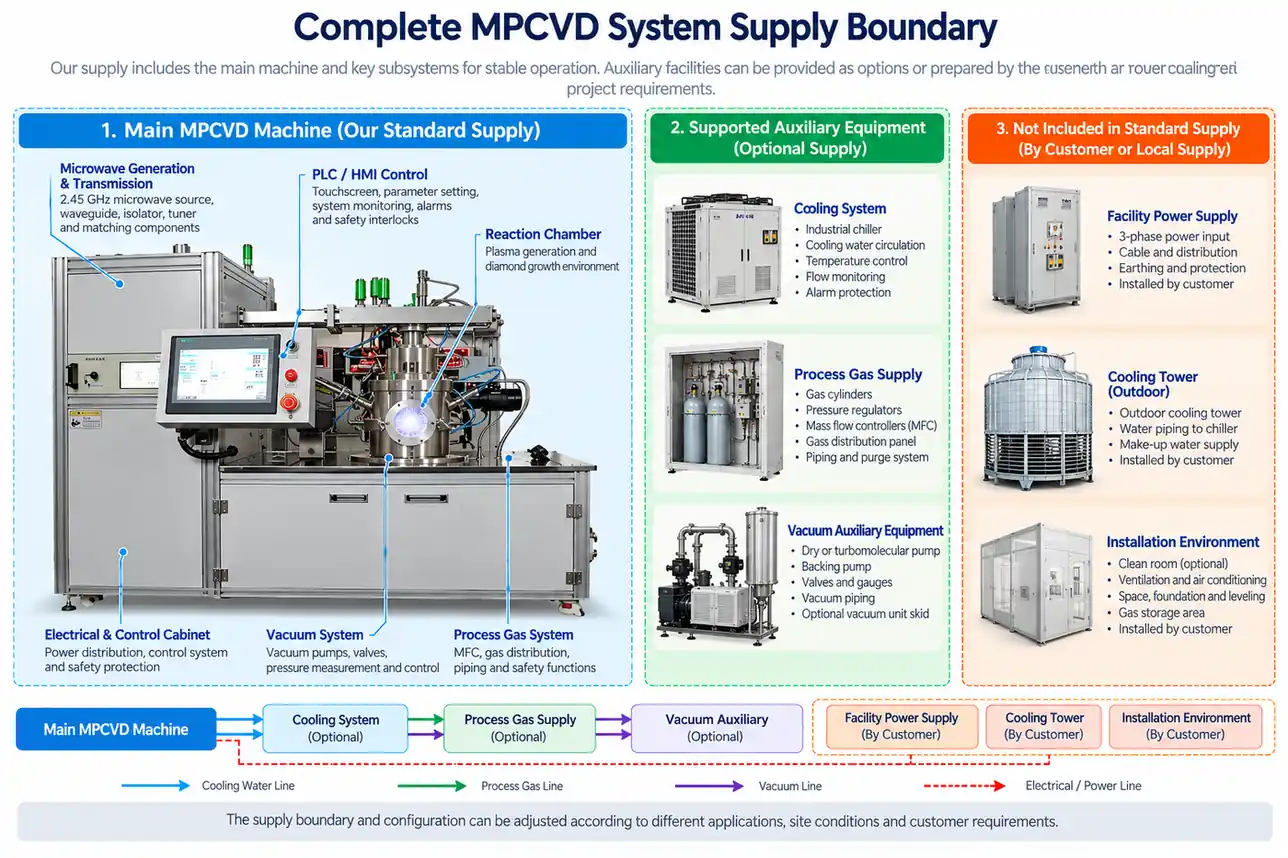
Complete MPCVD Supply Scope
Define the supply boundary before comparing MPCVD quotations.
The phrase “complete MPCVD system” can mean different things to different suppliers. For a meaningful commercial comparison, responsibilities for equipment, auxiliary systems, utilities, installation and local site work should be defined clearly.
Main MPCVD Equipment Scope
- MPCVD main machine
- Microwave subsystem
- Reaction chamber and stage
- Vacuum and pressure control
- Process-gas control
- Temperature monitoring
- PLC / HMI control
- Configured protection functions
Project-Configured / Optional Scope
- Gas cabinet
- Process-gas piping
- Matched cooling equipment
- Cooling-water piping
- FAT / remote witnessing
- Installation coordination
- Commissioning support
- Operation / process-oriented training
Site / Local Responsibilities
- Civil work and foundation
- Main electrical distribution
- Local electrical connection
- Gas storage
- Fire-protection requirements
- Exhaust
- Local permits and compliance
- Local contractors and site labor
MPCVD Applications
Lab-Grown Diamond
MPCVD systems can be evaluated for research, pilot, production-development and expansion projects involving lab-grown diamond.
System selection depends on seed size, loading, process objectives, utility conditions, operating experience and future production plans.
Equipment specifications support the process environment, but final diamond color, clarity, growth rate, yield and commercial output are influenced by the complete growth process and are not determined by microwave power alone.
Single-Crystal Diamond
MPCVD is widely used as a process platform for single-crystal diamond growth and related material-development work.
System evaluation should consider seed geometry, target growth area, plasma condition, temperature distribution, material specification and required process flexibility.
Polycrystalline Diamond Films
MPCVD can also be applied to polycrystalline diamond-film growth where the project requires controlled plasma conditions over an appropriate substrate area.
Important engineering inputs include substrate geometry, film thickness, deposition area, thermal management and the required material characteristics.
Semiconductor and Thermal-Management Diamond
Diamond materials are being evaluated for semiconductor, heat-spreading and thermal-management applications because these projects can require specialized material properties beyond conventional gem-diamond production.
For these applications, the MPCVD system should be evaluated around the material specification, substrate interface, film or crystal requirement, purity objective, usable area and downstream integration process.
Other Advanced Diamond-Material Projects
Project-configured MPCVD systems may also be evaluated for:
- industrial diamond;
- optical diamond;
- doped diamond;
- homoepitaxial diamond research;
- other microwave-plasma-assisted diamond-material development.
These applications should be reviewed individually because substrate, purity, thickness, doping, uniformity and process requirements can differ substantially.
Engineering Features That Support Process Development and System Operation
Available monitoring, control and subsystem functions vary according to the selected model and project configuration.
Adjustable Microwave Power
Allows operating power to be adjusted according to the process and selected machine configuration.
PLC and Touchscreen Operation
Centralizes parameter setting, machine-status monitoring, alarms and operating information.
Multi-Channel Gas Control
Configured MFC channels support controlled delivery of required process gases.
Vacuum and Pressure Management
Provides the controlled chamber-pressure environment required for MPCVD process development.
Temperature Monitoring
Provides operating feedback on substrate temperature during the process cycle.
Water-Cooled System Design
Supports thermal management of the reaction chamber and other temperature-sensitive system components.
Microwave Operating-Condition Monitoring
Supports observation of applicable microwave operating conditions.
Configurable Safety Functions
Monitoring and interlocks can be configured around cooling, vacuum, temperature, electrical and emergency conditions.
Project-Based System Integration
Coordinates the reactor, microwave, gas, vacuum, cooling and control systems around project requirements.
FAT and International Project Support
FAT, remote witnessing, export delivery, installation coordination and training can be planned as part of the project scope.
ACME-MW1070 Upgraded
The current ACME-MW1070 upgraded configuration is positioned as SDACME’s mainstream 2.45GHz MPCVD system for production-development projects.
It is intended for customers who require a step beyond smaller research platforms while maintaining a project-configured approach to chamber, loading, utilities, auxiliary systems and process objectives.
Detailed chamber, stage, vacuum, loading, utility and process references are provided on the dedicated 10kW page rather than repeated in full on this product-line Hub.
Control, Monitoring and Protection During MPCVD Operation
MPCVD process cycles can require extended operating periods, so system operation depends not only on the plasma but also on utilities, monitoring, cooling and maintenance.
Configured control and monitoring can include:
Process Pressure
Applicable process-pressure monitoring and control.
Gas Flow
Configured gas-flow control through selected MFC channels.
Temperature
Temperature monitoring for operating and process review.
Cooling Conditions
Cooling-water operating-condition monitoring where configured.
Microwave Status
Monitoring of applicable microwave operating conditions.
Vacuum Status
Vacuum-condition monitoring according to machine configuration.
Electrical Fault Monitoring
Applicable electrical-fault and operating-state monitoring.
Emergency Stop
Emergency operating functions integrated according to machine configuration.
HMI Alarms
Alarm and operating-status information through the HMI.
From Application Review to System Operation
Application Review
Confirm the material, seed or substrate, expected loading, project stage and required result.
Site and Utility Review
Confirm electrical supply, cooling, gases, compressed air, exhaust, facility conditions and installation location.
Engineering Recommendation
Evaluate the appropriate MPCVD model and required project configuration.
Technical and Commercial Confirmation
Define specifications, options, responsibilities, commercial terms, delivery requirements and service scope.
Production and System Integration
Manufacture, assemble, integrate and inspect the configured equipment.
Factory Acceptance Testing
Perform the agreed system checks and arrange remote witnessing when required.
Shipment, Installation and Commissioning
Prepare export packing and logistics, followed by agreed installation and startup support.
Training and After-Sales Support
Provide agreed operation, maintenance and process-oriented training, followed by warranty and technical-support contact.
Thailand 10kW MPCVD Project
A 10kW MPCVD system was delivered to a customer project in Thailand and subsequently installed and put into operation.
SDACME managed the international customer interface, project coordination, delivery, warranty and after-sales communication, while manufacturing and engineering resources supported equipment production and applicable engineering execution.
The customer identity and detailed process results remain confidential.
This project reference is used to demonstrate confirmed project delivery and operating status rather than unverified claims about production output, diamond color, clarity or yield.
FAT, Installation, Training and Warranty Support
Reduce project risk before and after shipment.
Factory Acceptance Testing
An agreed FAT checklist can be prepared for the configured MPCVD system. Remote video witnessing can be arranged according to project requirements.
Installation & Commissioning
Installation coordination, startup and commissioning support can be included according to the agreed project scope.
Operation & Training
Training can include machine operation, safety procedures, startup, shutdown, routine maintenance and agreed process-oriented guidance.
Warranty & Documentation
Warranty scope, covered components, exclusions, service responsibilities and applicable documentation are confirmed for the selected project.
Information Needed for an MPCVD Recommendation
A useful quotation requires more than a power rating.
Application
What material do you plan to grow or deposit?
Project Stage
Research, pilot, production development, expansion or replacement?
Seed / Substrate
Material, dimensions, quantity per run and required process area.
Target Result
Crystal growth, film thickness, purity, usable area or another project objective.
Preferred System
6kW, 10kW, 15kW or “Need recommendation”.
Vacuum / Pressure
Any known pressure or vacuum-system requirements.
Process Gases
Required gases, available supply and any special MFC requirements.
Electrical Supply
Local voltage, frequency, phase and available electrical capacity.
Cooling
Available cooling conditions and whether matched cooling equipment is required.
Control / Data
Any special control, monitoring or data-interface requirements.
Supply Scope
Machine only or machine plus auxiliaries, FAT, installation, commissioning and training.
Location / Schedule
Installation country, project quantity and expected timing.
Frequently Asked Questions
What is an MPCVD machine?
What MPCVD systems does SDACME currently offer?
Which MPCVD power should I choose?
Can an MPCVD system grow lab-grown diamond?
Can MPCVD be used for single-crystal and polycrystalline diamond?
What is the difference between 2.45GHz and 915MHz MPCVD?
What is included in a complete MPCVD system?
What utilities does an MPCVD machine require?
How much does an MPCVD machine cost?
What affects MPCVD diamond growth rate?
What information is needed for an MPCVD quotation?
Can SDACME provide FAT, installation and training?
Why Work With SDACME on an MPCVD Project?
One international project interface from requirement review to delivery and after-sales communication.
SDACME acts as an MPCVD Machine and System Supplier and System Integration Partner for international projects.
SDACME International Project Interface
- Requirement collection
- Preliminary model selection
- Project coordination
- Commercial communication
- Contract coordination
- Export delivery
- Warranty interface
- After-sales communication
Engineering & Manufacturing Resources
- Detailed engineering
- Equipment manufacturing
- Assembly
- System integration
- FAT
- Installation
- Commissioning
- Technical training
This approach gives international customers a defined commercial and after-sales interface while maintaining access to engineering and manufacturing resources required for the project.
Send Your MPCVD Project Requirements
Start with the application — you do not need to select the final power level yourself.
Material / Application
What do you plan to grow or deposit?
Seed / Substrate
Dimensions and expected quantity per run.
Project Stage
Research, pilot, production development or expansion.
Target Result
Material, film, crystal or production-development objective.
Site Utilities
Electrical supply, cooling conditions and process gases.
Project Scope
Installation country, equipment scope and expected schedule.
If you are not sure whether 6kW, 10kW or 15kW is appropriate, simply tell us that you need a recommendation.