Shore Power Utilization and Port Decarbonization
Installing shore power is only the beginning. Real operating value comes when compatible vessels can actually connect, remain connected and transfer measurable energy during normal berth operations.
Direct answer: shore power utilization should be managed as an operating process rather than reported only as installed capacity or annual electricity consumption.
Each stage of shore power operation answers a different question. If one stage is missing, installed shore power can remain underused even when the main electrical equipment itself is technically sound.
Define the Utilization Denominator First
The first question is not how many ships enter the port. It is how many vessel calls could realistically use the shore power service.
For operating analysis, an eligible compatible call should meet the electrical and operational conditions relevant to the berth. These can include:
- voltage and frequency;
- expected electrical demand;
- high- or low-voltage connection arrangement;
- connector and cable interface;
- cable reach and vessel inlet position;
- earthing arrangement;
- protection and interlock compatibility;
- available berth position;
- sufficient time alongside;
- approved operating procedure.
This distinction matters because a connection rate calculated against every vessel entering a port can produce a misleading result.
A ship that does not have compatible onboard equipment is not the same operating case as a compatible ship that arrived at the correct berth but failed to connect because the shore cable was unavailable. Those two cases require completely different corrective actions.
The IEC/IEEE 80005 series also illustrates why compatibility cannot be reduced to voltage alone. The published high-voltage framework covers the shore distribution system, shore-to-ship interface, conversion equipment, ship distribution, control, monitoring, interlocking and power management.
For the electrical information required before placing a vessel on that operating list, see our shore power selection and compatibility guide .
Use a Utilization Funnel, Not One Annual kWh Number
Annual shore energy is important, but it cannot explain the whole operating result.
A port can deliver a large amount of energy during a small number of long calls while missing many other compatible vessels. Another terminal can achieve a high connection rate but connect late during each berth stay, leaving substantial potential shore-power hours unused.
This is a useful operating KPI rather than a universal IEC performance requirement. The port should define eligibility rules and apply them consistently.
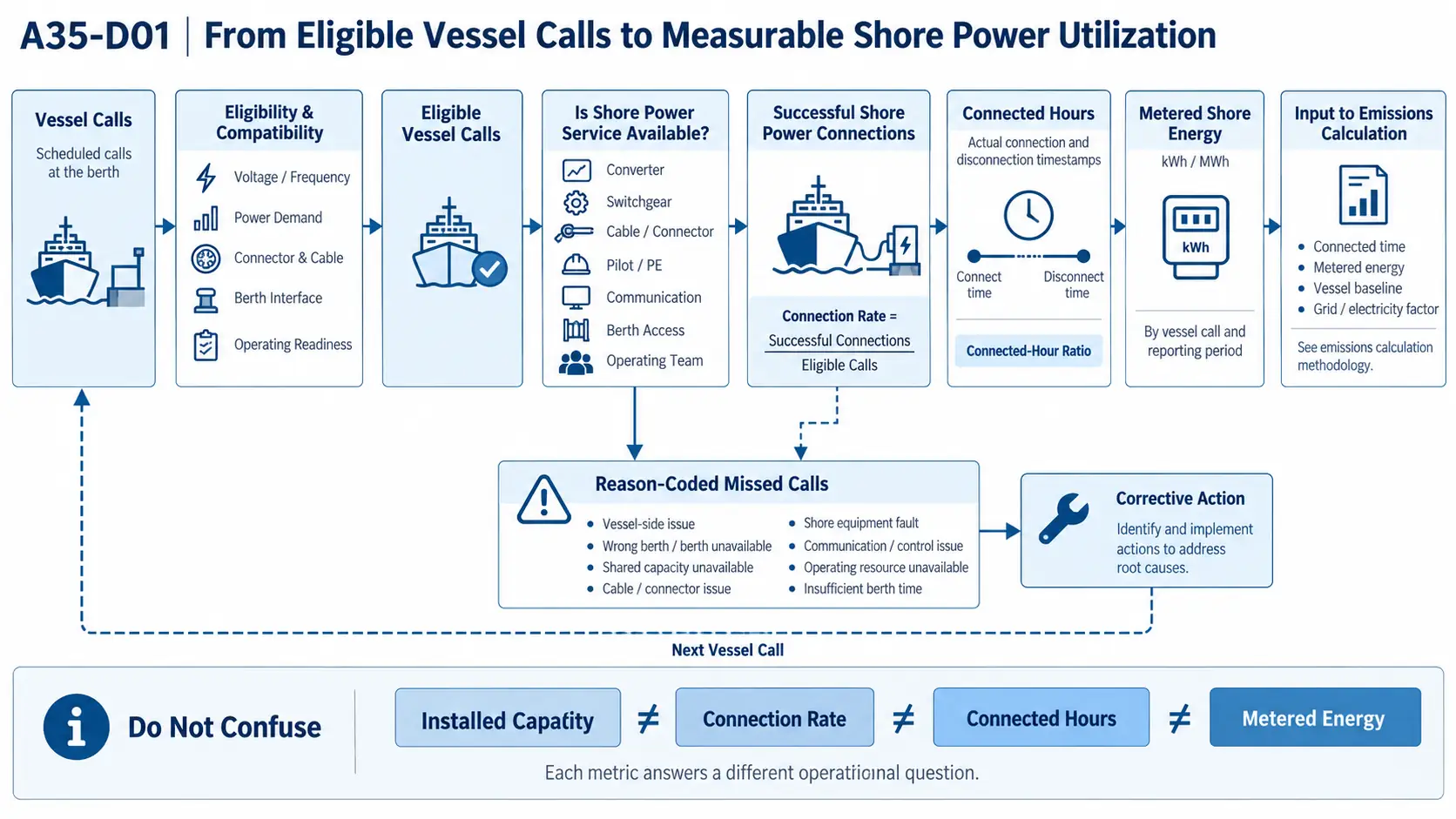
Find Where Time Is Lost During Each Vessel Call
A vessel call can be divided into a sequence of operating stages:
A delay at any stage reduces the period in which the vessel can use shore electricity. The reason may be electrical, mechanical or operational.
- vessel information arriving too late;
- incorrect berth allocation;
- cable reach limitations;
- connector or pilot problems;
- shore equipment unavailable;
- vessel-side equipment unavailable;
- communication failure;
- unclear operating authority;
- personnel not ready;
- a berth stay too short for practical connection.
Faster operation should come from removing repeated uncertainty and unnecessary waiting—not from bypassing electrical checks, interlocks or operating permissions.
Repeat Vessels Should Become Easier to Connect
Frequently returning vessels create one of the strongest opportunities to improve shore power utilization.
The first connection normally requires more engineering confirmation because the ship-to-shore interface has not yet been proven in normal operation. Once a vessel has connected successfully, the port can maintain a controlled vessel profile.
- nominal voltage and frequency;
- expected berth demand;
- connector arrangement;
- vessel inlet position;
- cable requirements;
- earthing arrangement;
- transfer method;
- known operating restrictions;
- ship and shore responsibilities;
- previous connection results.
The purpose is not to assume that a vessel will always arrive unchanged. It is to avoid rediscovering information that has already been verified.
In one documented terminal operating reference, recurring vessel connections became more efficient as the shore and vessel teams developed a familiar operating routine. Regularly connected vessels were supported by established equipment records and procedures, reducing part of the repeated communication and preparation required during earlier calls.
A Project-Specific Operating Reference
The same operating reference recorded a repeat connection completed in approximately 18 minutes from cable handling through transfer to shore power after the operating procedure had become familiar.
Match Berth Coverage to the Vessel Schedule
Electrical capacity is only useful when a compatible vessel can reach it. A port can have adequate converter capacity and still achieve low utilization if compatible vessels regularly berth at locations without a usable shore connection.
The review should consider:
- which vessel classes call at each berth;
- how frequently compatible ships return;
- where the shipboard connection point is located;
- which berth outlets can physically reach that inlet;
- whether cable management interferes with cargo operations;
- whether multiple vessels may require shore power simultaneously;
- whether multiple connection points share one conversion source.
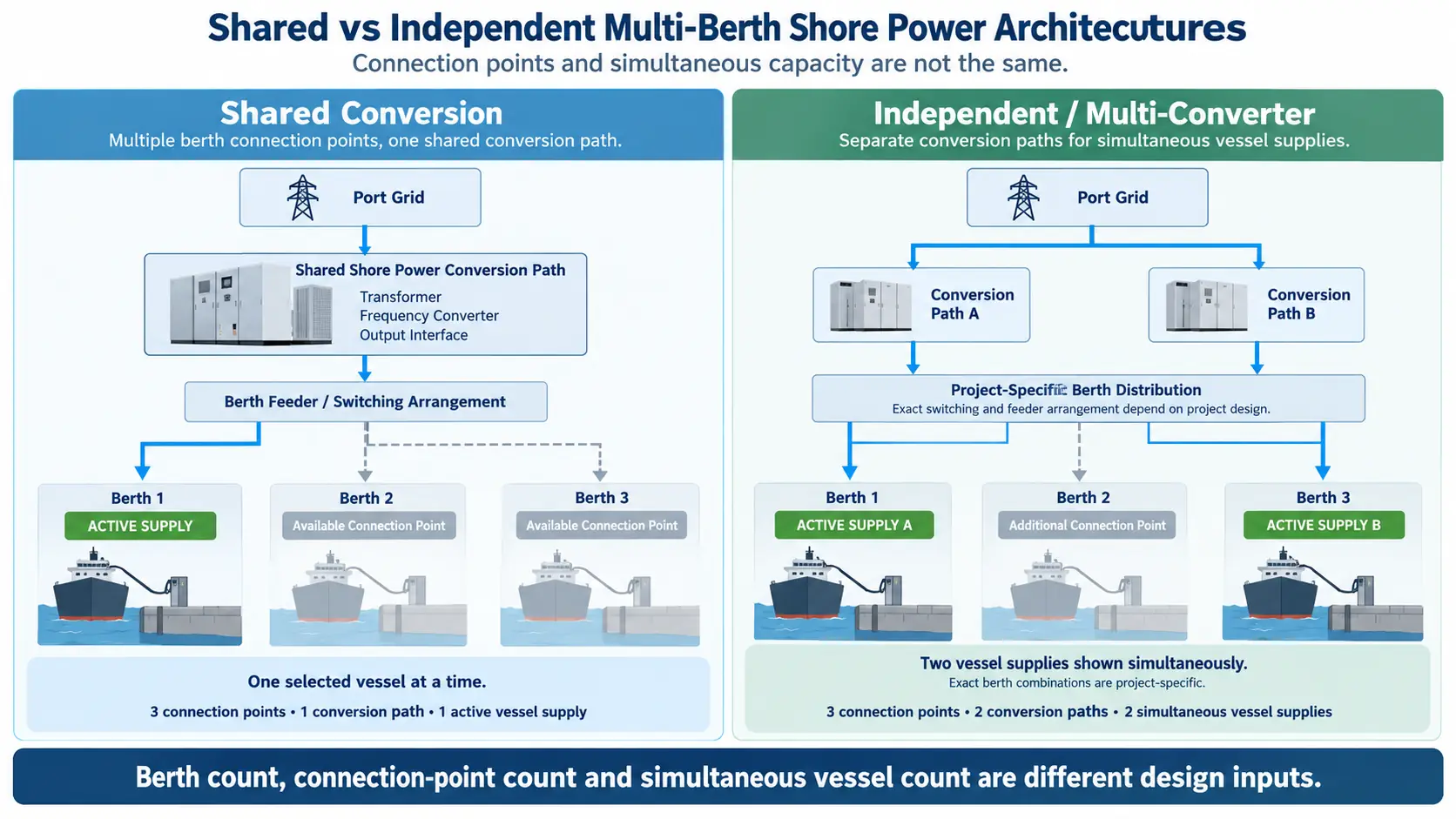
For a full comparison of shared capacity and independent berth supply, see our multi-berth shore power system design article.
Separate Equipment Availability From Service Availability
A shore power system can be electrically healthy and still be unavailable for an arriving vessel.
| Equipment Availability | Service Availability |
|---|---|
| Incoming switchgear healthy | Correct berth actually accessible |
| Converter operational | Compatible cable and connector ready |
| Transformer available | PE / pilot circuits available |
| HVAC and auxiliaries healthy | Required communication path available |
| Control power available | Operating personnel and authority ready |
The vessel does not connect to the converter in isolation. It connects to a complete operational service path.
Interpret Utilization Metrics Together
No single utilization metric can identify the operating constraint by itself.
Connection rate, connected hours, metered energy and availability describe different parts of the same operating process. Their value increases when they are reviewed together.
For example, a high equipment-availability figure does not explain why only a small percentage of eligible vessels connect. In that case, the main constraint may be outside the converter or switchgear and instead involve berth allocation, vessel compatibility, cable access or operating readiness.
Similarly, a high connection rate does not automatically mean that the available berth period is being used effectively. Vessels may connect successfully but only after a long preparation delay, leaving relatively few connected hours.
| Observed Pattern | Possible Operating Meaning | Check First |
|---|---|---|
| High connection rate + low connected hours | Vessels usually connect, but useful shore-power time is being lost before connection or before departure. | Preparation time, connection timing, berth duration |
| Low connection rate + high equipment availability | Main electrical equipment is normally healthy, but vessels still fail to reach shore-power operation. | Compatibility, berth assignment, cable interface, operating readiness |
| High connected hours + relatively low metered energy | Connected vessels may have lower berth demand, or the measurement boundary may differ from expectations. | Vessel load profile, meter location, operating mode |
| Low equipment availability | Electrical or auxiliary equipment is directly limiting operating opportunity. | Converter, switchgear, transformer, HVAC, controls, cable system |
| High equipment availability + low service availability | Individual equipment is healthy, but the complete vessel-service path is not ready. | Berth access, connector, PE/pilot, communication, personnel |
| Repeated difficulty with first-time vessels | Technical onboarding may be consuming excessive berth time or preventing connection. | Vessel data exchange, compatibility review, pre-arrival preparation |
| Repeat vessels improve while new vessels remain slow | Standardized vessel profiles and operating familiarity are working, but first-call preparation remains the constraint. | Onboarding process and vessel-profile creation |
The objective is not to make every KPI move upward independently.
Shortening connection preparation can improve connected hours without changing converter capacity. Improving berth assignment can increase connection rate without changing equipment availability. Solving a recurring cable-interface problem can improve both service availability and connected time.
Treat People and Operating Authority as Part of the System
Shore power is an electrical system, but every successful connection is also an operating coordination task.
At minimum, the operating chain can involve:
- the vessel crew;
- berth or terminal personnel;
- the shore power operator.
Depending on the project, utility, control-room, maintenance and contractor personnel may also participate.
Each operating party should know:
- who confirms vessel readiness;
- who handles the cable;
- who verifies the interface;
- who authorizes energization;
- who controls the relevant breaker;
- who confirms transfer;
- who responds to an abnormal condition;
- who records the event.
Training should cover more than a successful start. Aborted connection, communication loss, loss of permissive, emergency action and local/remote authority should also be understood.
Code Every Missed or Aborted Connection
A utilization dashboard becomes much more valuable when every eligible call ends with either a successful connection or a defined reason why shore power was not used.
| Reason Group | Example | Likely Response |
|---|---|---|
| Vessel-side | Onboard shore power unavailable or incompatible | Technical review / vessel readiness |
| Berth | Wrong berth or berth unavailable | Berth-allocation planning |
| Capacity | Shared source already serving another vessel | Architecture / schedule review |
| Connection hardware | Cable reach or connector problem | Cable-management or interface correction |
| Shore equipment | Converter, switchgear or auxiliary fault | Maintenance / spares / reliability action |
| Control | Communication or permissive not available | Control and interface troubleshooting |
| Operations | Personnel or operating authority unavailable | Procedure and responsibility improvement |
| Time | Insufficient berth duration | Pre-arrival preparation / call assessment |
Over time, repeated reason codes show whether the limiting factor is equipment, berth allocation, vessel readiness or the operating process. The next step is to compare how often each problem occurs with how much connected time and energy opportunity it removes.
Prioritize Constraints by Lost Connected Time, Not Frequency Alone
Reason codes show what went wrong, but event count alone does not show which problem is causing the greatest utilization loss.
A frequent minor delay may have less effect on annual shore-power use than a rare failure that removes an entire vessel call.
The energy term does not need to be treated as a precise emissions calculation at this stage. Its purpose is to distinguish a short operational delay from a failure that removes several hours of potential shore-power service.
Consider two different operating patterns.
One issue may occur frequently but delay connection only briefly. Another issue may occur only a few times, but each event may prevent shore power from being used for most of the berth stay.
If management looks only at event frequency, the first issue may appear more important. If the objective is to increase connected hours and energy delivery, the second issue may deserve earlier engineering attention.
The same principle applies to equipment faults. A recurring alarm that does not interrupt service should not automatically receive the same utilization priority as a low-frequency cable, connector or switchgear failure that makes the berth unavailable to an eligible vessel.
Questions for Corrective-Action Priority
- How many eligible vessel calls were affected?
- How much connection time was lost?
- Did the event prevent connection completely or only delay it?
- Was shore energy delivery reduced materially?
- Is the cause recurring?
- Can the cause be corrected through procedure, maintenance, berth planning or equipment modification?
- What is the expected operating benefit if it is corrected?
This also prevents the port from responding to every utilization problem by adding more converter capacity.
If the dominant loss is caused by berth assignment, cable access, communication or vessel preparation, additional installed MW may leave the real constraint unchanged.
Turn Operating Records Into a Management Loop
Shore power monitoring systems can provide an important technical base for utilization analysis through operating history, status and event records, energy metering and reporting functions.
However, electrical data needs operating context. For each eligible vessel call, the port should be able to reconstruct:
- which vessel arrived;
- whether it was eligible;
- which berth was assigned;
- whether the service was available;
- whether connection was attempted;
- whether connection succeeded;
- connection and disconnection times;
- metered energy;
- the reason for any failure or aborted connection.
Real Operating Evidence Is More Useful Than Installed Capacity
One established terminal operating reference progressed from initial vessel-connection work into recurring shore-power operation.
After routine operation became established, its records described nearly 80 vessel connections and more than 2,000,000 kWh of shore electricity supplied.
These figures are not universal utilization targets. Vessel schedules, berth durations, load profiles, infrastructure and operating conditions differ between ports.
Connect Utilization to Emissions Reporting
Utilization and emissions calculation should be connected, but they are not the same calculation.
A utilization review establishes what actually happened:
- how many eligible calls occurred;
- how many connected;
- how long vessels remained on shore power;
- how much electrical energy was delivered.
Those records then become inputs to the emissions calculation. Installed converter capacity or theoretical full-berth hours should not substitute for actual connected energy.
If connection rate increases while average connected duration falls, the connection count alone does not prove that the environmental result improved proportionally.
For the vessel baseline, grid factor, system-loss boundary and pollutant-specific method, see our shore power emissions reduction calculation article.
Policy Can Increase Demand, but It Does Not Create Utilization by Itself
Regulation is increasing the importance of shore-side electricity in some jurisdictions, but regulatory requirements should not be presented as evidence of operating performance.
Within the European Union, Regulation (EU) 2023/1804 establishes shore-side electricity infrastructure targets for defined categories of TEN-T maritime ports and vessel calls. For applicable cases, the regulation uses 31 December 2029 as an infrastructure target date and includes vessel-type, gross-tonnage and port-call thresholds rather than applying one identical requirement to every port and vessel.
FuelEU Maritime, Regulation (EU) 2023/1805, adds a vessel-use dimension. From 1 January 2030, vessels within the relevant scope are required to use on-shore power supply while moored at covered ports, subject to the regulation's scope and exceptions.
Common Shore Power Utilization Errors
Reporting installed MVA as an operating result
Installed capacity describes what the system can supply under defined conditions. It does not show whether vessels actually used it.
Using all port calls as the denominator
Ships without compatible onboard systems can distort the connection rate. Define eligible calls first.
Measuring only annual kWh
Energy cannot explain whether utilization is limited by low connection rate, short connected duration or vessel load.
Measuring only connection count
A brief commissioning connection and a long commercial berth stay are not equivalent operating results.
Prioritizing causes only by event count
A frequent minor delay may have less utilization impact than a rare event that removes many hours of potential shore-power operation.
Treating every missed call as a vessel problem
Berth allocation, cable availability, shore equipment, staffing and maintenance can also cause missed opportunities.
Assuming multiple outlets mean simultaneous capacity
Several connection boxes can share upstream equipment. Review the architecture before interpreting berth coverage.
Optimizing connection time at the expense of the operating sequence
Pre-approval and repeat-vessel profiles can remove repeated work, but they should not remove required verification, interlocks or permissions.
Treating equipment availability as service availability
A healthy converter does not guarantee that an eligible vessel can connect.
Information Needed for a Shore Power Utilization Review
A useful review starts with operating data rather than only equipment nameplates.
- vessel-call schedule;
- berth allocation records;
- vessel categories;
- compatible-vessel list;
- voltage and frequency requirements;
- expected vessel demand;
- connector and cable arrangement;
- shore connection locations;
- shared-capacity limitations;
- successful connection records;
- connection and disconnection timestamps;
- metered energy by vessel call;
- first-time and repeat-vessel status;
- equipment downtime;
- service-unavailable periods;
- aborted or missed-call reasons;
- estimated lost connected time by reason;
- maintenance periods;
- operating responsibilities;
- applicable reporting or regulatory scope.
Frequently Asked Questions
What is shore power utilization?
Shore power utilization describes how installed shore power infrastructure is actually used by eligible vessels. A useful assessment combines successful connections, connected hours, metered energy, service availability and missed-call reasons.
How should a port calculate the shore power connection rate?
For operating management, a useful method is successful shore power connections divided by eligible compatible vessel calls. Eligibility rules should be defined and applied consistently.
Is annual shore power energy enough to measure utilization?
No. Annual energy does not show how many eligible vessels failed to connect, how much usable berth time was lost or why service was unavailable.
What is the difference between equipment availability and service availability?
Equipment availability describes whether individual electrical equipment is technically ready. Service availability asks whether the complete shore power path—including berth access, cable, connector, protective circuits, communication and operating personnel—was available to the vessel.
Can repeat vessels connect faster?
They can when previously verified vessel information, interfaces and operating responsibilities are maintained in a controlled profile and confirmed before arrival. Connection time remains project-specific.
Should the most frequent missed-call reason always receive the highest priority?
No. Frequency should be reviewed together with lost connected time and lost energy opportunity. A less frequent event may deserve earlier action if each occurrence removes a large part of the vessel's usable berth period.
Does adding more converter capacity always improve utilization?
No. The limiting factor may instead be vessel compatibility, berth coverage, cable access, simultaneous-demand architecture, service availability or operating readiness.
Does higher shore power utilization prove a specific emissions reduction?
No. Utilization provides operating inputs such as connected time and metered energy. The emissions result still depends on the vessel baseline, shore-electricity emissions and calculation boundary.
Technical References
IEC/IEEE 80005-1:2019 — Utility connections in port, Part 1: High-voltage shore connection systems, including published amendments. Reference
IEC/IEEE 80005-3:2025 — Utility connections in port, Part 3: Low-voltage shore connection systems. Reference
U.S. EPA — Shore Power Technology Assessment at U.S. Ports, 2022 Update. Reference
European Maritime Safety Agency — Shore-Side Electricity guidance. Reference
Regulation (EU) 2023/1804 — Alternative Fuels Infrastructure Regulation. Reference
Regulation (EU) 2023/1805 — FuelEU Maritime. Reference
From Installed Equipment to Recurring Vessel Connections
The important question after commissioning is not only how much shore power capacity was installed. It is how much of the eligible vessel operation actually transferred to shore power—and what prevented the remaining opportunities from connecting.
For an engineering review, provide:
- vessel schedule;
- electrical compatibility data;
- berth arrangement;
- connection records;
- metered energy;
- missed-call reasons;
- estimated lost connected time where available.