Microwave Power for Industrial Heating & Drying

Microwave Generators for Industrial Heating & Drying

Integrate controlled microwave power into industrial heating and drying equipment with generator and microwave-subsystem configurations selected around the material load, applicator, required power and equipment interfaces.

SDACME supports industrial microwave projects from generator selection through power-delivery and OEM integration review.

Industrial Heating Industrial Drying Microwave Power Source OEM Integration
Application Overview

Microwave Power in Industrial Heating and Drying Equipment

A microwave generator is the microwave-energy source within a larger industrial heating or drying machine. The complete application combines the power source with the microwave-delivery path, applicator or chamber, material load and equipment controls.

01

Microwave Generator

Generates and controls the microwave power required by the equipment.

02

Power Delivery

Transfers microwave energy through the selected transmission, monitoring and matching arrangement.

03

Applicator / Load

Couples microwave energy into the material or product being heated or dried.

04

Heating / Drying Process

Material condition, loading method and operating requirements influence how microwave energy is used in the process.

Selection starts from the load. Material characteristics, load size, applicator geometry, operating mode and required process conditions help determine the appropriate microwave power source and delivery configuration.
Power Selection

Microwave Power Options for Industrial Heating & Drying

For higher-power industrial heating and drying projects, the primary configurations highlighted here are 25 kW, 75 kW and 100 kW. The appropriate power class should be selected together with the material load, applicator, operating duty, microwave-delivery path, cooling and equipment architecture.

25 kW
Industrial Microwave Generator

25 kW Microwave Generator

For project-configured industrial microwave equipment where the required load and operating conditions support the 25 kW power class.

  • Material and load condition
  • Applicator interface
  • Microwave transmission
  • Cooling requirements
  • Equipment controls
75 kW
Industrial Microwave Generator

75 kW Microwave Generator

For higher-power industrial equipment requiring a larger microwave power source and coordinated microwave-subsystem integration.

  • Load and applicator conditions
  • Reflected-power conditions
  • Waveguide and matching
  • Cooling capacity
  • OEM equipment integration
100 kW
Industrial Microwave Generator

100 kW Microwave Generator

For industrial projects requiring the upper end of the current high-power project range.

  • Required microwave power
  • Site electrical conditions
  • Cooling capacity
  • Transmission architecture
  • Equipment and control interfaces
Lower-Power Project Evaluation

Lower-power configurations, including 6 kW, can also be evaluated for industrial heating equipment when the material load, applicator and required operating duty support a smaller microwave power class.

Selection Principle

Higher rated microwave power alone does not define heating rate or drying throughput. Power selection should be based on the complete microwave application.

System Architecture

How Microwave Power Reaches the Industrial Load

An industrial microwave heating or drying installation can be viewed as a complete microwave-power path from the generator to the application load.

01

Site Power

Electrical supply for the selected microwave-generator configuration.

02

Microwave Generator

Generates and controls microwave power.

03

Microwave Head

Provides the microwave-output interface to the power-delivery path.

04

Isolation & Monitoring

Applicable protection and monitoring support changing load conditions.

05

Waveguide Transmission

Transfers microwave power toward the application equipment.

06

Impedance Matching

Supports load matching where required by the selected configuration.

07

Applicator / Load

The equipment-side interface where microwave energy reaches the material.

01

Control & Interlocks

Coordinates generator operation, equipment status and project interlocks with the larger industrial machine.

02

Cooling

Supports the generator, microwave head and applicable microwave components according to the selected configuration.

03

Material & Process Conditions

Material properties, loading and operating requirements influence complete-system design.

Project-Configured

Potential Microwave-Side Project Scope

  • Microwave generator
  • Microwave head
  • Power-delivery components
  • Monitoring & protection
  • Waveguide components
  • Matching components
  • Control integration
  • Cooling-interface review
  • Factory verification
  • Technical documentation

The exact supply scope is defined by the selected configuration, quotation and technical agreement.

Complete Application

Equipment & Process Side

  • Applicator or chamber
  • Material handling
  • Conveyor / batch arrangement
  • Material load
  • Process settings
  • Heating / drying objective
  • Final production performance
System-level selection matters. Process performance depends on the complete industrial equipment, material load and operating conditions—not on generator power alone.
Application Engineering

Match the Microwave Source to the Material Load and Applicator

The material load is a major part of industrial microwave-system selection. Its physical condition and interaction with the microwave field influence how energy is absorbed and how the complete power-delivery system should be configured.

01

Material Characteristics

Material composition, moisture condition and microwave interaction influence energy absorption.

02

Load Size & Geometry

Load depth, dimensions, density and positioning influence microwave coupling and application-system design.

03

Applicator Geometry

The applicator or chamber determines how microwave energy is presented to the material.

04

Operating Mode

Batch, intermittent and continuous equipment arrangements create different load and integration conditions.

05

Changing Load Conditions

Material conditions may change during heating or moisture removal, which can also change the microwave load seen by the generator.

06

Energy Distribution & Temperature Uniformity

Heating uniformity is influenced by applicator geometry, material distribution, load depth, microwave coupling and operating conditions.

Key Engineering Principle

Generator Power Is Only One Part of Heating Performance

The microwave generator provides controlled power. The applicator, material load and operating conditions determine how that power is distributed and used.

Review Temperature Uniformity at System Level

  • Applicator geometry
  • Material distribution
  • Load depth and positioning
  • Microwave coupling
  • Operating conditions
Microwave Transmission

Power Delivery, Waveguide and Impedance Matching

The generator must be connected to the industrial applicator through a microwave-delivery path suitable for the selected power level, equipment geometry and load conditions.
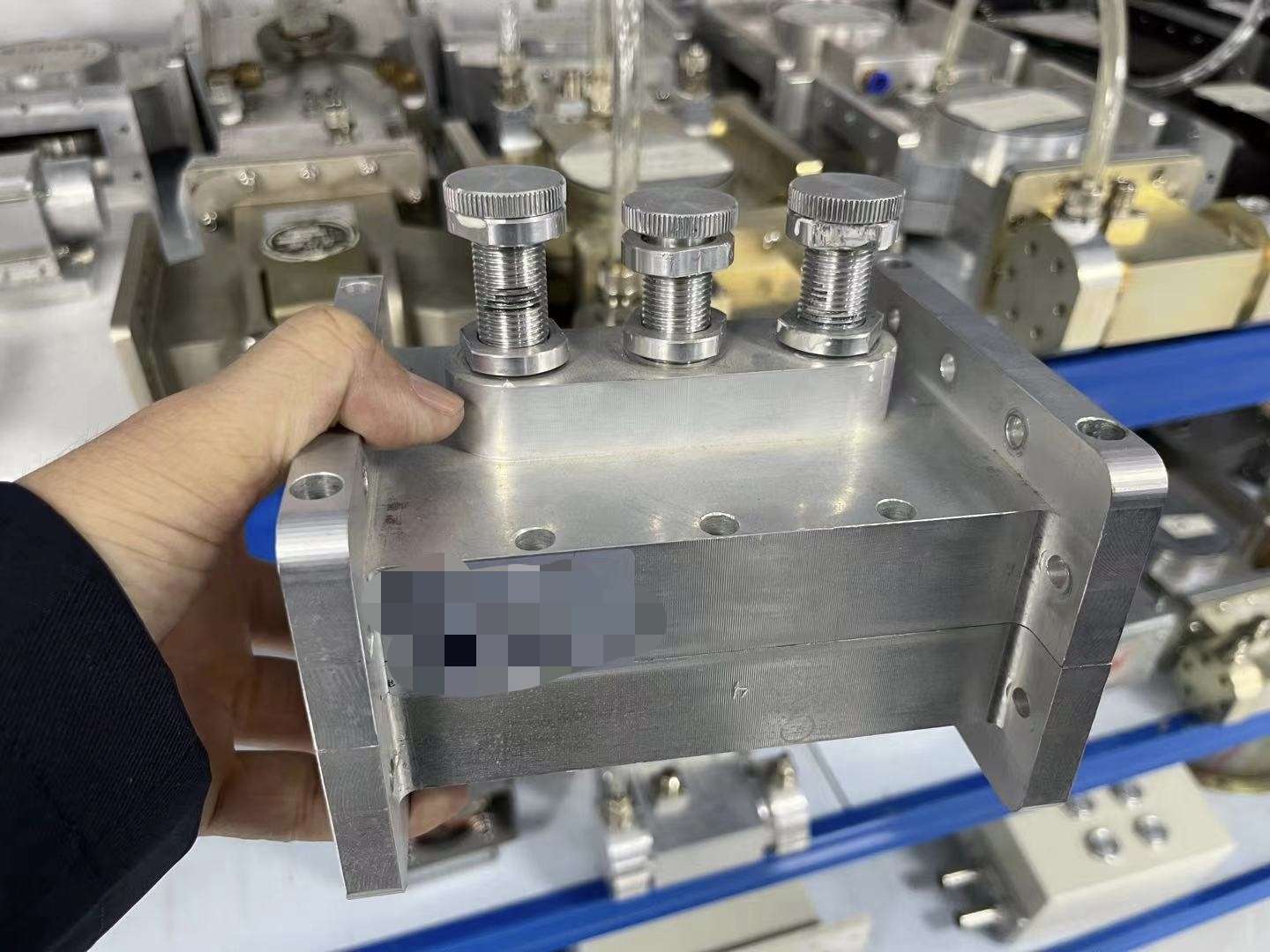
Three-probe impedance tuner for microwave waveguide matching
Impedance-matching hardware example. The final matching and waveguide arrangement depends on the selected microwave source, equipment interface and load.
01 · TRANSMISSION

Waveguide Transmission

Waveguide type, route, orientation and connection geometry are coordinated with the generator and application equipment.

02 · LOAD CONDITION

Reflected-Power Conditions

The load presented to the microwave system can affect reflected power during operation.

03 · PROTECTION

Isolation & Monitoring

Applicable configurations can include microwave-side protection and forward / reflected-power monitoring.

04 · MATCHING

Impedance Matching

Matching components can be incorporated where the actual load and project architecture require impedance adjustment.

Heating & Drying Loads Can Change During Operation

As material conditions change during heating or moisture removal, the microwave load can also change. Load behavior is therefore an important consideration when selecting transmission, monitoring and matching components.

Engineering selection: the required microwave-delivery configuration is determined from the actual equipment and load rather than from generator wattage alone.
Control Integration

Integrate the Microwave Generator with the Industrial Equipment

The microwave generator normally operates as part of a larger heating or drying machine. Control, monitoring and equipment interlocks should therefore be coordinated with the overall machine architecture.

01

Local Operation

Applicable generator configurations provide local operating and status functions.

02

Remote Operation

Remote operating requirements can be reviewed for OEM and integrated industrial equipment.

03

Communication

Communication interfaces, including RS485 on applicable configurations, can be reviewed according to the selected generator and equipment-control requirements.

04

Operating Status & Alarms

Generator status and applicable alarm information can be integrated into the equipment operating workflow.

05

Equipment Interlocks

Project interlocks coordinate microwave operation with equipment status, cooling and other required machine conditions.

06

Microwave Power Monitoring

Forward / reflected-power monitoring can be incorporated where applicable to the selected configuration.

Typical Equipment-Integration Categories
  • Generator operating status
  • Power setting
  • Alarm / fault status
  • Remote operation
  • Cooling interlocks
  • Machine interlocks
  • Communication interface
  • Microwave power monitoring
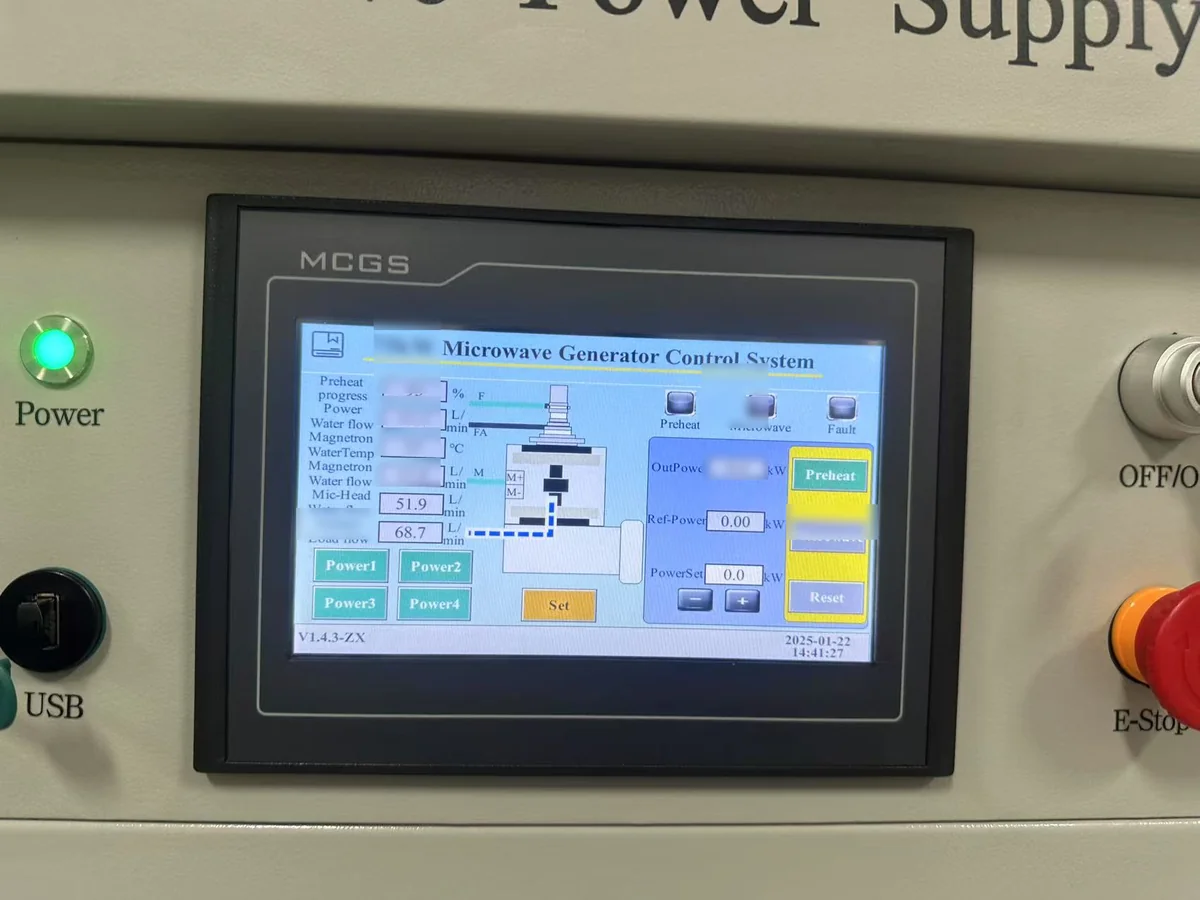
HMI control interface on a 75 kW microwave generator
75 kW microwave-generator HMI example. The exact operating interface and communication requirements depend on the selected generator and project configuration.
Project integration: detailed communication definitions and model-specific interface requirements are confirmed during project engineering for the selected generator and equipment architecture.
Site & Installation Conditions

Cooling and Installation Conditions for Industrial Microwave Equipment

Higher-power industrial microwave installations require the site utilities, equipment arrangement and cooling conditions to be reviewed before final configuration.
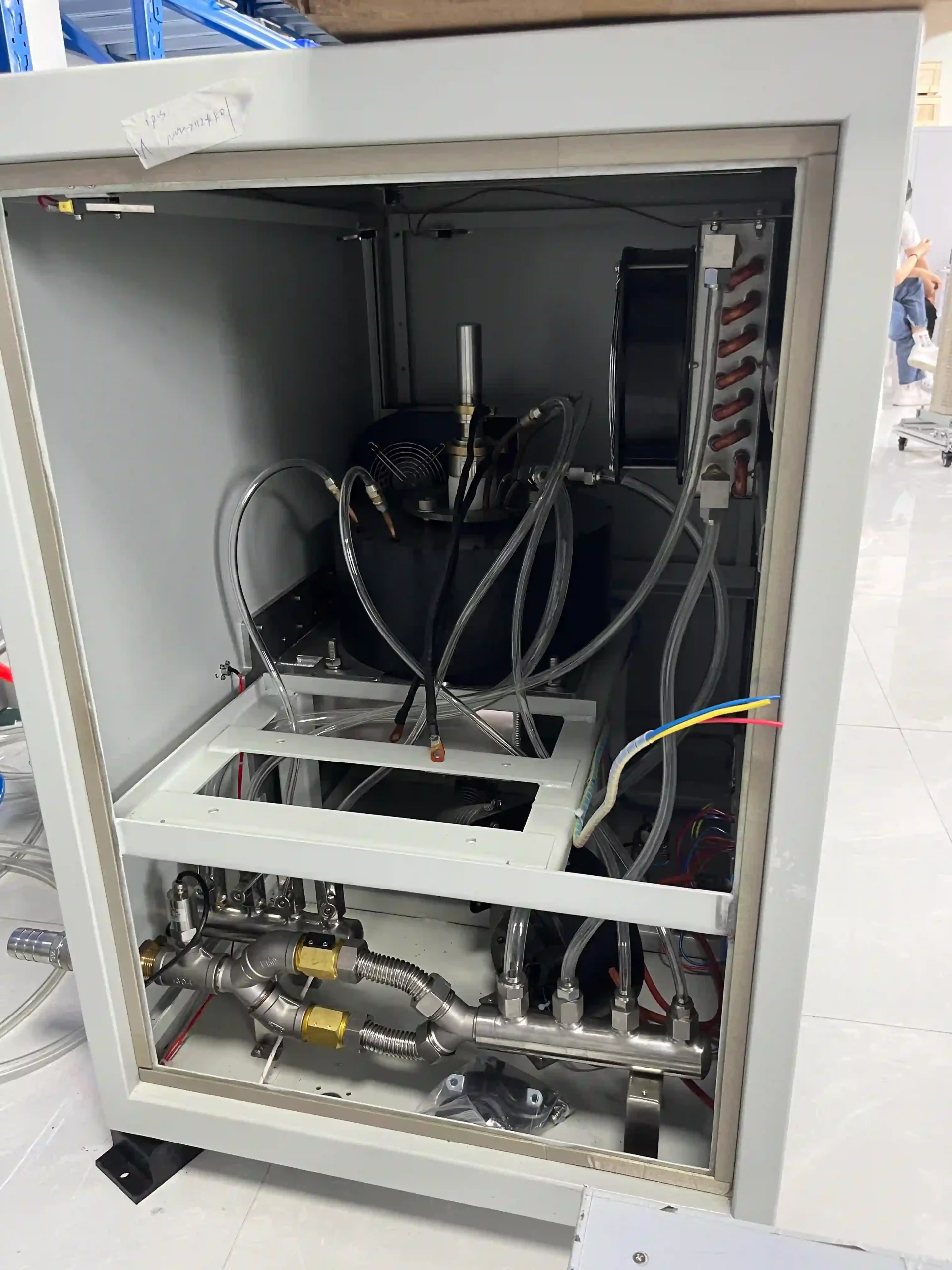
Internal cooling piping inside a 75 kW 915 MHz microwave generator
75 kW microwave-generator cooling example. Cooling conditions and connection requirements are confirmed against the selected generator and project configuration.
01

Cooling Requirements

Confirm the cooling requirements of the selected generator, microwave head and applicable microwave components.

02

Site Electrical Supply

Confirm the available site voltage, frequency and electrical conditions for the selected generator.

03

Mechanical Installation

Review generator location, service access, microwave-head position, waveguide routing and applicator connection.

04

Equipment Environment

Installation environment and operating conditions should be considered during project planning.

Installation Information to Review
  • Available cooling system
  • Cooling-water conditions
  • Cooling connection arrangement
  • Operating duty
  • Site voltage and frequency
  • Generator installation location
  • Service / maintenance access
  • Microwave-head position
  • Waveguide route
  • Applicator interface
Plan utilities and interfaces early. Reviewing cooling, electrical supply and mechanical interfaces before equipment layout is finalized helps reduce later changes to cooling connections, electrical routing, waveguide geometry and machine layout.
Engineering Inputs

Information Required for an Industrial Heating or Drying Project

A useful generator recommendation starts with information about the material, equipment and required operating conditions. Provide as much of the following information as available.

01

Application Type

Industrial heating, drying or other intended microwave application.

02

Material / Load

Material type, dimensions, quantity, loading arrangement and current condition.

03

Existing Heating / Drying Equipment

Existing chamber, conveyor, dryer, heating equipment or machine layout where microwave power will be integrated.

04

Required Microwave Power

Known current power or initial target power, if available.

05

Heating / Drying Objective

Required heating condition, moisture-removal objective or other operating target.

06

Applicator / Chamber

Dimensions, drawings and microwave-input arrangement.

07

Operating Mode

Batch, intermittent or continuous operating arrangement.

08

Waveguide Interface

Existing flange, transmission route, orientation or related drawings.

09

Site Power

Available electrical voltage and frequency.

10

Cooling Conditions

Available cooling utilities and installation conditions.

11

Control / Communication

Required local operation, remote control, interlocks and communication requirements.

12

Quantity & Destination

Required quantity, installation country and project delivery requirements.

Existing Equipment Integration

Have an Existing Machine or Technical Drawing?

Send the available equipment information together with your material and operating requirements for engineering review.

Send Project Requirements
Factory Verification

Verify the Agreed Microwave Configuration Before Delivery

Factory verification is performed against the selected generator, agreed microwave-subsystem configuration and project requirements. The verification scope focuses on the microwave equipment being supplied.

✓

Configuration Check

Confirm the agreed generator and applicable microwave-side components.

✓

Functional Operation

Check applicable generator operating functions.

✓

Control & Monitoring

Verify the agreed operating, status and monitoring functions.

✓

Output-Related Verification

Perform agreed measurements under the defined factory test configuration.

✓

Protection & Interlocks

Verify applicable protection and project interlock functions included in the agreed test scope.

✓

Documentation

Prepare agreed factory-test records and technical documentation.
Factory functional testing of a 15 kW microwave generator
15 kW generator functional-test example. Representative factory verification of microwave-generator operation.
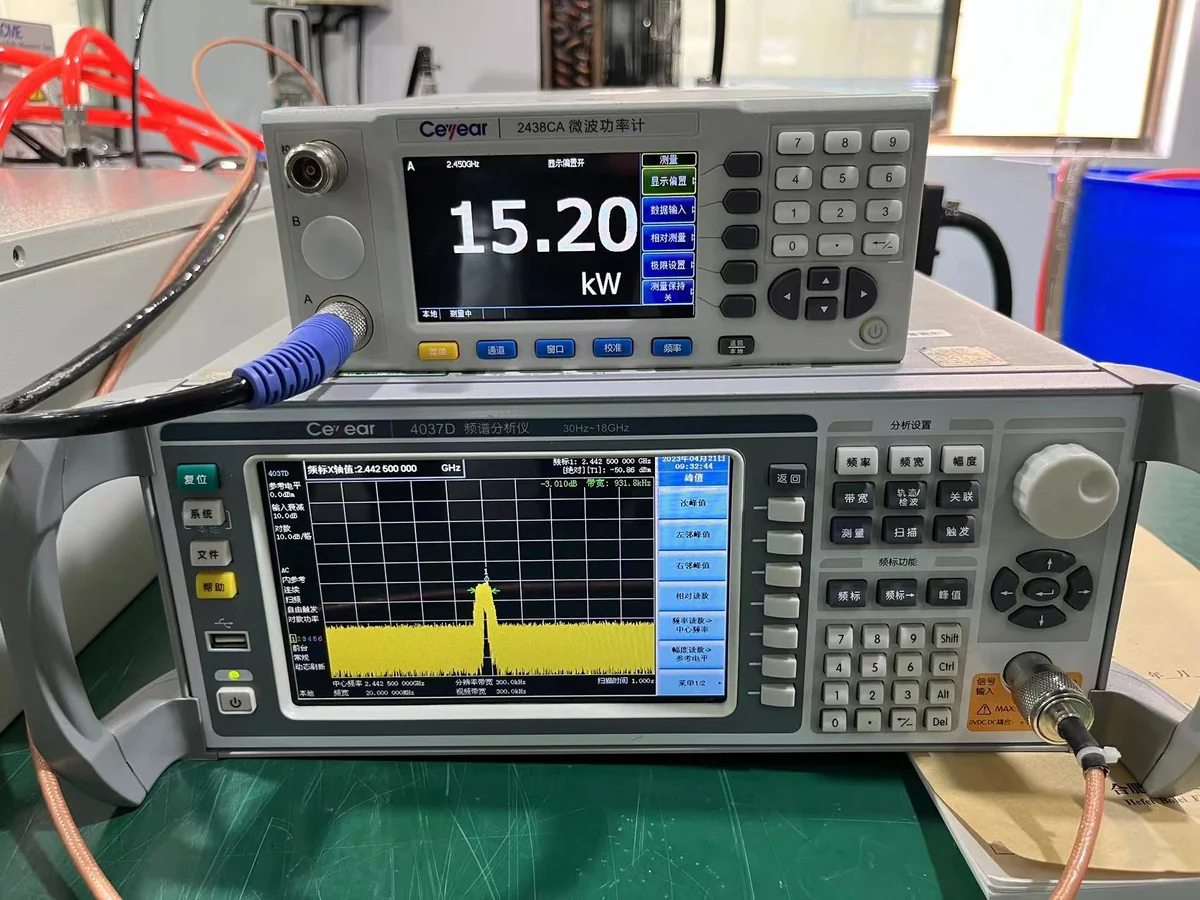
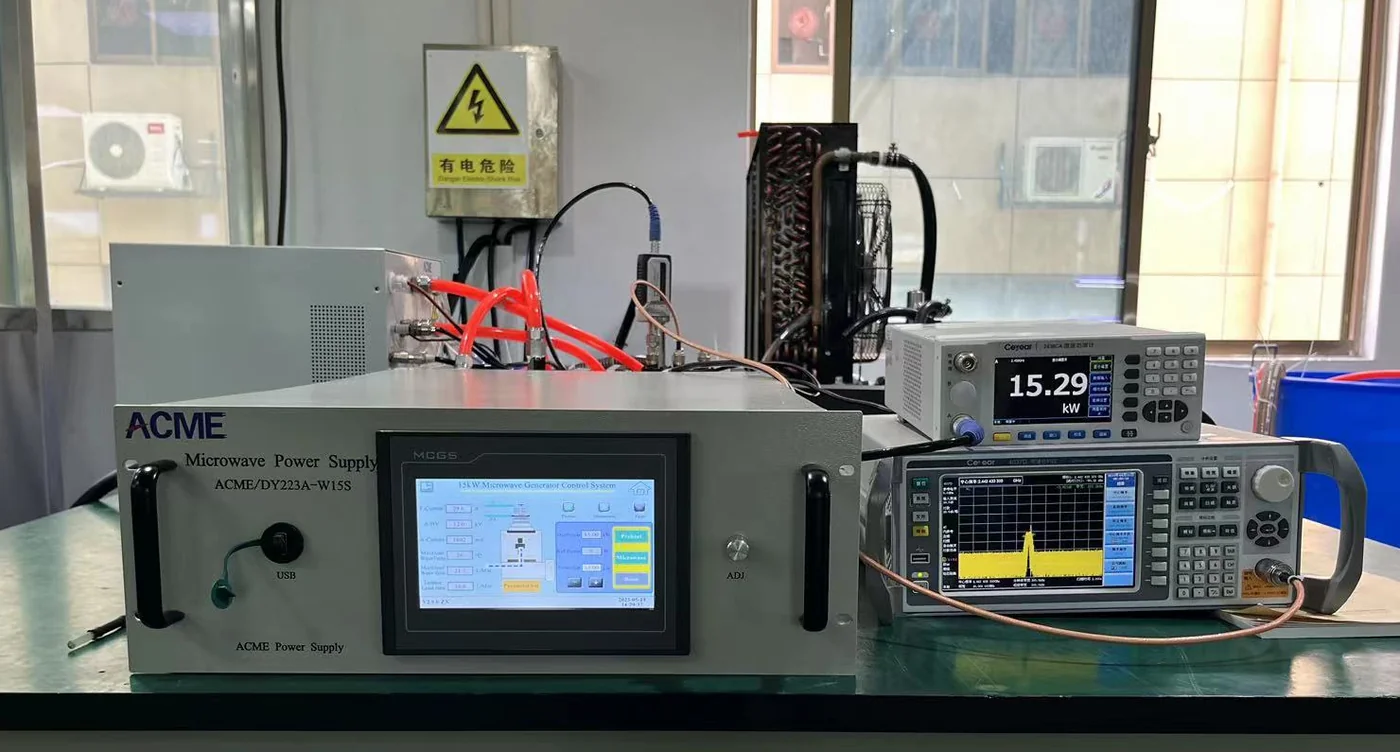
Power and spectrum testing of a 15 kW microwave generator
15 kW power and spectrum test example. Actual test scope depends on the selected generator and project agreement.
Verification Boundary

Generator & Microwave-Subsystem Verification

Factory verification demonstrates the agreed microwave-generator and subsystem functions. Heating rate, moisture removal, temperature uniformity and final production throughput depend on the complete industrial equipment, material load and operating conditions.

Project-defined acceptance: FAT items, test conditions, acceptance criteria and records are defined for the applicable generator configuration and agreed project scope.
Frequently Asked Questions

Industrial Microwave Heating & Drying FAQ

Initial engineering guidance for selecting and integrating a microwave generator into industrial heating or drying equipment.

What microwave generator is suitable for industrial heating?

For higher-power industrial heating and drying projects, 25 kW, 75 kW and 100 kW configurations are key options. Final selection depends on the material load, applicator, microwave-delivery interface, cooling and equipment-control requirements.

What microwave power is required for industrial drying?

There is no single microwave-power rating suitable for every drying application. Required power depends on the material, moisture condition, load quantity, applicator design, operating mode and required process conditions.

Can a 6 kW microwave generator be used for industrial heating?

Yes. A 6 kW configuration can be evaluated for lower-power industrial heating equipment when the material load, applicator and required operating duty support that power class.

How do I choose between 25 kW, 75 kW and 100 kW?

Compare the required microwave power together with the material load, applicator, operating duty, reflected-power conditions, cooling capacity, electrical supply and equipment architecture.

Does SDACME supply the complete industrial microwave dryer?

The final supply level depends on the project. SDACME can provide and configure microwave-generator and microwave-side components according to the selected scope. Applicators, chambers, conveyors, material handling and process equipment are reviewed separately according to the application and project agreement.

Can a SDACME microwave generator be integrated with an industrial applicator?

Yes. Microwave-side integration can be reviewed around the applicator or chamber interface, including required power, transmission path, waveguide connection, matching, monitoring, cooling and control requirements. The exact equipment and supply scope is defined for the project.

What information is required to select a microwave generator for drying?

Provide the material and load information, heating or drying objective, existing equipment drawings, applicator dimensions, required power if known, operating mode, electrical supply, cooling conditions, waveguide interface and control requirements.

Does higher microwave power guarantee faster drying?

No. Rated microwave power alone does not determine drying throughput. Actual heating and drying performance also depends on material coupling, load distribution, applicator geometry, microwave-energy distribution and operating conditions.

→
Selection Summary

Select the Microwave Generator as Part of the Complete Application

The material load and applicator determine how microwave power is actually used. Generator power, transmission, matching, cooling and equipment controls should therefore be evaluated together.

Industrial Heating & Drying RFQ

Discuss Your Industrial Heating or Drying Project

Send the available material, equipment and operating information. SDACME can review the appropriate microwave-generator power class, microwave-delivery requirements, equipment interfaces and project configuration.

Include in Your Inquiry

The more equipment and load information available at the beginning, the more focused the initial engineering review can be.

Application / equipment type
Material / load
Existing heating or drying equipment
Heating / drying objective
Required microwave power, if known
Applicator / chamber information
Waveguide interface
Operating mode
Site electrical supply
Cooling conditions
Control / communication
Quantity & destination country
Available technical drawings
For faster evaluation, attach available equipment drawings, applicator dimensions, existing generator information and known material or operating requirements with your inquiry.