MPCVD Machine Price: What Determines the Final Quotation?
An MPCVD machine does not have one meaningful price that applies to every project.
The final quotation depends on the selected microwave power class, reactor configuration, vacuum and gas-control scope, cooling arrangement, auxiliary equipment, acceptance requirements, project support and delivery conditions.
For this reason, SDACME prepares MPCVD quotations against a defined technical and commercial scope rather than relying on a single universal list price.
If you are comparing 6 kW, 10 kW or 15 kW MPCVD equipment, the first step is not only to compare the headline number. It is to confirm what each quotation actually includes.
Why Two MPCVD Machines with the Same Rated Power May Have Different Prices
Microwave power is an important specification, but it does not define the complete MPCVD system.
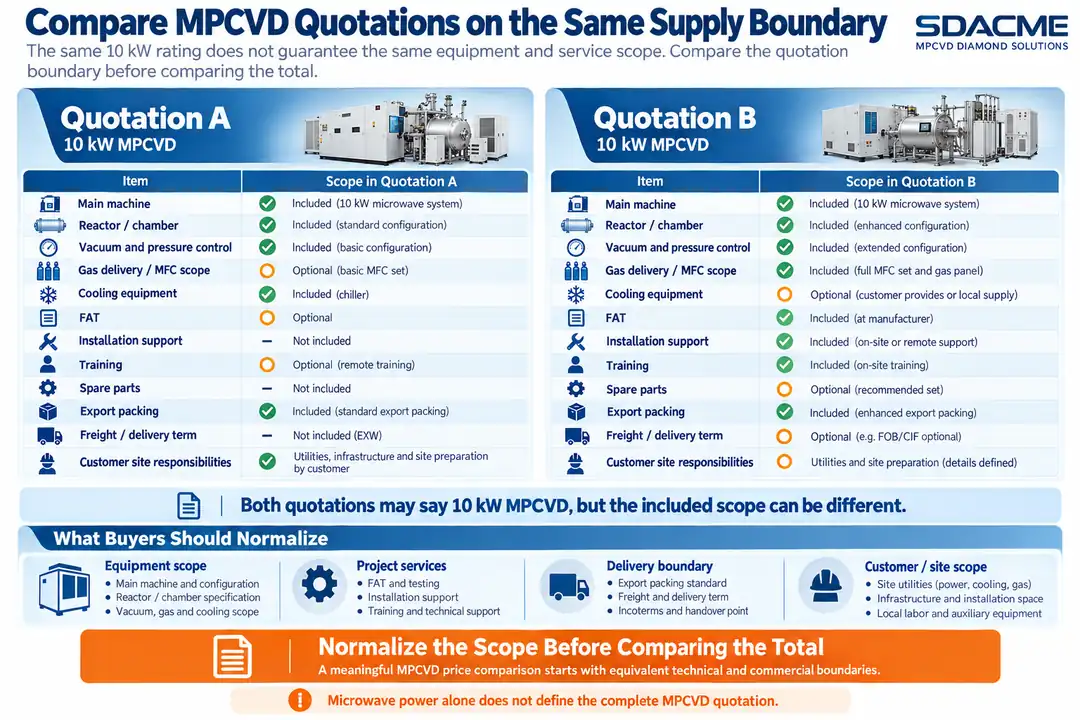
Two quotations may both describe a “10 kW MPCVD machine” while covering different equipment and service boundaries. One quotation may include a broader machine-side or auxiliary scope, while another may leave selected equipment, utilities or project services outside the quoted package.
That is why a meaningful MPCVD machine price must always be read together with the configuration and supply boundary.
The same principle applies whether a buyer is reviewing an MPCVD system price, MPCVD system cost, MPCVD reactor price, microwave plasma CVD system quotation or CVD diamond machine price.
For buyers searching for a diamond growth system price, cost or quotation, the commercial comparison should still begin by confirming the actual MPCVD configuration and what is included in the supplier’s scope.
What equipment is included?
Confirm the machine-side system, auxiliaries and optional equipment stated in the quotation.
What project services are included?
FAT, installation support, commissioning, training, spare parts and other support items should be checked against the agreed scope.
What remains the buyer’s responsibility?
Local utilities, electrical connection, gas infrastructure, exhaust, site work and regulatory requirements may remain outside the equipment supplier’s contract.
A lower quotation is not automatically a better or worse quotation. The important question is whether the offers are being compared on an equivalent technical and commercial boundary.
6 kW vs 10 kW vs 15 kW MPCVD Pricing Logic
For the current SDACME 2.45 GHz MPCVD range covered by this page, the principal power classes are 6 kW, 10 kW and 15 kW.
Microwave power establishes an important starting point for system selection, but MPCVD machine price does not increase according to a simple price-per-kilowatt formula.
6 kW MPCVD
A 6 kW configuration may be considered where the intended application, project stage and reactor requirements support this power class.
However, a 6 kW MPCVD machine should not be viewed simply as a 10 kW machine with every cost reduced in direct proportion. The reactor, vacuum, gas-control, monitoring and other machine functions still form a substantial part of the complete system.
10 kW MPCVD
A 10 kW quotation should also be evaluated as a complete system rather than as the cost of the microwave source alone.
Reactor and substrate-stage requirements, vacuum configuration, gas-control scope, cooling arrangement, auxiliary equipment and project-support requirements can change the final quotation even when two suppliers state the same nominal microwave power.
15 kW MPCVD
A 15 kW project requires the higher-power machine to be reviewed as an integrated configuration.
The relevant purchasing question is therefore not only:
“How much more does 15 kW cost than 10 kW?”
It is:
“What changes in the complete system and project scope when the selected power class changes?”
That is the more reliable basis for comparing quotations.
What Affects MPCVD Machine Price?
MPCVD pricing is determined by the complete technical and commercial configuration, not by microwave power alone. The main quotation drivers should be reviewed as connected system requirements rather than isolated line items.
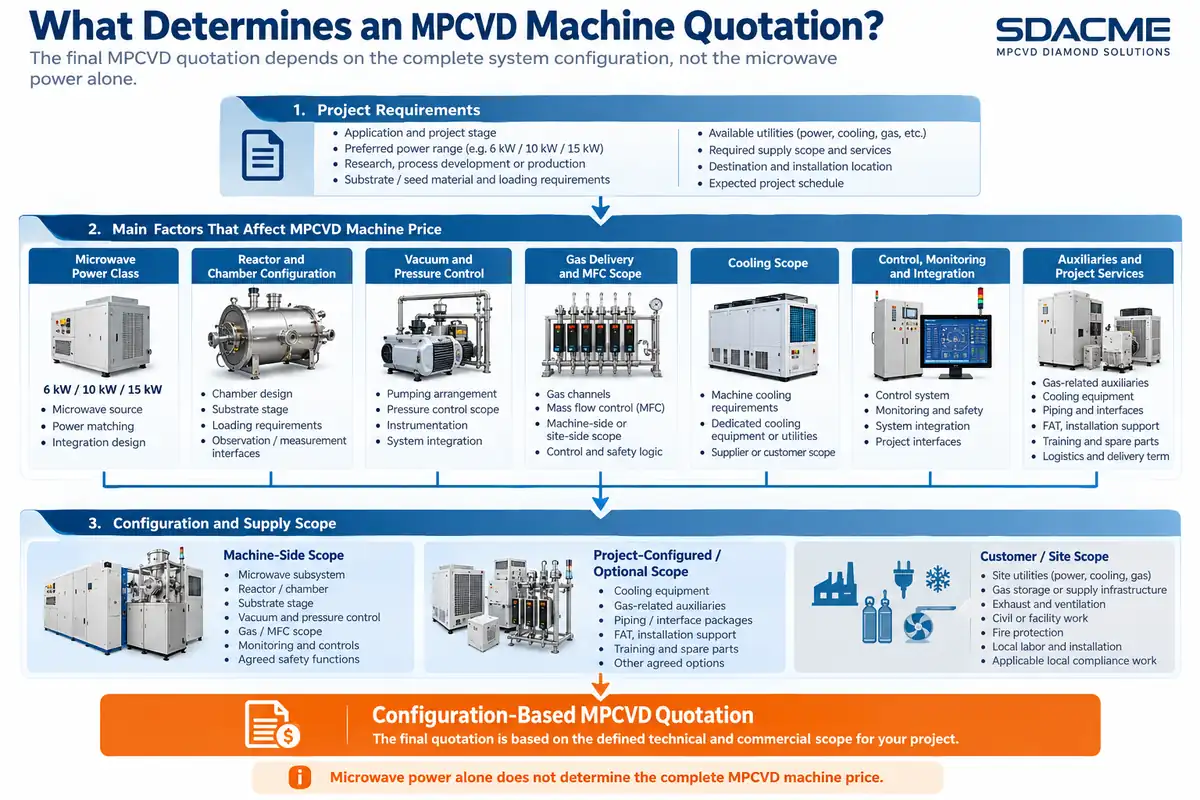
Microwave Power Class
The selected microwave power class establishes an important engineering starting point.
Changing the power class may also require corresponding review of the reactor, cooling, protection and integration requirements of the complete system.
For quotation purposes, buyers should therefore provide the intended application and power range rather than selecting equipment only from a price-per-kilowatt assumption.
Reactor and Chamber Configuration
The reactor is a central part of the MPCVD machine.
Requirements related to chamber configuration, substrate arrangement, loading needs, observation or measurement interfaces and project-specific mechanical requirements can change the equipment scope.
Two quotations using the same microwave power should therefore not be assumed to represent equivalent reactor configurations.
Vacuum and Pressure-Control Scope
The required vacuum and pressure-control arrangement forms part of the machine configuration.
Quotation scope may vary according to the pumping arrangement, pressure-control requirements, instrumentation and degree of system integration required for the project.
When comparing suppliers, the buyer should confirm what vacuum-related equipment is actually included rather than comparing only the top-line machine price.
Gas Delivery and MFC Scope
Gas delivery is another important quotation boundary.
The required gas channels, mass-flow-control scope and division between machine-side and site-side gas equipment should be defined for the project.
The purchasing requirement is to confirm the required control capability and interfaces. Proprietary process recipes and detailed operating settings are not necessary for a commercial price comparison.
Cooling Scope
Cooling can be divided differently between supplier and customer depending on the project.
A quotation should clarify the distinction between:
- machine cooling requirements,
- dedicated cooling equipment supplied with the project,
- and cooling utilities provided by the customer.
Two equipment prices may appear different because one quotation includes additional cooling equipment while another assumes suitable site utilities are already available.
Control, Monitoring and Integration
The machine requires control and monitoring functions appropriate to the agreed system configuration.
Commercial scope can change with the required machine-side control, monitoring, project interfaces and integration responsibilities.
For quotation comparison, the customer needs to understand the supplied functionality and interface boundary—not the supplier’s proprietary internal control logic.
Auxiliary Equipment
Depending on the project, additional equipment may be required beyond the main machine.
This can include applicable gas-related auxiliaries, cooling equipment, piping or interface packages, spare-parts packages and other project-configured items.
Each item should be identified as included, optional or customer-supplied.
FAT, Installation Support, Training and Logistics
Commercial scope is not limited to hardware.
Factory acceptance testing, remote witnessing where applicable, installation or commissioning support, technical or operator training, spare parts, packing and international logistics may affect the total quotation.
These items should be explicitly defined in the technical-commercial proposal rather than assumed to be automatically included or excluded.
What Should an MPCVD Quotation Actually Include?
A useful MPCVD quotation should allow the buyer to understand where the equipment supplier’s responsibility starts and ends.
The scope can be reviewed in three layers:
- Microwave subsystem
- Reactor / chamber
- Substrate stage
- Vacuum and pressure-control scope
- Gas / MFC scope
- Monitoring
- Controls
- Agreed safety functions
- Cooling equipment
- Gas-related auxiliaries
- Piping / interfaces
- FAT
- Training
- Installation support
- Commissioning support
- Spare parts
- Other agreed options
- Site utilities
- Electrical connection
- Gas storage or supply infrastructure
- Exhaust
- Civil or facility work
- Fire protection
- Local labor
- Applicable local compliance work
The exact allocation is project-specific and should be confirmed in the technical-commercial proposal.
For each major item, the quotation should make clear whether it is:
This avoids one of the most common problems in equipment purchasing: comparing a broader integrated-system quotation with a quotation that covers a narrower equipment boundary.
How to Compare Two MPCVD Supplier Quotations
When two MPCVD quotations show different totals, the first step is to normalize the scope.
| Comparison Item | What to Check |
|---|---|
| Microwave power | Same power class and comparable project requirement? |
| Reactor / chamber | Comparable reactor and machine configuration? |
| Substrate stage | Comparable loading and project requirement? |
| Vacuum system | Comparable pumping and pressure-control scope? |
| Gas delivery | Required gas-control equipment and interfaces included? |
| Cooling | Only machine requirements, or dedicated cooling equipment too? |
| Controls | Comparable monitoring and control functionality? |
| Auxiliaries | Included, optional or excluded? |
| FAT | What acceptance scope is actually included? |
| Installation | Customer installation, remote support or on-site service? |
| Commissioning | Included or separately defined? |
| Training | Included, optional or separately scoped? |
| Spare parts | Included package or additional option? |
| Warranty / support | What contractual coverage is stated? |
| Packing | Export packing included? |
| Freight | What delivery term and destination are being quoted? |
| Local responsibilities | What must the customer provide at the installation site? |
A quotation with a lower total may require additional equipment or local work outside the supplier’s stated scope.
A higher total may represent a broader equipment or support package.
The correct conclusion is therefore not that one commercial structure is automatically better than the other.
Machine Price, Delivered Cost, Installed CAPEX and Operating Cost Are Different
A machine quotation is only one layer of the total investment decision.
Machine / Equipment Quotation
This is the commercial value of the equipment and services included in the supplier’s defined scope.
It may cover the main MPCVD machine together with selected auxiliaries and project services.
Delivered Equipment Cost
Delivered equipment cost may additionally reflect export packing, freight, insurance or other logistics according to the agreed delivery term and destination.
A factory-level quotation and a delivered quotation therefore represent different commercial boundaries.
Total Installed Project CAPEX
The buyer’s complete project investment may also include local infrastructure and work outside the equipment quotation.
Depending on the site, this can include electrical infrastructure, gas storage and supply, exhaust, cooling utilities, fire-protection requirements, civil or facility work, local installation labor and locally required compliance work.
Operating Cost
Operating cost is a separate calculation from the initial equipment purchase price.
It depends on equipment configuration, operating conditions, electricity, process gases, cooling and other utilities.
The purchase price of an MPCVD machine should therefore not be used as a substitute for an operating-cost or cost-per-carat calculation.
What Information Is Needed for an MPCVD Quotation?
A quotation can be prepared more effectively when the available project information is sufficient to define the equipment and commercial boundary.
Useful inputs include:
Application and Machine Requirements
- intended application and project stage;
- preferred power class, or a request for model recommendation;
- research, process-development or production objective;
- substrate or seed material, dimensions and loading requirements where known;
- required gas and interface scope;
Site, Scope and Commercial Inputs
- available electrical supply;
- cooling conditions and available utilities;
- required machine and auxiliary supply scope;
- FAT requirements;
- installation or commissioning support requirements;
- training requirements;
- destination country and installation location;
- required quantity;
- and expected project schedule.
Not every project will have all parameters fixed at the beginning.
If the project is still at an early planning stage, SDACME can review the available information and identify which technical inputs need to be confirmed before the final configuration and quotation are established.
MPCVD Machine Price FAQ
How much does an MPCVD machine or MPCVD system cost?
Why can two 10 kW MPCVD machines have different prices?
Does MPCVD machine price increase directly with microwave power?
What information is needed for an MPCVD quotation?
Does an MPCVD quotation include installation and training?
Is MPCVD machine price the same as the total investment for a diamond-growth facility?
How much does it cost to run an MPCVD machine?
Can a CVD diamond coating machine price be compared directly with a diamond-growth MPCVD quotation?
Request a Configuration-Based MPCVD Quotation
A useful MPCVD quotation starts with a clearly defined project boundary.
Send us your intended application, project stage, preferred power range if known, major supply-scope requirements, support needs and delivery destination.
SDACME can review the available information and identify the technical inputs required to establish a comparable equipment quotation.
If your project is still at the concept or budget-planning stage, you do not need to define every engineering parameter before contacting us. Start with the information already available, and the remaining quotation inputs can be reviewed step by step.