MPCVD Installation Requirements & RFQ Checklist
Prepare the Site, Utilities and Project Information Before Final System Configuration
Installing an MPCVD machine involves more than choosing a microwave power rating.
Electrical supply, cooling, process gases, compressed air, vacuum and exhaust interfaces, room conditions and the required supply scope should all be reviewed before the final system configuration is confirmed.
SDACME reviews these conditions together with the application, seed or substrate requirements and project location so that the recommended MPCVD system, auxiliary equipment and installation scope match the actual project.
You do not need to define every technical parameter before contacting us. If some information is not yet available, send the conditions you already know and select Need Recommendation where applicable.
What Utilities Does an MPCVD System Require?
Start With the Facility Conditions Before Finalizing the Machine
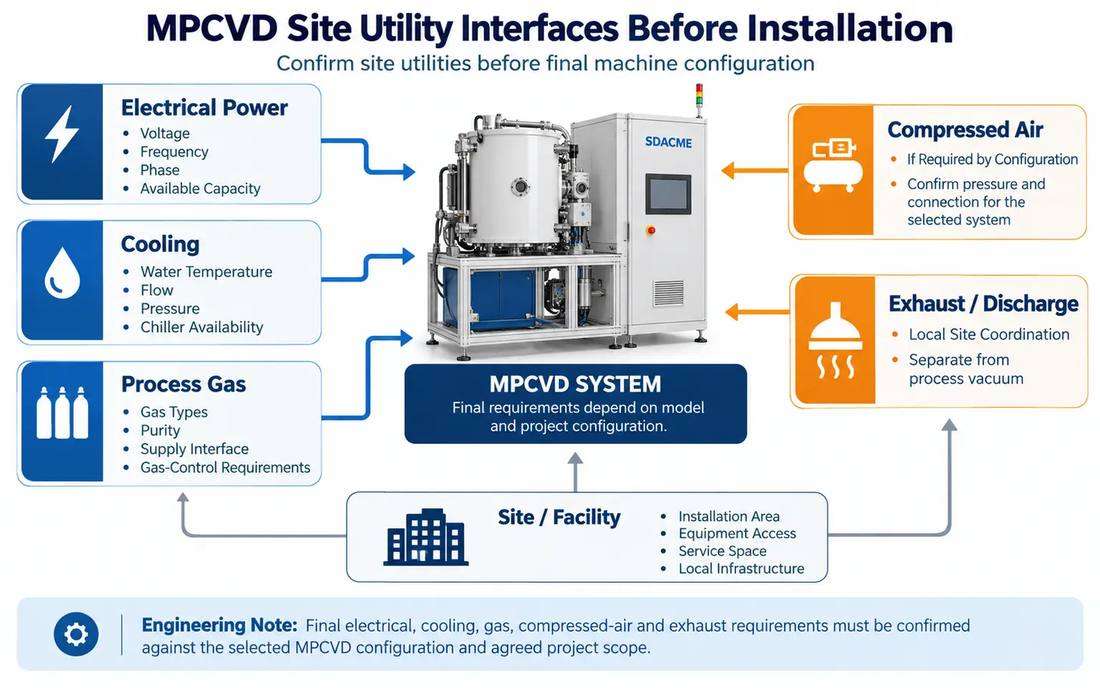
An MPCVD project typically requires electrical power, cooling, process gases and suitable site interfaces.
Depending on the selected machine and auxiliary configuration, the project may also require compressed air, local exhaust or discharge arrangements and other supporting facility conditions.
Before the equipment configuration is finalized, the project team should normally review several groups of site information.
Electrical Supply
Provide the available voltage, grid frequency, phase and electrical capacity.
Cooling
Provide the available cooling-water temperature, flow, pressure and whether an existing chiller is available.
Process Gases
Identify the process gases available at the site, their purity where known, the existing supply infrastructure and any special gas-control requirements.
Compressed Air
Confirm whether plant compressed air is available if the selected machine or auxiliary equipment requires pneumatic operation.
Exhaust and Facility Interfaces
Confirm the proposed equipment location, exhaust or discharge arrangement and other local infrastructure that may affect installation.
Project Information
Also provide the installation country and site, required MPCVD power class if known, machine quantity, project schedule and required supply scope.
The final utility requirements are confirmed against the selected MPCVD configuration rather than assumed from microwave power alone.
MPCVD Electrical Power Requirements
Microwave Power Rating Is Not the Same as Total Facility Power Requirement
A 6kW, 10kW or 15kW MPCVD designation describes the microwave power class of the system.
It should not be treated as the complete electrical demand of the installed project.
The total facility requirement can also be influenced by the configured vacuum system, cooling equipment, control system and other auxiliary equipment.
What Electrical Information Should You Provide?
Before technical selection, provide your local supply voltage, grid frequency, phase, available electrical capacity and any known limitations in the existing electrical infrastructure.
Why Does This Matter?
Electrical conditions can influence the final equipment configuration and the local electrical work required before installation.
For international projects, the site power conditions should therefore be reviewed before equipment manufacture and shipment rather than assumed from the microwave rating alone.
What Happens After the Site Data Is Submitted?
SDACME reviews the site electrical conditions together with the selected MPCVD model and project scope.
The final electrical requirement and local connection responsibility are then defined in the project technical documentation.
MPCVD Cooling Water Requirements
Cooling Capacity Must Match the Selected Machine and Project Configuration
Cooling is an essential part of MPCVD operation because heat must be removed from the reaction chamber, microwave-related components and other temperature-sensitive parts of the system.
However, cooling requirements should not be selected from microwave power alone.
What Cooling Information Should You Provide?
Where possible, provide the available cooling-water temperature, flow, pressure and whether an industrial chiller is already installed.
Also indicate whether the new MPCVD project should include matched cooling equipment.
Why Does Cooling Need to Be Reviewed?
The required cooling conditions can change with the MPCVD model, chamber and microwave configuration, auxiliary equipment, installation environment and project scope.
Its available water temperature, flow, pressure and connection conditions should be reviewed against the selected MPCVD configuration.
Do You Need a Separate Chiller?
That depends on the existing facility and the agreed equipment scope.
A matched cooling system can be considered as part of the project where required, while customers with an existing cooling system can submit the available operating conditions for engineering review.
Historical MW1070 documentation confirms that cooling flow and water temperature are real machine-specific installation parameters, reinforcing why these values must be checked against the actual configuration rather than generalized across the series.
Process Gas & Gas Supply Requirements
Define the Gas Infrastructure Before Finalizing the MPCVD System
MPCVD operation requires controlled process-gas delivery.
The required gas configuration depends on the material application, process objectives and selected machine configuration.
Information to Provide
Please identify the process gases available at the site, gas purity where already specified, existing gas-storage or distribution infrastructure and any special gas-control or MFC requirements.
Gas Infrastructure Is Not the Same as a Process Recipe
Facility planning should identify which gases are available, how they are supplied to the installation area and which interfaces must be coordinated with the selected system.
The actual operating gas ratios, flow settings and process conditions belong to the process-development and application scope rather than a universal installation specification.
Is a Gas Cabinet Included?
It depends on the agreed project scope.
A project may include gas-control equipment, process-gas piping or related auxiliary systems, while other projects may use infrastructure prepared locally.
The final boundary should be defined before quotations from different suppliers are compared.
Compressed Air, Vacuum & Exhaust
These Requirements Serve Different Functions
Compressed air, process vacuum and facility exhaust can all appear in an MPCVD project, but they should not be treated as the same utility.
Does MPCVD Need Compressed Air?
Compressed air may be required depending on the machine configuration and pneumatic auxiliary components.
If plant compressed air is already available, provide that information during the project review.
The required pressure and connection conditions should be confirmed for the selected system rather than assumed for all MPCVD machines.
Historical MW1070 technical documentation includes a dedicated compressed-air connection, which confirms that this can be a real configuration-specific installation requirement.
Does the Customer Need to Provide a Separate Vacuum Source?
MPCVD operation requires a vacuum and pressure-control system as part of the process architecture.
Whether every vacuum-related component is supplied within the quoted equipment package should be confirmed against the agreed system scope.
Customers should therefore not assume either that a separate facility vacuum source is always required or that every vacuum-related item is automatically included in every quotation.
Is Vacuum the Same as Exhaust?
No.
The process vacuum system establishes and controls the reaction-chamber pressure required for MPCVD operation.
Facility exhaust or discharge planning deals with the routing of gases leaving the system and with local site requirements.
These interfaces should be reviewed separately during site preparation.
MPCVD Site & Facility Preparation
Review the Installation Area Before the Equipment Arrives
Good site preparation reduces installation delays and avoids last-minute changes to utilities or local infrastructure.
Before shipment or on-site installation, the project team should review the equipment location, utility access and local site conditions.
Equipment Location
Confirm the planned installation room or production area.
The review should consider available floor area, equipment-handling access, maintenance space and the route used to move the equipment into position.
Where required, any prepared installation area or foundation work should also be identified before delivery.
Electrical Infrastructure
Confirm that the local electrical distribution can support the project requirements and that the required connection work has been planned.
Cooling Infrastructure
Confirm whether cooling will be provided by an existing facility system or by project-specific cooling equipment.
Gas Infrastructure
Review gas storage, routing, connection location and the relevant local facility requirements.
Exhaust or Discharge
Confirm the planned exhaust or discharge route and how the interface will be coordinated with the MPCVD installation.
Local Safety and Compliance
Depending on the project location, local requirements may involve fire protection, gas storage, electrical rules, permits and environmental requirements.
These items should be confirmed by the customer together with the relevant local authorities, consultants or contractors.
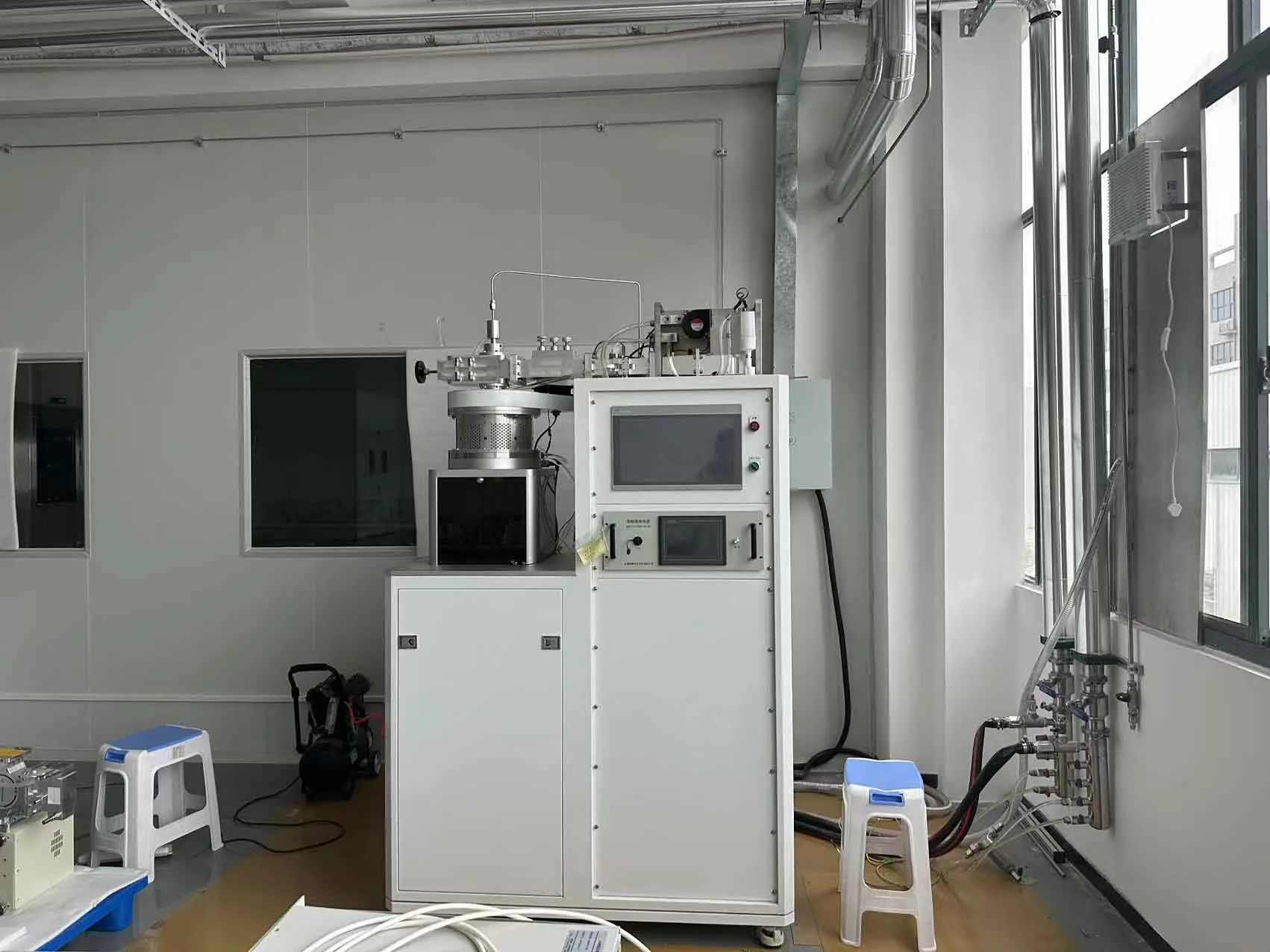
Room or production area prepared for the selected equipment.
Handling route and access for delivery and positioning.
Local distribution and planned equipment connection.
Existing facility cooling or project-specific cooling equipment.
Storage, routing, connection location and facility coordination.
Planned route and interface with local site infrastructure.
Fire protection, permits, electrical and environmental requirements.
Who Is Responsible for MPCVD Site Preparation?
Site Preparation Is Normally a Shared Project Responsibility
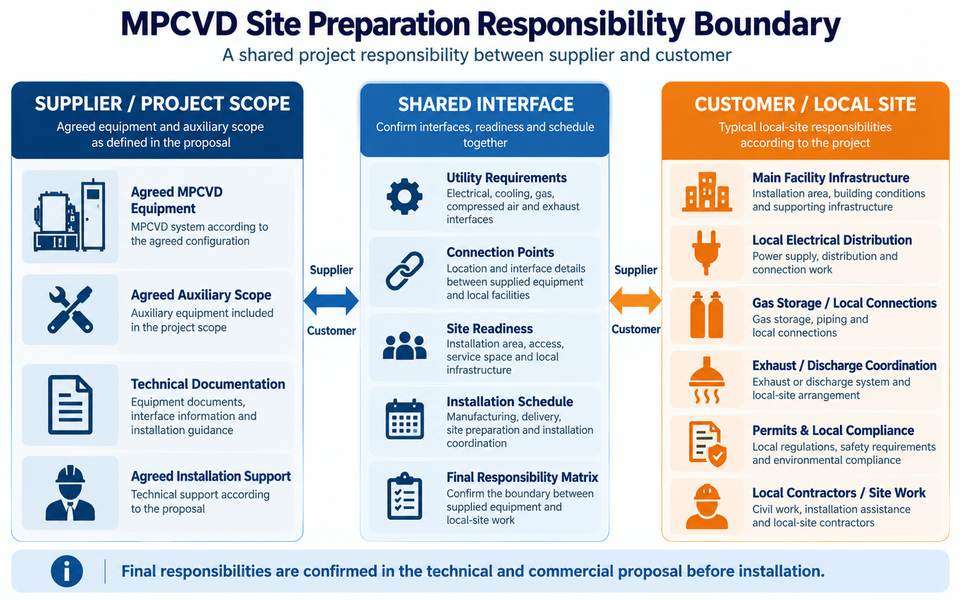
MPCVD installation is not usually a matter of either “the supplier does everything” or “the customer does everything.”
The project should define the responsibility boundary before equipment delivery.
Equipment / Project Supplier
The supplier is responsible for the equipment and auxiliary scope specifically included in the agreed technical and commercial proposal.
Customer / Local Site
The customer normally coordinates the local infrastructure required to receive and connect the system, including site work that falls outside the agreed equipment supply.
Shared Interfaces
The customer and supplier should jointly confirm utility interfaces, connection points, installation readiness, project schedule and the boundary between supplied equipment and local work.
Depending on the project, locally prepared or coordinated items can include electrical distribution, site connections, gas storage, exhaust, permits, environmental compliance and local site contractors; the final scope remains proposal-specific.
Do Installation Requirements Change Between 6kW, 10kW and 15kW MPCVD Systems?
Yes — Site Requirements Should Be Reviewed for the Selected Configuration
The 6kW, 10kW and 15kW MPCVD systems should not be treated as identical machines with only different microwave ratings.
Changes in machine configuration can affect cooling demand, electrical capacity, chamber and stage arrangement, vacuum-system configuration, auxiliary equipment, facility layout and installation scope.
This is why final site preparation should follow model selection rather than rely on one universal utility specification for every MPCVD system.
If you are not sure which power class is appropriate, submit the application, seed or substrate requirements and expected loading first.
MPCVD RFQ Checklist
Information Needed Before an MPCVD Quotation
A useful MPCVD quotation requires more than a request for “one machine.”
The more clearly the application, site utilities and project scope are defined, the more accurately the equipment configuration and quotation can be prepared.
Application
Describe what you plan to grow or deposit and whether the project is for research, pilot development, production development, equipment replacement or capacity expansion.
Seed or Substrate
Provide the material, dimensions, expected quantity per run and required process area where known.
Preferred MPCVD System
Select 6kW, 10kW, 15kW or Need Recommendation.
You do not need to choose the final machine yourself before submitting the RFQ.
Site Electrical Supply
Provide the voltage, frequency, phase and available electrical capacity.
Cooling Conditions
Provide the available water temperature, flow, pressure and existing chiller information.
Process Gases
Provide the available gases, purity where known, existing gas infrastructure and any special gas-control requirements.
Required Supply Scope
Indicate whether you need only the MPCVD equipment or also project-configured auxiliaries such as gas-control equipment, piping, cooling equipment, installation, commissioning or training.
Project Location and Schedule
Provide the country, installation location, machine quantity and expected purchasing or installation schedule.
Existing Technical Information
If available, provide technical specifications, layout drawings, existing equipment information, old equipment nameplates or sample/substrate requirements.
These categories are consistent with the existing MPCVD RFQ workflow, which already requests material, project goal, seed/substrate details, electrical supply, cooling, gas/MFC conditions, supply scope, site and purchasing schedule.
MPCVD Installation Requirements FAQ
What utilities are required for MPCVD installation?
An MPCVD project typically requires electrical power, cooling, process gases and suitable facility interfaces.
Compressed air, exhaust and other supporting utilities depend on the selected machine and auxiliary configuration.
Final requirements should be confirmed after the MPCVD model and project scope are defined.
What electrical information should I provide before ordering an MPCVD machine?
Provide the local voltage, frequency, phase and available electrical capacity.
This allows the equipment and auxiliary systems to be reviewed against the actual site conditions before the final configuration is confirmed.
What cooling-water information is required for an MPCVD system?
Provide the available cooling-water temperature, flow, pressure and whether a chiller already exists.
An existing chiller should still be reviewed against the selected machine rather than assumed compatible based only on its nominal capacity.
Does MPCVD need compressed air?
Compressed air may be required depending on the machine configuration and pneumatic auxiliary components.
The final requirement and connection conditions should be confirmed for the selected MPCVD system.
Does an MPCVD system require a separate facility vacuum source?
Not necessarily.
MPCVD operation requires process vacuum and pressure control, but the supplied vacuum equipment and any customer-side infrastructure depend on the agreed system configuration and supply scope.
Does an MPCVD installation require exhaust or discharge planning?
An exhaust or discharge interface may need to be coordinated as part of the site preparation.
This is separate from the process vacuum system and should be reviewed according to the selected machine and local facility requirements.
Is a gas cabinet included with an MPCVD system?
It can be included according to the project configuration.
Gas cabinets, gas piping and related auxiliary equipment should be identified clearly in the proposal so the customer can distinguish supplied equipment from locally prepared infrastructure.
What information is needed before an MPCVD quotation?
Provide the application, project stage, seed or substrate dimensions, expected loading, electrical conditions, cooling conditions, process gases, installation location and required supply scope.
If you are not sure whether 6kW, 10kW or 15kW is appropriate, select Need Recommendation.
Prepare Your MPCVD Project Before the Quotation
You do not need to complete the engineering design before contacting SDACME.
Start with the project information already available: your application, seed or substrate, expected loading, electrical supply, cooling conditions, available process gases, installation location, required supply scope and project schedule.
SDACME can then review the available information, identify the site conditions that still need confirmation and evaluate the appropriate MPCVD configuration.
Submit MPCVD Project Requirements
Not sure which model to choose?
Select Need Recommendation and send the application and available site conditions first.