MPCVD System Components & Supply Scope
An MPCVD machine is more than a microwave generator or a reaction chamber.
A complete microwave plasma chemical vapor deposition platform brings together microwave generation and transmission, the reaction environment, vacuum and pressure control, process-gas delivery, cooling, temperature monitoring, machine control and safety functions.
For purchasing purposes, however, a required system function does not always mean that every related external device is included as standard supply. A gas cabinet, industrial chiller, external piping, voltage-adaptation equipment or site infrastructure may be included, configured as an option or prepared locally according to the project.
SDACME defines the final MPCVD equipment, auxiliary systems and site interfaces in the technical and commercial proposal.
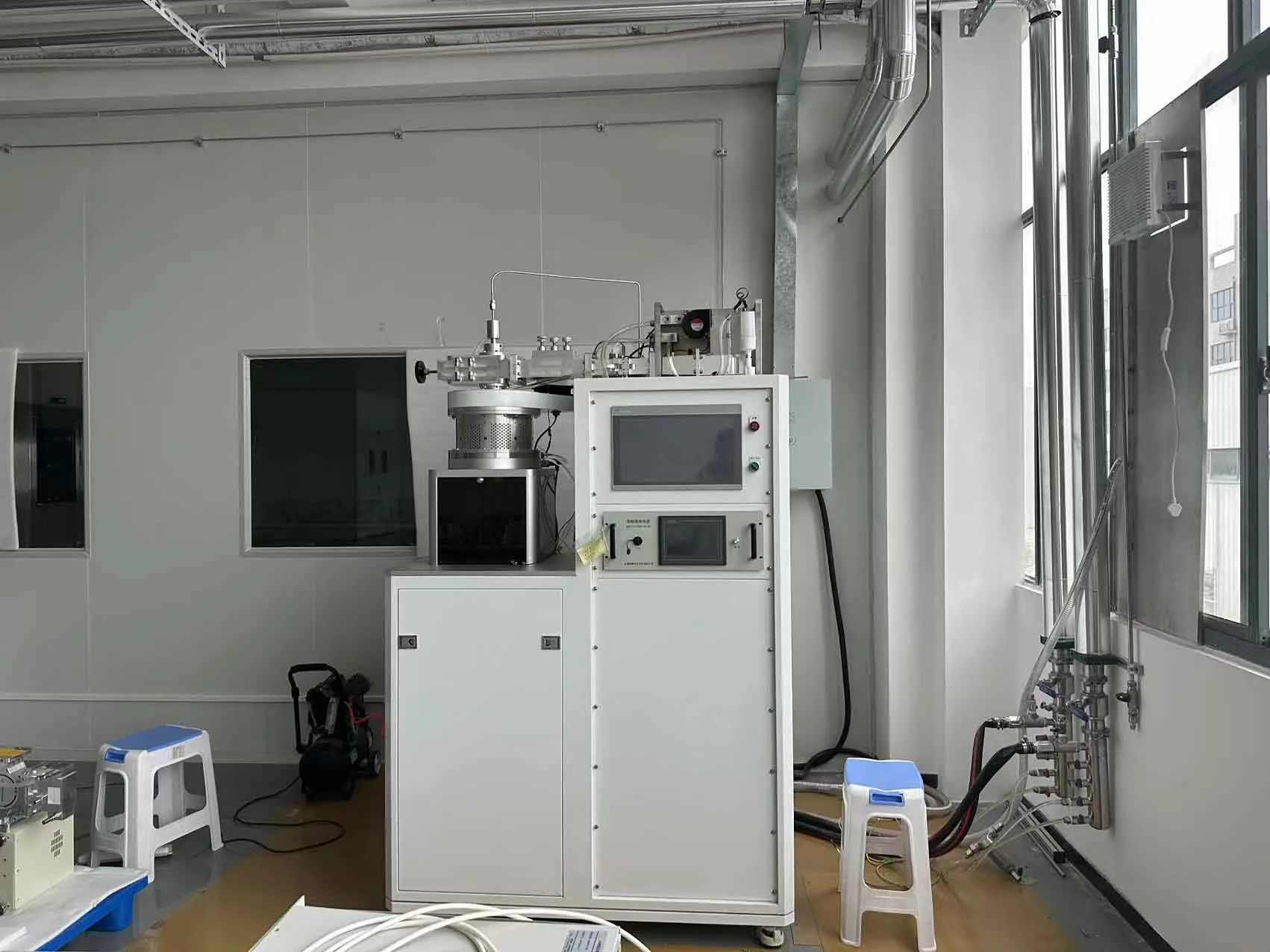
What Makes Up a Complete MPCVD System?
A Complete MPCVD Machine Is an Integrated Process Platform
The deposition process depends on several engineering subsystems operating together.
The principal functional groups of an MPCVD system include:
A complete MPCVD system combines microwave, chamber, vacuum, pressure, gas-flow, cooling, temperature-monitoring, machine-control and safety functions.
The exact hardware used to provide those functions—and which auxiliary items are included in the quotation—depends on the selected machine and agreed project scope.
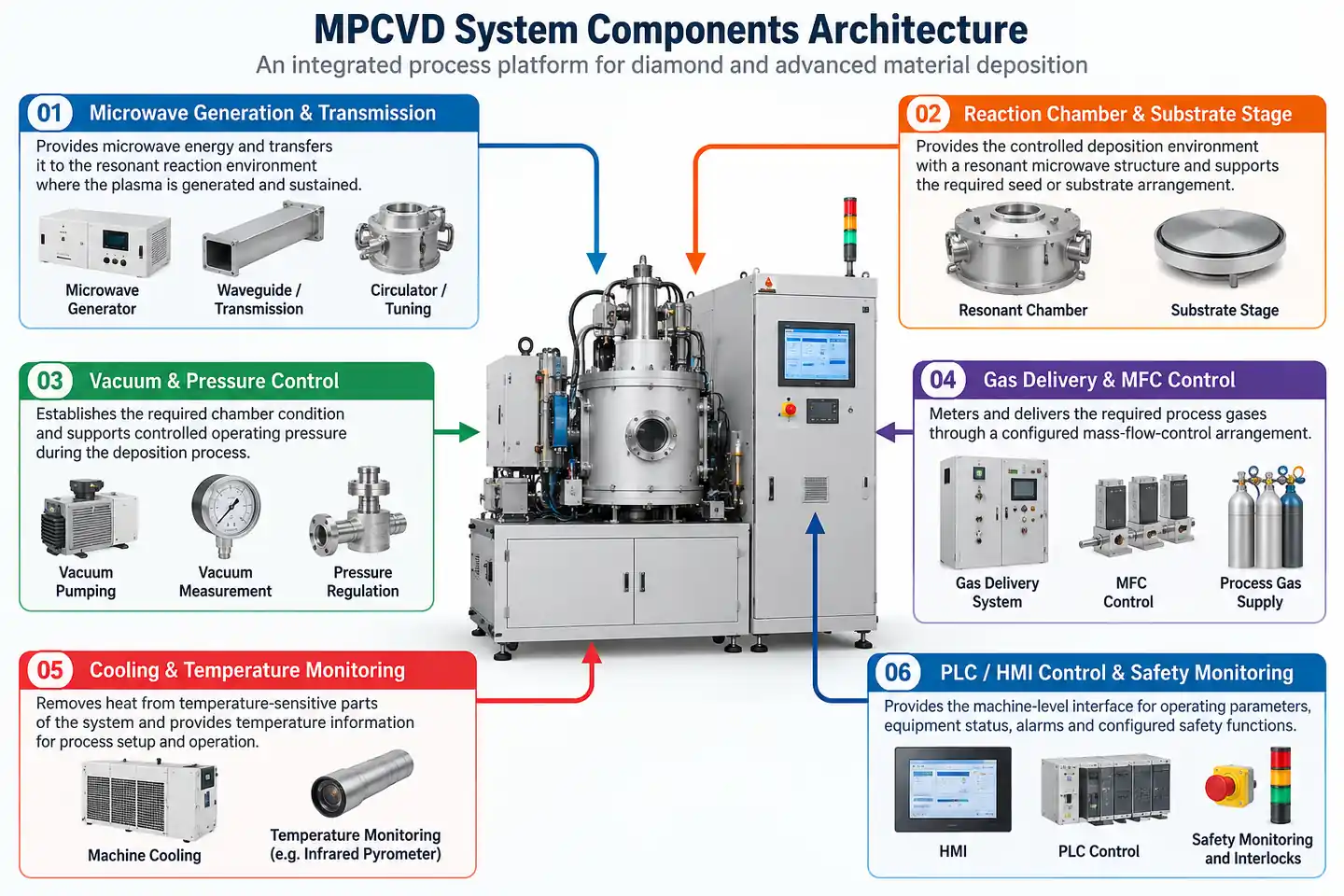
Microwave Generation and Transmission
Provides microwave energy and transfers it toward the resonant reaction environment where the plasma is generated and sustained.
Reaction Chamber and Substrate Stage
Provides the controlled deposition environment and supports the required seed or substrate arrangement.
Vacuum and Pressure Control
Establishes the required chamber condition before processing and supports controlled operating pressure during the deposition cycle.
Gas Delivery and MFC Control
Meters and delivers the required process gases through a configured mass-flow-control arrangement.
Cooling and Temperature Monitoring
Removes heat from temperature-sensitive parts of the system and provides temperature information for process setup and operation.
PLC / HMI Control
Provides the machine-level interface for operating parameters, equipment status, alarms and configured control functions.
Safety Monitoring and Interlocks
Coordinates protective responses when monitored equipment or utility conditions move outside the permitted operating state.
Microwave Generation and Transmission
The Microwave Generator Is One Subsystem of the MPCVD Machine
Microwave energy is used to create and sustain the plasma, but the microwave generator alone is not a complete MPCVD system.
The generator operates as part of a microwave transmission arrangement that connects the energy source to the resonant reaction environment.
Depending on the machine architecture, this arrangement may include components such as the microwave generator, waveguide, circulator and tuning components.
Their engineering purpose is to support controlled transfer of microwave energy into the process environment.
Waveguide
The waveguide forms part of the microwave transmission path between the microwave source and the reaction system.
Circulator
A circulator can form part of the microwave transmission and protection arrangement used in the machine architecture.
Tuning Components
Tuning elements support the microwave matching requirements of the selected reactor architecture and operating condition.
These components should therefore be evaluated as part of the complete microwave subsystem rather than as isolated purchasing specifications.
No.
The microwave generator provides the microwave energy source. A working MPCVD platform also requires the reaction chamber, vacuum and pressure control, gas delivery, cooling, monitoring, control and safety systems.
Customers looking for a stand-alone microwave generator or replacement microwave subsystem should evaluate that equipment separately from the complete MPCVD machine.
Reaction Chamber, Resonant Cavity and Substrate Stage
The Chamber Provides the Controlled Deposition Environment
The MPCVD reaction chamber is the process environment in which microwave plasma-assisted deposition takes place.
Its operation is related to several other parts of the machine, including:
- the resonant microwave environment;
- substrate or seed positioning;
- chamber vacuum;
- process pressure;
- process-gas delivery;
- thermal management;
- temperature monitoring.
The resonant cavity forms part of the microwave-plasma architecture, while the substrate stage supports the required seed or substrate arrangement within the process region.
This means that two MPCVD machines with different chamber or stage arrangements should not be treated as identical simply because their microwave power ratings are similar.
Why does the chamber configuration matter?
The chamber, usable process region and substrate-stage arrangement influence how the equipment can be applied to a particular project.
Important project inputs include:
- substrate or seed dimensions;
- number of substrates;
- required usable process area;
- material or deposition objective;
- operating mode;
- expected future expansion.
For system selection, customers normally focus on substrate or seed requirements, usable process area, loading arrangement and application objectives. The detailed cavity and microwave-coupling configuration is defined as part of the selected machine design.
Vacuum and Automatic Pressure Control
A Vacuum System Is More Than a Vacuum Pump
Vacuum and pressure control perform different but closely related functions in an MPCVD machine.
Before processing, the vacuum system establishes the required chamber condition.
During operation, the pumping, measurement and pressure-control arrangement works together with process-gas flow to support the required chamber pressure.
The functional system can include:
- sealed reaction chamber and vacuum boundary;
- vacuum pumping;
- vacuum measurement;
- pressure sensing;
- configured valves;
- pressure-control elements.
Vacuum Pumping
The pumping arrangement provides the vacuum capability required for the selected equipment.
The exact pump architecture should be confirmed by model and project rather than assumed to be identical across every MPCVD system.
Vacuum Measurement
Vacuum gauges and pressure sensors provide information about chamber conditions during different stages of machine operation.
Vacuum Valves and Pressure Regulation
Configured valves and pressure-control hardware work with gas flow and pumping capacity to regulate the chamber condition.
Automatic Pressure Control
Automatic pressure control should be evaluated as a complete functional relationship between gas delivery, chamber condition, pumping and pressure regulation—not simply as a single valve specification.
Procurement Note
When comparing MPCVD quotations, confirm the proposed:
- pumping arrangement;
- vacuum measurement;
- pressure-control configuration;
- applicable machine configuration.
Comparing only the pump brand or pump model does not describe the complete vacuum system.
Gas Delivery, MFC Control and Gas Cabinet Scope
Separate Machine Gas Control from Facility Gas Infrastructure
Controlled process-gas delivery is a fundamental MPCVD function.
The machine uses a configured gas-control arrangement to meter and deliver the gases required by the process.
Mass flow controllers, or MFCs, form part of this gas-management function.
Gas Delivery System
The machine-side gas system manages the controlled gas path required for the deposition process.
MFC Gas Control
MFCs regulate individual gas flows according to the configured process-gas arrangement.
The number of channels, gas compatibility and detailed configuration depend on the selected machine and project requirements.
Gas Cabinet and External Gas Equipment
A gas cabinet is not the same thing as the machine-side MFC system.
Depending on the project, additional gas infrastructure may include:
- gas cabinet;
- pressure-reduction equipment;
- filters;
- external process-gas piping;
- gas-source connections;
- gas-safety or leak-monitoring equipment.
These items should be listed explicitly in the technical proposal.
Not automatically.
Gas delivery and MFC control are part of the MPCVD process platform, while the gas cabinet, external piping, pressure-reduction equipment and facility gas-safety infrastructure are confirmed separately according to the project.
This distinction is important because two suppliers can both describe their offer as a “complete MPCVD system” while including materially different gas-handling equipment.
Cooling and Temperature Monitoring
Machine Cooling and the External Chiller Are Related—but Not the Same Supply Item
MPCVD equipment requires thermal management because the reaction system and other machine components generate heat during operation.
The cooling arrangement supports temperature control of the equipment according to the selected machine configuration.
Machine Cooling
The machine has defined cooling requirements that must be satisfied during operation.
The exact requirement depends on the equipment configuration and operating conditions.
Temperature Monitoring
Temperature information supports process setup and machine operation.
MPCVD configurations can use infrared temperature monitoring or other appropriate measurement arrangements according to the machine and application.
Facility Cooling Supply
The installation requires a cooling-water source capable of meeting the selected machine requirements.
That source may be an existing facility cooling system or a dedicated industrial chiller supplied as part of the project.
Cooling is required, but an external industrial chiller should not automatically be assumed to be included in every quotation.
The required cooling arrangement, chiller scope and external cooling-water piping are confirmed according to the selected machine and installation project.
Detailed water-flow, temperature and utility requirements should be reviewed against the specific MPCVD model rather than generalized across the full product range.
PLC/HMI Control and Safety Monitoring
Machine-Level Control Coordinates the Main Process Subsystems
An MPCVD machine operates through the coordinated control of microwave power, vacuum, pressure, gas flow, temperature, cooling and other machine conditions.
The PLC and HMI provide the operator interface for these configured machine functions.
Depending on the system configuration, the control platform can provide access to:
- operating parameters;
- machine status;
- alarms;
- gas-flow information;
- chamber-pressure information;
- temperature information;
- cooling status;
- vacuum status;
- microwave operating status;
- emergency functions.
HMI
The HMI presents the machine condition and configured operator controls in a centralized interface.
Software and Data Functions
Data recording, PC software or remote-support functions can be provided according to the machine and project configuration.
Safety Monitoring and Interlocks
Configured safety monitoring can address conditions related to:
- cooling;
- vacuum and chamber pressure;
- temperature;
- microwave operating condition;
- gas-system status;
- equipment access;
- electrical faults;
- emergency stop.
The purpose of these functions is to coordinate protective machine responses.
Safety monitoring and interlock functions are configured around the selected MPCVD system and operating requirements. Final protection settings and operating parameters are confirmed during project engineering and documented in the project technical package.
MPCVD Supply Scope
What Is Core, Configured, Auxiliary or Site-Side?
The most reliable way to compare MPCVD quotations is to separate system function from commercial supply scope.
The following framework helps define the project boundary.
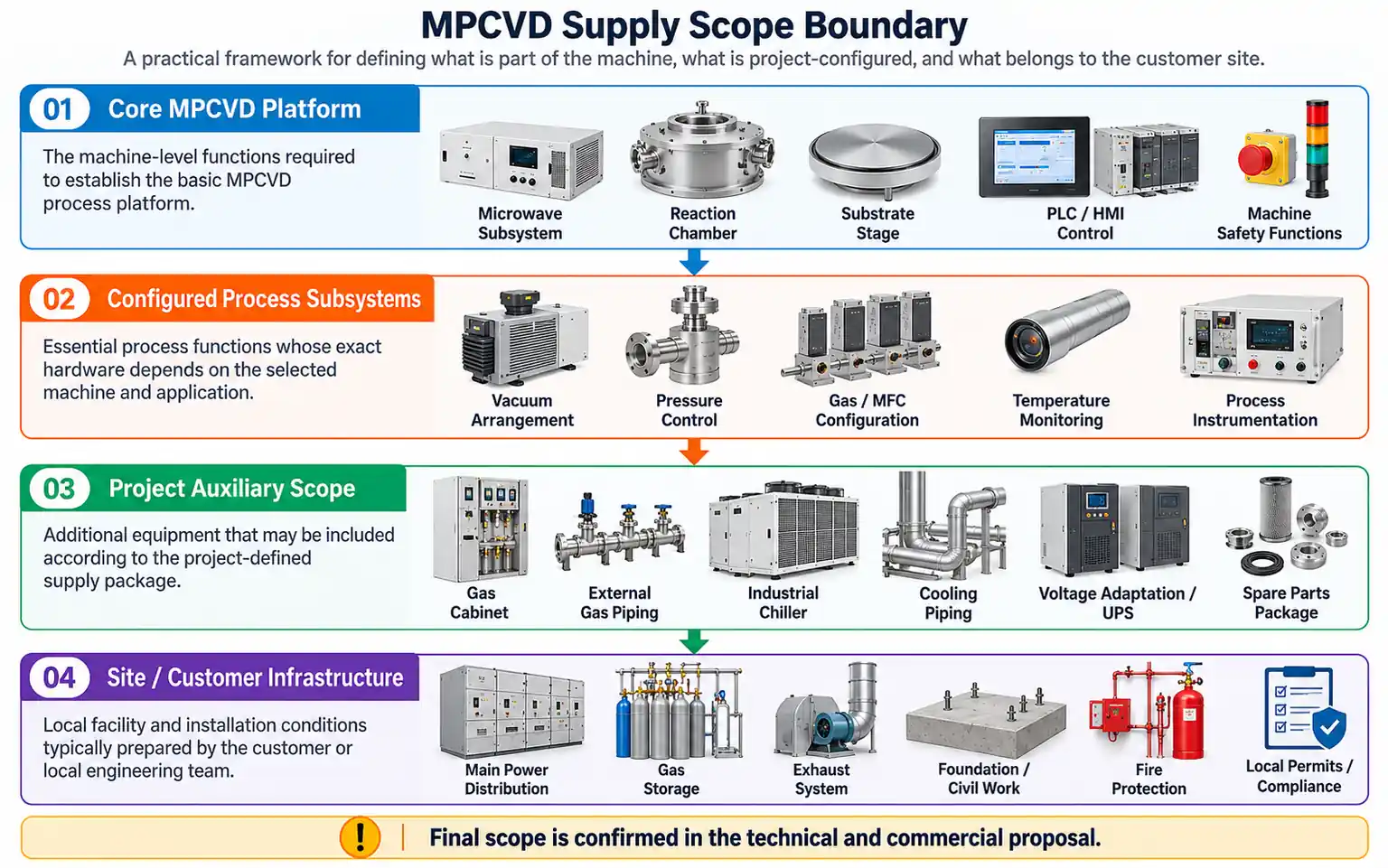
| Supply Layer | Typical Scope | Procurement Meaning |
|---|---|---|
| Core MPCVD Platform | Microwave subsystem, reaction chamber, substrate stage, machine control and configured machine-safety functions | Principal machine-level equipment required to establish the MPCVD process platform. |
| Configured Process Subsystems | Vacuum arrangement, pressure control, gas/MFC configuration, temperature monitoring and selected process instrumentation | Essential process functions whose exact hardware can vary according to the machine model and project. |
| Project Auxiliary Equipment | Gas cabinet, external gas piping, industrial chiller, cooling piping, voltage-adaptation equipment, UPS and spare-parts packages where required | Included only when defined in the project supply package or quotation. |
| Site / Customer Infrastructure | Incoming power distribution, gas storage, facility exhaust, civil work, foundation, local fire protection, permits and other local infrastructure | Normally depends on the installation site, local contractors and local regulatory requirements. |
This table describes the type of project boundary, not a fixed equipment list for every MPCVD quotation.
An essential system function can still use different hardware or commercial supply arrangements depending on the selected model and installation project.
Core MPCVD Platform
The core platform establishes the principal equipment required to perform the MPCVD process.
Configured Process Subsystems
Vacuum, gas, pressure, monitoring and related process systems are configured according to the machine and required application.
Project Auxiliary Equipment
Auxiliary equipment can be added where the customer requires a broader supply package.
Site Infrastructure
Building and facility systems are influenced by local electrical, gas, exhaust, safety and regulatory requirements and therefore need a clearly defined project interface.
What Does a Turnkey MPCVD System Actually Mean?
“Turnkey” Must Have a Defined Project Boundary
When a customer requests a turnkey MPCVD system, the term should describe an agreed integrated package—not an undefined promise that every factory utility and building requirement is automatically included.
A project-defined turnkey scope should clearly identify:
- the MPCVD equipment supplied;
- auxiliary systems included;
- installation-related equipment included;
- project services included;
- customer-side infrastructure;
- local responsibilities.
A broader turnkey package may include more auxiliary equipment than a main-machine quotation, but local civil work, facility utilities, permits or other infrastructure still need to be defined explicitly.
How Should Two MPCVD Quotations Be Compared?
The first comparison should not be only:
10kW vs 10kW
or:
one machine price vs another machine price.
Check whether both proposals contain the same system boundary.
Differences in supply scope can explain substantial differences between two commercial offers even when the nominal MPCVD power rating is the same.
MPCVD System Components & Supply Scope FAQ
What components are included in an MPCVD system?
A complete MPCVD process platform combines microwave generation and transmission, the reaction chamber, vacuum and pressure control, process-gas delivery and MFC control, cooling, temperature monitoring, PLC/HMI control and safety functions.
The exact hardware and commercial supply boundary depend on the selected machine and project.
Does an MPCVD system include a gas cabinet?
Not automatically.
Machine-side gas delivery and MFC control belong to the MPCVD process system, while the gas cabinet, external piping, regulators and facility gas-safety equipment are confirmed separately in the project scope.
Does an MPCVD system include a water chiller?
Cooling is required, but an external industrial chiller is not automatically included in every quotation.
The required cooling equipment and whether the chiller is supplied with the project are confirmed according to the selected machine and installation conditions.
Is the microwave generator the complete MPCVD machine?
No.
The microwave generator is the microwave-energy subsystem. A complete MPCVD machine also requires the chamber, vacuum, gas, pressure-control, cooling, monitoring, control and safety systems.
What is standard and what is project-configured?
Core machine functions form the MPCVD platform, while the exact vacuum arrangement, gas configuration, auxiliary cooling, external piping and other equipment can vary by machine and project.
The proposal should define the standard, project-configured and customer-side scope clearly.
What does a turnkey MPCVD system include?
A turnkey MPCVD system is a project-defined integrated equipment and support package.
It does not automatically mean complete responsibility for all factory civil work, utilities or local compliance infrastructure.
Define Your MPCVD Supply Scope Before Quotation
Request a Proposal That Matches the Project You Are Actually Building
The same nominal MPCVD power can be supplied with different auxiliary equipment and project interfaces.
To define the correct supply boundary, provide:
- preferred MPCVD model, or request a recommendation;
- application or material objective;
- installation country and project location;
- whether a gas cabinet is required;
- whether a matched industrial chiller is required;
- whether external gas or cooling piping is required;
- existing equipment or facility systems to be integrated;
- installation and commissioning requirements;
- training requirements;
- spare-parts or auxiliary-equipment requirements.
SDACME can then define the machine scope, auxiliary equipment and customer-side interfaces before the commercial quotation is finalized.