Energy Metering and Billing in Shore Power Systems
A shore-power billing error does not require a failed energy meter. The meter may be operating normally while the commercial result is still wrong.
Errors can enter at the metering boundary, the CT/PT chain, ratio or scaling settings, the communication path, the time reference, or the link between a feeder and the vessel using it.
Reliable shore power billing depends on four things staying aligned:
- the commercial metering boundary;
- the electrical measurement chain;
- the digital data path;
- the vessel transaction record.
A failure in any one of these layers can turn a technically plausible kWh value into the wrong commercial result.
Start With the Commercial Metering Boundary
The first question is not which energy meter to buy.
It is: At which electrical point does the commercial energy transfer take place?
A typical shore-power path may include:
Energy can be measured at more than one point along this path.
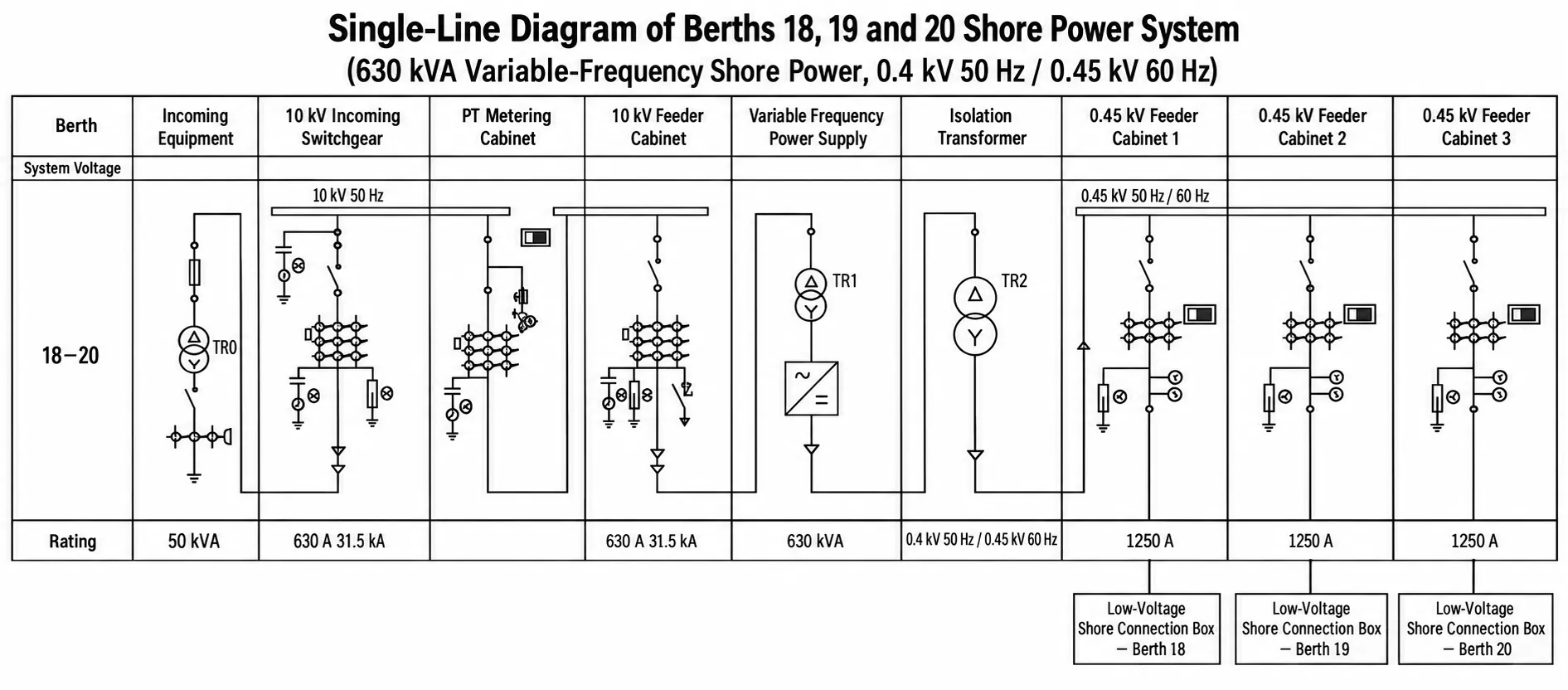
In one 630 kVA configuration serving three berth connection points, the shore-power source supplied one vessel at a time, with energy measurement provided on both the incoming and outgoing sides.
Those meters do not necessarily represent the same commercial quantity.
An incoming meter can be used to understand how much energy the shore-power installation takes from the upstream supply. A downstream or berth-feeder meter is closer to the energy delivered after part of the conversion chain.
Equipment between the two points may introduce converter losses, transformer losses, auxiliary consumption and cable losses.
Whether those losses are included in the vessel's bill is a commercial decision. The electrical design should show clearly what each metering point includes and excludes. The commercial agreement then defines which point is authoritative for billing.
Why Input and Output Metering Serve Different Purposes
Two meters can both display kWh and still answer different questions.
| Meter position | What the value can represent |
|---|---|
| Incoming side | Energy taken by the shore-power installation from the upstream supply |
| Converter or transformer downstream | Energy after some conversion stages |
| Berth feeder | Energy passing through a specific outgoing feeder |
| Agreed delivery boundary | Commercial quantity when this point is defined for settlement |
The difference between an input meter and an output meter should not automatically be treated as converter loss.
The measurement intervals may not be identical. Auxiliary loads may be included at one point and excluded at another. A transformer may sit between the two meters. Measurement uncertainty also exists at both points.
Meter readings therefore have to be interpreted within the shore power system architecture before different measurement points are compared.
The IEC/IEEE 80005 series takes the same system-level view of shore connection: distribution, conversion equipment, transformers, interfaces, control and monitoring are parts of one shore-to-ship system.
Billing Accuracy Depends on the Complete CT/PT Measurement Chain
A high-accuracy meter cannot correct an incorrect CT ratio.
In larger shore-power systems, the energy meter may not measure the primary current and voltage directly. The measurement chain can look like this:
Each stage affects the final value.
One project configuration used a dedicated 10 kV metering cabinet containing CTs, PTs and an energy meter. Another project requirement explicitly considered CT ratio, accuracy and burden as part of the measurement arrangement.
CT or PT Ratio
If the installed transformer ratio and the ratio configured in the metering system do not match, the accumulated energy can be systematically wrong.
Polarity and Phase Relationship
Incorrect polarity or phase association can affect calculated power and energy.
Burden
The instrument-transformer circuit has its own operating requirements. CT/PT selection cannot be separated from the meter application.
Scaling
Even when the primary measurement hardware is correct, an incorrect multiplier in the meter, SCADA system or billing platform can change the commercial result.
IEC 61869 treats instrument transformers as measurement-system components in their own right, while IEC 62052 and IEC 62053 address electricity-meter requirements and accuracy.
Compliance with a meter standard does not by itself establish the performance of the external CT/PT chain or the downstream billing-data system.
Do Not Assume Every kWh Value Is a Billing Value
A shore-power system can contain several electrical values that look similar.
Switchgear instrumentation, protection relays, frequency converters, local HMIs and central SCADA systems may all display voltage, current, active power or accumulated energy.
In one shore-power configuration, outgoing switchgear measurements included active and reactive energy together with the normal operating electrical parameters.
That does not make every displayed kWh value commercially equivalent.
An operating measurement may be used for operator visibility, diagnostics, protection or energy balancing.
A commercial measurement has a different role. It needs an agreed source, a defined measurement chain and a record that can be traced during settlement.
Which meter or register establishes the commercial electrical quantity?
Which billing record, database or approved report becomes the settlement record?
SCADA can be part of that architecture. A billing platform can also be part of it. What matters is that the final commercial value remains traceable to the measurement source.
A Billable Energy Record Must Identify the Vessel and Supply Period
Electrical accuracy alone is not enough in a multi-berth terminal.
A meter can record the correct energy while the invoice is still wrong because the value has been assigned to the wrong vessel.
In one shore-power operating procedure, vessel information was collected before connection, including vessel identity, required voltage, frequency, capacity and connection point.
The connection process also included a formal shore-power system data record. The physical operating sequence is covered in more detail in the shore power connection procedure.
In one project, two completed shore-power supply events were recorded with a combined 6.5 hours of supply and 9,981 kWh of vessel energy use.
The energy record becomes commercially useful only when it remains tied to an identifiable supply event.
For a multi-berth project, the design should answer:
- Which feeder was energized?
- Which berth was connected?
- Which vessel was receiving power?
- When did the supply period begin and end?
- Which energy register belongs to that transaction?
A common plant meter cannot answer all of those questions by itself.
Keep the Meter-to-Billing Data Path Traceable
The measurement process does not end when the energy meter calculates kWh.
The value may pass through several digital layers before it appears on a report or invoice.
In one shore-power architecture, energy data moved from the metering function to the billing function and then through fiber Ethernet to the monitoring center.

Errors can enter at these interfaces.
A register may be mapped incorrectly. A multiplier may be applied twice. One system may expect primary values while another expects secondary values. An energy channel may be associated with the wrong feeder.
These errors can be difficult to detect because the resulting number may still look reasonable.
The transformation path from the primary electrical quantity to the final billed value should therefore be documented.
Every ratio or scaling step that changes the commercial quantity should have a defined purpose and a verification method.
IEC 62056 provides a formal framework for electricity-meter data exchange and identification, which is relevant when several meters, registers or measurement channels are transferred between systems.
Communication, Time and Retention Affect Billing Integrity
Communication, time synchronization and data retention are often treated as monitoring functions. They can also affect commercial records.
Missing Data Is Not Zero Consumption
If communication between the meter and the billing platform fails, the central system may temporarily have no valid value.
That is different from a valid measurement of zero consumption.
Where required, the billing architecture should distinguish between:
- valid measured consumption;
- valid zero consumption;
- missing data;
- estimated data;
- recovered data.
Whether a selected meter stores interval data locally and can recover them after communication returns depends on the meter and system design. It should be confirmed rather than assumed.
Time Must Be Consistent With the Transaction
A correct energy value can still be allocated incorrectly if the meter, SCADA system and vessel transaction record do not use a sufficiently consistent time reference.
One shore-power monitoring configuration used GPS time synchronization. GPS is only one implementation method. The requirement is that the meter record and the vessel supply period can be correlated reliably.
Retention Belongs to Several Layers
Historical data may exist separately in the meter, local HMI, SCADA historian and billing database.
Shore-power project configurations can use different storage functions at local and remote monitoring levels.
Retention should therefore be defined by data layer. The objective is to keep enough source and transaction data to reconstruct the commercial result when required.
Verify the Complete Measurement Chain During Commissioning
Seeing a plausible number on the meter screen is not an end-to-end commissioning test.
Physical Verification
Confirm the intended metering point, CT/PT location, feeder relationship and wiring path.
Are we measuring the intended circuit?
Measurement Verification
Confirm CT/PT ratios, polarity, phase relationship, relevant burden, meter configuration and scaling.
Is the electrical quantity being measured correctly?
Data Verification
Compare the meter value, communication register, SCADA value and applied scaling.
Did the value remain correct after leaving the meter?
Transaction Verification
Confirm feeder, berth, vessel, connection start time and connection end time.
Does this energy belong to the correct commercial transaction?
Billing Verification
Confirm the final commercial quantity and make sure the record can be traced back to its source.
Can the billed value be reconstructed?
Great Britain's electricity-settlement commissioning framework provides one formal example of this approach: it checks instrument-transformer configuration, meter settings and the final metering-system output against the defined metering point.
The framework is jurisdiction-specific, but the verification logic is directly relevant to commercial energy measurement.
Metering and communication checks should also be included in the wider shore power manufacturing and FAT scope before site commissioning.
Common Metering and Billing Errors to Check Before Operation
| Error | Likely consequence |
|---|---|
| Meter selected before the billing boundary is agreed | Wrong commercial energy basis |
| Meter accuracy specified without CT/PT review | System-level measurement error remains |
| CT/PT ratio differs from the configured ratio | Systematic kWh error |
| Multiplier applied incorrectly in software | Persistent scaling error |
| Operational kWh assumed to be billing kWh | Commercial authority is unclear |
| Correct feeder energy linked to the wrong vessel | Correct measurement, wrong invoice |
| Communication gap treated as zero | Missing energy becomes a false commercial value |
| Time records are not aligned | Correct energy assigned to the wrong supply period |
| Billing parameters change without a traceable record | Historical results become difficult to reconstruct |
The objective is not to add instrumentation for its own sake. It is to make the number on the invoice traceable back to the physical electrical system.
Information Needed Before Finalizing the Metering and Billing Design
The final arrangement cannot be selected from a meter datasheet alone. For an engineering review, the useful project inputs fall into four groups.
Electrical Boundary
- single-line diagram;
- input and output voltage;
- system capacity;
- converter and transformer arrangement;
- feeder and berth arrangement;
- proposed meter locations.
Commercial Boundary
- intended billing point;
- treatment of converter, transformer and auxiliary losses;
- charging basis;
- applicable utility or legal-metrology requirements.
Measurement and Operation
- CT/PT ratios or available instrument-transformer data;
- required measurement accuracy;
- number of feeders and berths;
- number of vessels that can receive shore power simultaneously;
- vessel and berth identification method.
Data and Verification
- communication protocol;
- billing-system interface;
- time-reference method;
- data-retention requirement;
- audit/change-control requirement;
- FAT and commissioning expectations.
These inputs allow the metering design to be reviewed within the complete shore power system rather than as a standalone meter package.
Frequently Asked Questions
Where should the shore power billing meter be installed?
There is no single location that is correct for every project. The billing point should match the agreed commercial boundary and the treatment of conversion, transformer and auxiliary losses.
Should shore power be metered on the input or output side?
Both locations can have valid engineering purposes. An input meter can support plant or grid-side accounting, while an output or feeder meter can be closer to delivered vessel energy. The commercial billing point should be agreed for the specific project.
Is a high-accuracy energy meter enough for commercial billing?
No. CT/PT ratio, polarity, burden, secondary wiring, scaling and downstream data processing also affect the final commercial value.
Can SCADA energy data be used for billing?
SCADA can be part of a billing architecture, but a displayed kWh value should not automatically be treated as the authoritative commercial value. The project should define the authoritative measurement source and billing record.
How should individual vessels be metered at a multi-berth terminal?
The measurement channel should be associated with the correct feeder or berth and then linked to the vessel and supply period. A common plant total alone cannot identify individual vessel consumption without another validated allocation method.
What should be tested before shore power billing goes live?
At minimum, verify the physical metering point, CT/PT and meter configuration, transferred data, feeder/berth/vessel mapping, time relationship and final billing record.
Technical References
- IEC/IEEE 80005 series — Utility connections in port / shore connection systems
- IEC 61869-2 and IEC 61869-3 — Instrument transformers
- IEC 62052-11 and IEC 62053 series — Electricity metering equipment
- IEC 62056 series — Electricity metering data exchange
- OIML R 46 — Active electrical energy meters
- Elexon Code of Practice 4 — Calibration, testing and commissioning of metering equipment for settlement purposes
Review the Metering Boundary Before Finalizing the Equipment
If a shore-power project is still defining the meter location, CT/PT arrangement, berth allocation or billing interface, review the commercial boundary before the equipment configuration is frozen.
Useful inputs include the single-line diagram, voltage and frequency, system capacity, berth arrangement, proposed billing point, metering requirements and communication scope.
With those inputs, the metering architecture can be reviewed as one complete chain— from the electrical boundary to the final vessel energy record.
Send Your Shore Power Metering Requirements