What “Zero Emissions at Berth” Actually Means
Many vessels require substantial electrical power while moored. Depending on vessel type and operation, this demand can include accommodation services, lighting, HVAC, ventilation, refrigeration, pumps, controls, reefer loads and other approved service equipment.
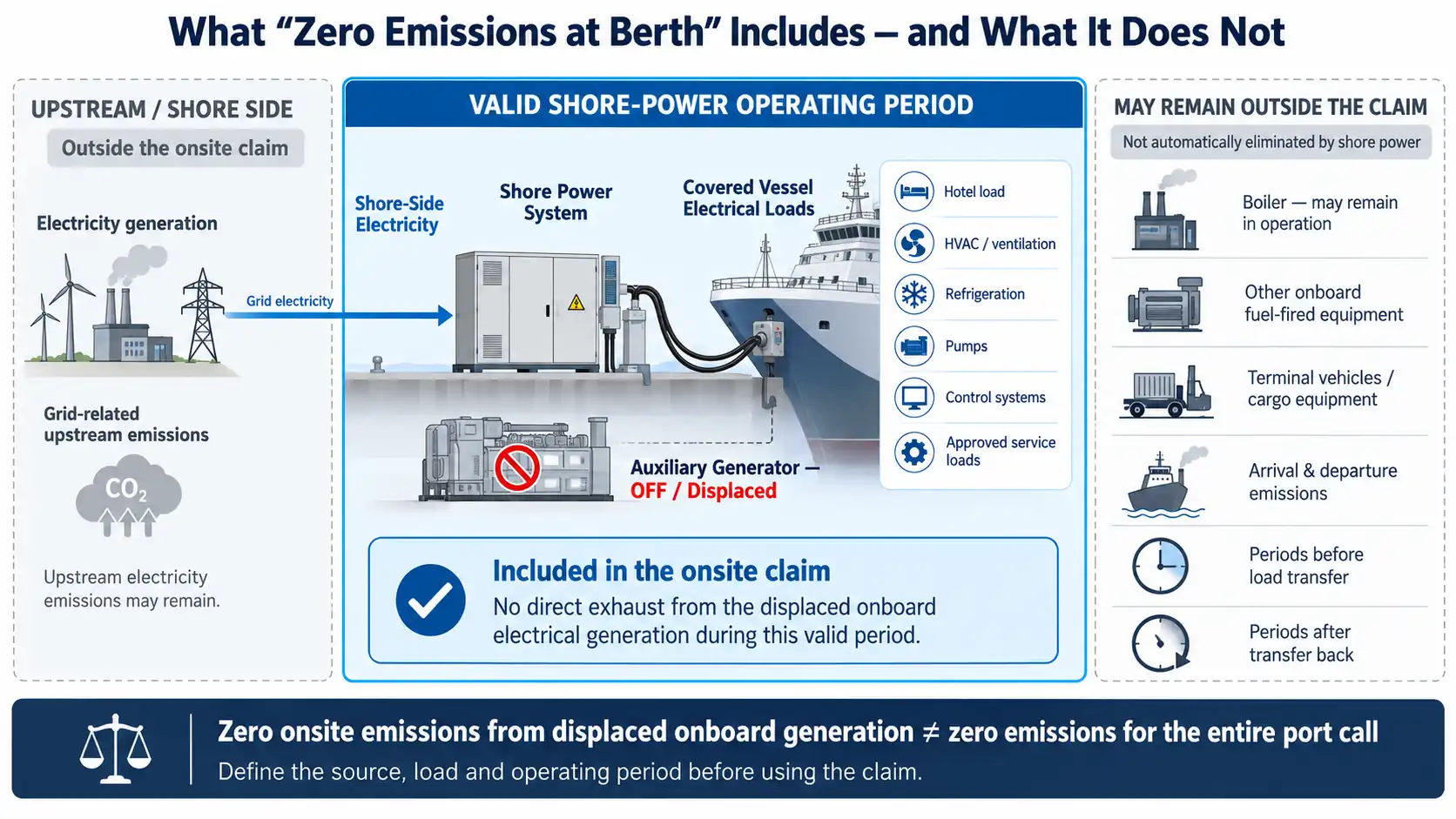
Without shore power, these loads are commonly supplied by onboard auxiliary generation. When compatible shore power takes over the covered electrical load and the relevant onboard generators are unloaded or stopped, the corresponding generator exhaust is no longer produced at the berth during that operating period.
The U.S. Environmental Protection Agency describes shore-power installations as typically producing zero onsite emissions. It also distinguishes that onsite result from emissions associated with electricity generation elsewhere and notes that boilers or other onboard emission sources may remain in service.
That is a more useful engineering statement than using “zero emissions” without defining the source, load and time boundary.
Not All “Zero-Emission” Statements Mean the Same Thing
Several statements that sound similar require very different evidence.
| Statement | What it actually establishes |
|---|---|
| Shore power is installed | Infrastructure exists. |
| Shore power was available | The system was capable of supplying the vessel. |
| The vessel was connected | A physical and electrical connection was established. |
| The vessel used shore power | Actual electrical power flowed from shore. |
| Onboard generation was displaced | The covered electrical load transferred away from onboard generation. |
| Zero onsite emissions from covered generators | Displaced generation and a defined valid operating period must both be established. |
| Net emissions were reduced | Operating evidence must be combined with an emissions calculation. |
| Zero emissions for the full port call | A substantially wider source and time boundary would need to be assessed. |
A socket on the quay proves infrastructure. A meter proves electrical energy. Neither alone proves the complete environmental result.
Which Vessel Emissions Shore Power Can Eliminate
Shore power primarily addresses emissions associated with onboard electrical generation. The loads transferred to shore can vary substantially.
A container vessel may have significant reefer demand. Passenger vessels can have large HVAC and hotel loads. Other vessels may operate pumps, process equipment or deck systems that produce changing power demand.
The shore-power system therefore has to serve the vessel's real electrical profile. That requires compatibility in voltage, frequency, capacity, earthing, protection, connection interface, cable arrangement and transfer procedure.
Only after the covered load has actually moved from vessel generation to shore supply can the operating boundary be treated as a displaced-generation period.
What May Remain Outside the Claim
Shore power supplies electricity. It does not automatically replace every energy-consuming or combustion process on a vessel.
Boilers may continue to produce steam or heat. Other fuel-fired machinery may remain in operation. Terminal vehicles and cargo-handling equipment can also produce emissions within the wider port area.
Emissions can additionally occur while the vessel is approaching the berth, preparing the connection, carrying out electrical checks, transferring load, transferring back to onboard generation, disconnecting and departing.
For this reason, zero direct onsite emissions from displaced onboard electrical generation during a defined operating period is fundamentally different from claiming zero emissions for the entire port call.
Onsite Emissions and Upstream Emissions Are Different
Removing an operating auxiliary engine from the berth does not mean that shore electricity was generated without emissions.
The upstream result depends on factors such as the electricity generation mix, reporting year, contracted electricity source, emission factor, transmission and conversion boundary, and the methodology being applied.
EPA's shore-power assessment identifies vessel type, auxiliary-engine characteristics, fuel, vessel electrical demand, time at berth and electricity generation mix among the factors that affect potential emissions benefits.
Onsite result
What direct emissions from covered onboard generators were removed from the berth?
Total accounting result
How does the displaced onboard-generation baseline compare with the emissions attributed to shore electricity and other elements included in the accounting boundary?
For the calculation methodology, see our shore power emissions reduction calculation guide.
The Valid Period Starts with Operating State, Not Cable Connection
One of the easiest reporting errors is to treat cable connection time as the beginning of the environmental reporting period.
Physical connection can therefore exist before the covered electrical load has actually transferred. Likewise, onboard generation may resume before the cable is physically disconnected.
For more detail on the operating sequence itself, see the shore power connection procedure .
Transfer Periods Need Special Treatment
The transition between vessel generation and shore power deserves particular attention.
Depending on the connection and transfer arrangement, vessel and shore electrical systems may temporarily operate in parallel while load is being transferred. During that transition, load sharing and power direction can change.
For environmental reporting, the valid displaced-generation period should not therefore be assumed to begin at the first instant that the two electrical systems are connected in parallel.
It should begin after the intended operating condition has been established and the covered onboard generation has actually been displaced.
The same principle applies during transfer back. Once onboard generation resumes supplying the covered load, the environmental operating boundary may end even though shore-side equipment remains energized or physically connected.
The detailed electrical protection issues associated with abnormal power flow belong to the shore power reverse power protection topic.

Example: Why a 10-Hour Berth Stay May Not Mean 10 Valid Shore-Power Hours
Consider an illustrative vessel call with a total berth stay of 10.0 hours.
| Operating event | Duration / result |
|---|---|
| Berthing and connection preparation | 0.7 h |
| Electrical checks and load transfer | 0.2 h |
| First valid shore-power period | 5.1 h |
| Temporary interruption / onboard generation resumed | 0.5 h |
| Shore power restored | 2.7 h |
| Transfer back before departure | 0.8 h |
The figures are illustrative rather than project data. Actual reporting should use recorded vessel-call events.
Connected Time Must Be Reconstructed from Events
Useful operating evidence can include berth events, electrical events, vessel-generation events, energy records and exception records.
- All-fast and departure time
- Cable connection and disconnection
- Breaker state
- Transfer start and completion
- Generator unload, stop and restart
- Active power and accumulated energy
- Trips, alarms and interruptions
A connection count alone says little about how much onboard generation was displaced. Even total connected time can be misleading if the vessel was not drawing shore power throughout that interval.
For fleet- or port-level measurement, see shore power utilization and port decarbonization .
The Electrical System Creates Part of the Evidence Trail
Environmental accounting does not happen inside the converter. However, the electrical system can create much of the operating evidence required to establish when shore power was actually being used.
- Connection status
- Breaker position
- Voltage
- Current
- Frequency
- Active power
- Accumulated energy
- Alarms and interruptions
- Operating timestamps
In one jointly delivered shore-power configuration, monitoring communicated with output metering, protection equipment and converter controls. Operating voltage and current, including necessary waveform information, could be retained to support reconstruction of abnormal supply interruptions.
Another documented project configuration used historical trending and time-range review of stored operating parameters. A specific storage configuration was designed for at least 200 parameters over approximately 200 hours. That number belongs to that configuration and should not be treated as a universal shore-power requirement.
A Claim Needs a Time-Aligned Data Trail
A meter total by itself has no operating context. An alarm by itself has no energy quantity. A breaker state by itself does not prove how much vessel load was being supplied. Generator status by itself does not show how much energy came from shore.
The records become more useful when they are aligned on a common timeline.
14:03 — voltage and frequency stable
14:05 — vessel load transfer begins
14:06 — shore active power rises
14:07 — auxiliary generator unloaded
14:08 — relevant generator stopped
If a later interruption causes onboard generation to resume, that interval should not remain inside a claim that assumes the onboard generation was displaced.
Cross-Checking the Operating State
A credible operating record should not depend on one signal alone.
| Evidence | What it helps establish |
|---|---|
| Connection / permissive status | The connection sequence reached the required state. |
| Breaker position | The electrical path was opened or closed. |
| Voltage and frequency | The shore supply was electrically available. |
| Current and active power | The vessel was actually drawing shore power. |
| Metered energy | The quantity of electrical energy delivered. |
| Vessel generator status | Whether the relevant onboard generation remained in service. |
| Alarm / trip history | Whether the valid state was interrupted. |
| Event timestamps | The exact sequence and duration. |
Commissioning Evidence Is Not the Same as Operating or Environmental Evidence
Commissioning evidence
Commissioning and acceptance tests show whether the shore-power system can perform under defined test conditions.
Depending on the project, testing can include rated-load operation, load increase and reduction, overload performance, voltage and current measurement, active and reactive power, power factor, harmonics, efficiency and stability over a defined period.
Operating evidence
Operating evidence answers a different question: what actually happened during a particular vessel call?
Environmental evidence
Environmental evidence adds the displaced onboard source, fuel or engine assumptions, electricity factors, included pollutants, reporting period and calculation methodology.
A successful FAT or full-load test is therefore important electrical evidence, but it is not proof of annual emissions reduction.
Real Operating Evidence: Load, Time and Energy Are Different Quantities
A useful example appears in records from a jointly delivered shore-power commissioning activity.
During one documented transfer, approximately 1,500 kW of vessel load was transferred to shore over roughly 30 seconds, after which the onboard generator was removed from that electrical duty.
Across two recorded shore-supply periods, the system operated for approximately 6.5 hours, with recorded vessel electricity use of approximately 9,981 kWh.
| Recorded quantity | What it represents |
|---|---|
| 1,500 kW | An operating load |
| 6.5 h | Recorded operating duration |
| 9,981 kWh | Electrical energy delivered |
None of these values, independently, is an avoided-emissions result.
To convert the operating record into an environmental result, the calculation still needs the appropriate vessel baseline, engine or fuel factors, shore-electricity factor and reporting boundary.
Metered Energy Is Evidence — Not the Emissions Result
Shore-side metering can establish how much electrical energy passed through a defined measurement point.
It does not independently establish how much CO₂, NOx, SOx or particulate matter was avoided.
That calculation can still require:
- The displaced onboard generator or generators
- Engine and fuel characteristics
- Generator operating load
- Applicable emission factors
- Shore-electricity emission factor
- System boundary
- Defined treatment of electrical losses
- Other vessel sources
- The approved reporting methodology
A Practical Verification Chain
| Question | Evidence that can support it |
|---|---|
| Was the vessel connected? | Connection / permissive status |
| Was shore supply energized? | Voltage, frequency and breaker state |
| Was the vessel drawing shore power? | Current and active power |
| How much energy was delivered? | Shore-side energy meter |
| Had load transfer completed? | Transfer event and power transition |
| Was onboard generation displaced? | Relevant vessel generator status |
| Was supply continuous? | Alarm and interruption records |
| What was the valid duration? | Time-aligned event history |
| Which emission sources are included? | Defined environmental boundary |
| What is the avoided-emissions result? | Approved calculation methodology |
Practical Data Quality Levels for a Zero-at-Berth Claim
The following is an engineering evidence-completeness framework rather than a regulatory rating system.
| Evidence level | Available data | What it can support |
|---|---|---|
| Level 1 — Infrastructure | Installed equipment, rated capacity and berth connection point | Infrastructure capability only |
| Level 2 — Connection | Connection status, breaker state and shore voltage | Electrical connection established |
| Level 3 — Operation | Current, active power, energy, timestamps and interruption history | Actual shore-power use and operating duration |
| Level 4 — Verified Displacement | Operating data plus relevant generator status, source boundary and emissions methodology | A defensible project-level environmental calculation |
The more specific the environmental claim becomes, the more specific the underlying evidence should become.
What If Some Operating Data Are Missing?
Not every existing shore-power installation was designed with environmental reporting in mind.
Older or simpler systems may have a revenue meter but limited event history, connection data but no vessel-generator record, monthly energy totals without vessel-call attribution, or separate vessel and shore records that cannot be automatically matched.
Missing data does not mean that nothing useful can be reported. It means that the statement should become narrower.
If only annual shore energy is available, a port may be able to report annual shore electricity delivered. It should not automatically reconstruct verified generator-off hours for every vessel call.
Who Provides Which Part of the Evidence?
Not every required environmental data point necessarily exists in the shore-power SCADA system.
| Data domain | Typical information |
|---|---|
| Shore-side electrical system | Breaker state, voltage, current, frequency, power, shore energy, alarms, interruptions and timestamps |
| Vessel-side operation | Auxiliary-generator status, generator load, transferred loads, switching events and boiler status |
| Port / environmental reporting | Vessel-call records, electricity factor, reporting year, pollutant boundary and aggregation method |
| Project / compliance review | Applicable methodology, jurisdiction, exceptions and audit requirements |
A defensible environmental claim can therefore depend on data alignment across system boundaries. No single shore-power controller should be assumed to contain every required element.
Why Installed Capacity Cannot Be Reported as the Environmental Result
A 5 MVA shore-power installation describes electrical capability under defined design conditions.
It does not indicate how many vessels connected, how long they used the system, how much energy was delivered, which onboard generators were displaced or how much pollution was avoided.
kWh ≠ tonnes of emissions avoided
Each value answers a different engineering or accounting question.
Interruptions and Mixed Operation Must Remain Visible
Real vessel calls are not always a clean transition from onboard generation to shore power and back again.
A vessel may connect late, keep one generator operating, transfer only part of its demand, experience a trip, temporarily return to onboard generation, reconnect later or disconnect early.
If a vessel uses shore power for four hours, returns to onboard generation for one hour and then uses shore power for another three hours, the reporting boundary should reflect two valid shore-power periods rather than one continuous eight-hour period.
Local Air Quality and Greenhouse-Gas Accounting Are Related — but Not Identical
One of shore power's most direct effects is local: when an auxiliary engine is no longer operating at the berth, its direct exhaust is no longer released at that location during the covered period.
Greenhouse-gas accounting requires another step because the shore electricity has its own generation profile.
A project can therefore have a clear local air-quality benefit while still requiring a separate calculation to establish the overall greenhouse-gas result.
Policy Language Must Be Dated and Scoped
“Zero emissions at berth” may be used as an engineering description, environmental reporting expression, policy objective or regulatory concept. Those uses are not interchangeable.
As of September 2026, Article 9 of Regulation (EU) 2023/1804 establishes shore-side electricity infrastructure requirements for qualifying TEN-T maritime ports and specified seagoing container and passenger ship traffic, with the relevant infrastructure target applying by 31 December 2029 and subject to the Regulation's scope and traffic thresholds.
FuelEU Maritime, Regulation (EU) 2023/1805, contains additional requirements for energy used at berth. Article 6 includes OPS-use requirements from 1 January 2030 for ships and ports within the defined scope, together with further conditions and exceptions.
These provisions do not mean that every ship, berth and port worldwide is subject to the same requirement.
For the permanent framework, see shore power standards and compliance .
How to Document a Defensible Claim
A project-level reporting package should connect environmental language to both vessel operation and electrical records.
Vessel and port-call identity
- Vessel or anonymized vessel reference
- Vessel type
- Berth and port-call date
- Reporting period
Electrical interface and operating state
- Voltage and frequency
- Connection arrangement
- Transfer sequence
- Breaker state
- Generator status
- Interruptions
Electrical performance
- Current
- Active power
- Energy
- Relevant timestamps
Environmental accounting
- Displaced onboard generation
- Fuel and engine information
- Electricity emission factor and reporting year
- Included and excluded emission sources
- Boiler treatment
- Losses and auxiliary consumption
- Methodology and assumptions
Sensitive vessel or customer information does not have to be published publicly. An anonymized public result can still be supported by controlled, auditable project records.
Common Zero-Emission Claim Errors
“The berth has shore power, therefore it is zero-emission.”
Infrastructure availability does not prove actual use.
“The vessel was plugged in for eight hours, therefore eight hours were zero-emission.”
Physical connection does not establish the load-transfer or generator-state boundary.
“The port delivered 10,000 kWh, therefore the emission reduction is known.”
Energy is an input to the calculation, not the complete environmental result.
“This is a 5 MVA system, therefore it has greater environmental performance.”
Capacity and environmental utilization are different metrics.
“Shore power means zero carbon.”
Onsite exhaust and upstream electricity emissions belong to different accounting layers.
“The ship used shore power, so all vessel emissions stopped.”
Boilers and other fuel-fired sources may remain.
“Another port achieved a given reduction, so the same factor applies here.”
Vessel engines, fuel, load, operating time and electricity factors can differ.
“The regulation says zero emissions from 2030.”
Regulatory requirements need their exact jurisdiction, vessel, port, date and exception scope.
Design the Evidence Path Before Commissioning
A port intending to use shore-power operation in environmental, ESG or regulatory reporting should define the required evidence before routine operation begins.
Waiting until months after commissioning can expose avoidable data gaps.
Where is energy measured?
Define whether the measurement represents shore-system input energy, vessel-delivered energy or another electrical boundary.
Are event clocks synchronized?
Breaker events, SCADA data, meter intervals and vessel-side records are much easier to compare when timestamps are aligned.
How are vessel calls identified?
An annual energy total becomes more useful when operating periods can be associated with a particular vessel call, berth and reporting period.
How long are records retained?
Environmental reporting may occur months after the vessel call, so historical retention should be considered during monitoring-system design.
Can interruptions be reconstructed?
Temporary returns to onboard generation should remain visible rather than being absorbed into one continuous shore-power interval.
What information must come from the vessel?
Generator status, transferred loads and boiler operation may not exist in the shore-side control system.
How will operating data reach the reporting system?
Information Needed Before Making the Claim
For a project-specific review, useful inputs include:
- Vessel type and berth profile
- Auxiliary-generator arrangement
- Normal berth electrical demand
- Expected peak demand
- Loads to be transferred
- Voltage and frequency
- Connection arrangement
- Synchronization or transfer method
- Generator unload / stop sequence
- Transfer-back sequence
- Meter location and measurement boundary
- Actual connected hours
- Metered shore energy
- Breaker and event logging
- Generator-status availability
- Interruption records
- Historical data-retention requirements
- Grid emission factor and reporting year
- Boiler and other onboard-source status
- Required pollutants and calculation methodology
- Audit, regulatory or ESG reporting requirements
Frequently Asked Questions
Does shore power make a vessel zero-emission at berth?
It can eliminate direct exhaust emissions from the onboard electrical generators whose covered load has transferred to shore during the valid operating period. Boilers, other combustion sources and upstream electricity emissions may remain.
Is shore power always zero carbon?
No. The total greenhouse-gas result depends on the displaced onboard generation, electricity source, energy delivered, reporting period and accounting method.
Does the valid period start when the cable is plugged in?
Not necessarily. It should follow actual load transfer and the operating state showing that the covered onboard generation has been displaced.
Can the valid period end before cable disconnection?
Yes. If onboard generation resumes or the covered load transfers back first, the reporting boundary can end before the cable is physically disconnected.
Is shore-power kWh enough to calculate emissions avoided?
No. Metered energy is an important operating input, but the calculation also requires an onboard-generation baseline, electricity factor and defined methodology.
What if one auxiliary generator continues running?
The claim should reflect the actual operating boundary. Relevant onboard generation that remains in service should not be treated as displaced.
Can installed MVA be used as an environmental KPI?
Installed capacity is an infrastructure metric. Connected hours, delivered energy and the resulting environmental calculation describe operating performance.
What should the shore-power monitoring system record?
Useful records can include connection state, breaker status, voltage, current, frequency, active power, energy, alarms, interruptions and timestamps. Vessel generator information may need to come from the vessel side.
Do current shore-power regulations apply to every ship and port?
No. Applicability depends on jurisdiction, effective date, vessel category, port coverage and defined conditions or exceptions.
Technical References
Shore Power Technology Assessment at U.S. Ports — 2022 Update
Article 9 — Targets for shore-side electricity supply in maritime ports
Article 6 — Additional zero-emission requirements for energy used at berth
Define the Boundary Before Publishing the Result
A credible zero-at-berth statement begins with the operating boundary—not with equipment nameplate capacity, the complete berth stay or a reduction percentage borrowed from another project.
Send the vessel electrical profile, berth schedule, voltage and frequency, expected load, connection and transfer sequence, metering point, generator-status information, connected-time data and environmental reporting requirement.
SDACME can review the shore-power architecture and the operating data points that should be retained so that the electrical system and the environmental reporting boundary are aligned.
Send Your Project Data